






The Bournillon Cave (French: grotte de Bournillon) is located in the commune of Châtelus in the Isère Department of France, in the Vercors Massif. Its entrance is 105 metres (344 ft) high, and 60 metres (200 ft) wide, and is the largest in Europe.[1][2] It is one of the main karst springs of Vercors, with a maximum flow rate of 80 cubic metres (2,800 cu ft) per second, which feeds a hydroelectric plant.[3][1]
| Bournillon Cave | |
|---|---|
| Grotte de Bournillon | |
 Entrance of the Bournillon Cave, the highest in Europe. | |
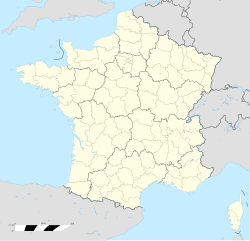  | |
| Location | Isère, France |
| Coordinates | 45°03′16″N 5°25′57″E / 45.05444°N 5.43250°E |
| Length | 7,886 metres (25,873 ft) |
| Elevation | 418 metres (1,371 ft) |
| Geology | Limestone |
Description
edit
The main passage may be followed for over a kilometre to the Salle Terminale. Two short passages lead off from here, both terminating in sumps, where the passage disappears underwater. A passage in the west wall of the entrance porch joins the main passage via a ledge after some 600 metres.[4]
After four or five months of drought the sump in the right-hand passage leading off from the Salle Terminale drains, allowing access to further passages upstream. This section is dangerous in the event of storms. The Salle des Centaures, a chamber 30×10 metres (98×33 ft), is followed by a bedding passage leading to another gallery: Minos Centre. The following Galerie des Champs Elyséens, some 10 metres (33 ft) wide, splits, one branch finishing at Siphon Alpha and the other at Siphon Beta. These siphons continue towards the south-by-southwest for 500 metres (1,600 ft) at a depth of 36 metres (118 ft) in Siphon Beta, and for 543 metres (1,781 ft) at a depth of 85 metres (279 ft) in Siphon Alpha).[5]
Exploration history
editIn 1897 a team led by French caver Oscar Decombaz (1866 - 1914) explored the grotto as far as the Metro Needle where the galley becomes a siphon. In 1942 André Bourgin and Roger Pénelon found the upper gallery and the lateral gallery. Attempts to dive at the Metro Needle siphon did not achieve significant upstream penetration.[6] An exceptional drought in 1985 allowed Maurice and Franck Chiron to discover 1,600 metres (5,200 ft) of new galleries, terminating a point 95 metres (312 ft) higher than the cave entrance, at the two siphons Alpha and Beta.[7] David Bianzani and other cave divers probed the siphons, but further upstream exploration remains.[8]
Hydrology
edit
Lower in the Bournillon Gorge is the Sources de Arbois, which is the normal resurgence for the catchment area, which constitutes much of southern Vercors: the high plateau of Vercors and the Vassieux High Plateaux. When the Sources de Arbois flow in excess of 3.5 cubic metres (120 cu ft) per second, the overflow goes into the Bournillon system. When the flow rate in the cave exceeds 40 cubic metres (1,400 cu ft) per second then another overflow starts at the Grotte de la Luire, some 18 kilometres (11 mi) due south in the Varnaison valley.[9] The stream from the Bournillon flows into the Bourne, which is a tributary of the Isère river, and from thence to the Rhône.
Geology
editThe cave developed at the base of the Urgonian limestone formation. Dating one of the stalagmites indicated that the speleothem had been formed more than 350,000 years ago. The formation of the cavity, 200 metres (660 ft) above the Bourne Gorge, dates to 3–4 million years before the present, to the Pliocene Epoch.[6]
References
edit- ^ a b Gilli, Eric (November 2020). Big Karst Chambers. Switzerland: Springer Nature. pp. 25–33. ISBN 978-3-030-58731-4.
- ^ Liz Wheeler, ed. (2003). Earth. Dorling Kindersley. p. 256. ISBN 1-4053-0018-3.
- ^ Lismonde, Baudouin (December 2014). "Réseaux souterrains du Vercors - Comment ils se sont fabriqués..." (PDF) (in French).
- ^ Chiron, Maurice (2002). "Bournillon et son labyrinthe, Bournillon et sa rivière, Hydrogéologie du système Luire-Arbois-Bournillon, Bibliographie de Bournillon" (PDF). Scialet: Bulletin du CDS de l'Isère (in French). 31. Comité départemental de spéléologie de l'Isère: 55–75. ISSN 0336-0326.
- ^ Bianzani, David (2018). "Vercors: grotte de Bournillon - Campagne de plongées pour Alpha et Bêta". Spéléo (in French). Vol. 103. Corenc: Spéléo magazine. pp. 6–7. ISSN 1629-1573.
- ^ a b Caillault, Serge; Haffner, Dominique; Krattinger, Thierry; Delannoy, Jean-Jacques (1999). Spéléo sportive dans le Vercors-Tome 2 [Speleological adventures in the Vercours: Volume Two] (in French). Aix-en-Provence: Edisud. pp. 162–165. ISSN 0764-2520.
- ^ Chiron, Maurice; Lismonde, Baudouin; Fédération française de spéléologie (1985). "Bournillon: histoire de la progression vers le sud" [Bournillon: History of progress towards the south] (PDF). Scialet: Bulletin du CDS de l'Isère (in French). 14. Comité départemental de spéléologie de l'Isère: 46–54. ISSN 0336-0326.
- ^ Bianzani, David; Garnier, Marlène (2017). "Vercors: grotte de Bournillon - Les plongées des siphons terminaux" [Vercors: Bournillon Cave - Diving into the last siphons]. Spéléo (in French). Vol. 100. Corenc: Spéléo magazine. pp. 18–23. ISSN 1629-1573.
- ^ Delannoy, Jean-Jacques; Maire, Richard (1984). "Les grandes cavités alpines. Répartition et contexte hydrogéologique" [Large alpine cavities. Distribution and hydrogeological context]. Karstologia (in French). 3. Fédération française de spéléologie and Association française de karstologie..