






The Libertador General Bernardo O'Higgins Region[5][6][7] (Spanish: Región del Libertador General Bernardo O'Higgins, pronounced [liβeɾtaˈðoɾ xeneˈɾal βeɾˈnaɾðo oˈçiɣins]),[8] often shortened to O'Higgins Region (Spanish: Región de O'Higgins), is one of Chile's 16 first order administrative divisions. It is subdivided into three provinces. It is named in honour of Bernardo O'Higgins Riquelme, one of Chile's founding fathers.
Libertador General
Bernardo O'Higgins Region Región del Libertador General Bernardo O'Higgins | |
|---|---|
 Río Claro | |
 Flag  Seal  Coat of arms | |
 Map of Libertador General Bernardo O'Higgins Region | |
| Coordinates: 34°10′11″S 70°44′28″W / 34.16972°S 70.74111°W | |
| Country |  Chile Chile |
| Capital | Rancagua |
| Provinces | Cachapoal, Colchagua, Cardenal Caro |
| Government | |
| • Presidential Regional Delegate | Fabio López (Independent) |
| • Governor | Pablo Silva Amaya (PS) |
| Area | |
• Total | 16,387.0 km2 (6,327.1 sq mi) |
| • Rank | 14 |
| Lowest elevation | 0 m (0 ft) |
| Population (2024 census)[2] | |
• Total | 987,228 |
| • Rank | 6 |
| • Density | 60.2446/km2 (156.033/sq mi) |
| GDP (PPP) | |
| • Total | $16.376 billion (2014) |
| • Per capita | $17,985 (2014) |
| ISO 3166 code | CL-LI |
| HDI (2022) | 0.829[4] very high |
| Website | goreohiggins |
The Libertador General Bernardo O'Higgins Region is bordered to the west by the Pacific Ocean, to the east by the Republic of Argentina, to the north by the Valparaíso and Santiago Metropolitan Regions, and to the south by the Maule Region. It extends approximately between the parallels of 33° 51' and 35° 01' south latitude, and between the meridian of 70° 02' west longitude and the Pacific Ocean.
The capital and largest city of the region is Rancagua. The second major town is San Fernando.
Geography
edit
In pre-Quaternary times extensive Nothofagus forests covered much of Libertador General Bernardo O'Higgins Region.[9]
The Libertador General Bernardo O'Higgins Region is part of the very restricted range of the endangered Chilean Wine Palm, Jubaea chilensis; in prehistoric times this Chilean endemic tree had a significantly larger range.[10]
In the high Andes of O'Higgins Region lie the copper mine of El Teniente and 25 km southeast of this the copper mine prospect of Catedral which lies in an area of glaciers and rock glaciers.[11][12]
History
editFrom 9000 BCE to 300 BCE (the Archaic Period), the humans who inhabited the region moved between the coast and the valley as well as the Andes. At sites such as Pichilemu, Cáhuil and Bucalemu, they left trash deposits or shell middens bearing testimony to their raids [citation needed]. During the Agroalfarero Period (300 BCE – 1470 CE), the inhabitants experienced changes in their way of life, the most important being the cultivation of vegetables and the manufacture of clay objects. From 600 CE onwards, they started cultivating beans, maize, squashes, pumpkins and quinoa[citation needed]. All of these except quinoa and some types of maize required irrigation, which prompted them to move to the banks of creeks and rivers. During this period, groups of people lived in Quincha houses with straw roofs, in the vicinity of irrigation channels and horticulture crops, a style of life attributable to the Promaucaes or Picunches and to the Chiquillanes. During the Colonial Period (1541 CE to 1811 CE), the region became dominated, like the rest of the country, by the Spanish, and a system of ranching became predominant [citation needed].
Demography
edit
The Libertador General Bernardo O'Higgins region contains a large part of the rural population (surpassed only by the Maule Region). Amongst the highly populated cities, Rancagua (257,774 inhabitants) stands out for having been transformed, in recent times, into an outskirt of Santiago. It is close being located 87 km south of Santiago. It is the capital of the Cachapoal Province as well the Libertador General Bernardo O'Higgins Region. According to the census of 2024,[13] other densely populated cities are: San Fernando (75,585 inhabitants); Rengo (63,620); Machalí (60,875); San Vicente de Tagua Tagua (49,559); Santa Cruz (41,209); Chimbarongo (37,258); Graneros (35,938); Requinoa (29,508); and Las Cabras (27,554).
Economy
editThe main industrial and export activity takes place at CODELCO's El Teniente mine, which contributes 7.7% of Chile's copper production. The ore is processed at the Sewell and Colón concentrator plants, smelted and refined at Caletones, and shipped from the port of San Antonio, in the Valparaíso Region. Byproducts include molybdenum and silver.
Agriculture contributes 30.1% of the region's GDP. One out of every four hectares of fruit orchards in Chile is in the Libertador General Bernardo O'Higgins Region. The main crops are apples and pears, followed by table grapes, plums, kiwis, and nectarines.
Manufacturing activity in the region is mostly related to copper mining, agribusiness, and food and beverages. One particular growth area is the production of fruit juices and pulp, and dehydrated fruit.
Over the past few years, there has been significant development in the forestry sector, especially plantations of eucalyptus and radiata pine.
Law and government
editThe region is co-governed by a presidential regional delegate, who is appointed by the president —currently independent Fabio López— and popularly-elected governor of O'Higgins, Pablo Silva Amaya, who was elected in 2021 and will serve until 2025.[14]
The administration of the region rests with the regional government which is headed by the regional governor and the regional council (Consejo Regional de Chile). The latter comprises twenty regional council members, who are popularly elected since 2013 (thirteen from Cachapoal, five from Colchagua, and two from Cardenal Caro).
Administrative divisions
editFor purposes of interior administration, the Libertador General Bernardo O'Higgins Region is divided into three provinces:
- Cachapoal Province, capital: Rancagua,
- Colchagua Province, capital: San Fernando,
- Cardenal Caro Province, capital: Pichilemu.
The provinces are subdivided into 33 communes.
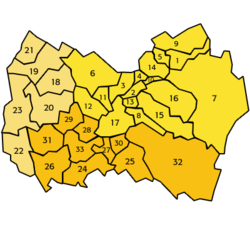
|
Education
editCulture
editThis area is known as the "huaso province" after the name of the Chilean cowboy, the huaso. Sashes and mantas – traditional items of the huaso costume – are woven in Doñihue on heavy vertical looms. Designs imitate vine leaves, bunches of grapes, pines and copihues. Other designs of colored stripes are woven on horizontal looms.
The population is a mixture of both European (including Argentine immigrants) and indigenous races and cultures, thus the region has a homogeneous culture known as Chileanidad is present and a mestizo imprint is evident.
The Libertador General Bernardo O'Higgins Region was settled by Spaniards (notably Andalusians, Basques, Aragonese and Navarrese) and other Europeans. French and Italian families established agriculture including the important wine industry: the Wine Route is one of the main tourist attractions of the Colchagua valley. Breweries can be found as well, the legacy of German and Swiss immigration. Livestock herding was especially influenced by British, Greek and Yugoslavian settlers.
Regional festivals
edit| Date | English name | Spanish name | Notes |
|---|---|---|---|
| 1–2 October | Disaster of Rancagua | Desastre de Rancagua | In memory of the Battle of Rancagua which occurred in 1814 |
Notable people
edit- Violeta Zúñiga (1933–2019), human rights activist
- Stephanie Vaquer (born 1993), professional wrestler signed with WWE
References
edit- ^ "O'Higgins Region". Government of Chile Foreign Investment Committee. Archived from the original on 10 May 2020. Retrieved 13 March 2010.
- ^ "Población censada por sexo y edad en grupos quinquenales". Instituto Nacional de Estadísticas (in Spanish). Retrieved 21 December 2025.
- ^ Regions and Cities > Regional Statistics > Regional Economy > Regional GDP per Capita Archived 14 September 2019 at the Wayback Machine, OECD.Stats.
- ^ "Subnational Human Development Index". Archived from the original on 28 February 2022. Retrieved 26 October 2021.
- ^ Rupp, David E; Oscar Reckmann; Jorge Vergara; Hamil Uribe; John S. Selker (2011). "Unconfined Aquifer Permeability near hand-dug Wells in the Coastal and Interior dryland of the Libertador General Bernardo O'Higgins Region, Chile". Chilean Journal of Agricultural Research. 71 (2): 267–274. doi:10.4067/S0718-58392011000200012. hdl:1807/45895. ISSN 0718-5839.
In the dryland of the Libertador General Bernardo O'Higgins Region in Chile, most farmers rely [...]
- ^ Merriam-Webster's Geographical Dictionary. Merriam-Webster. 1997. p. 977. ISBN 9780877795469. Retrieved 26 July 2012.
Rancagua. City of Libertador General Bernardo O'Higgins Region.
- ^ Division, Library of Congress. Federal Research (December 1994). Chile, a country study. The Division. p. 299. ISBN 9780844408286. Retrieved 26 July 2012.
[...] the provinces of San Felipe de Aconcagua, Colchagua and Valparaíso, as well as Libertador General Bernardo O'Higgins Region and [...]
- ^ "Decreto Ley 2339. Otorga denominación a la Región Metropolitana y a las regiones del país, en la forma que indica". Ley Chile (in Spanish). Biblioteca del Congreso Nacional de Chile. 10 October 1978. Retrieved 26 July 2012.
- ^ Thomas T. Veblen, Robert S. Hill and Jennifer Read (1996) The Ecology and Biogeography of Nothofagus Forests, Yale University Press, 403 pages ISBN 0-300-06423-3
- ^ C. Michael Hogan (2008) Chilean Wine Palm: Jubaea chilensis, GlobalTwitcher.com, ed. Nicklas Stromberg Archived 17 October 2012 at the Wayback Machine
- ^ Catedral (PDF) (Report) (in Spanish). ENAMI. 2019. Retrieved 12 December 2025.
- ^ Brenning, Alexander; Azócar, Guillermo (2010). "Minería y glaciares rocosos: impactos ambientales, antecedentes políticos y legales, y perspectivas futuras" (PDF). Revista de Geografía Norte Grande (in Spanish). 47: 143–158.
- ^ "Chile: Proyecciones y Estimaciones de Población. Total País 1950–2050 Archived 1 September 2022 at the Wayback Machine" Instituto National de Estadísticas (INE)
- ^ "Gobernador Regional". Archived from the original on 5 December 2023. Retrieved 5 December 2023.
External links
edit
- "The Libertador Bernardo O'Higgins Region" at the Chilean government website (in Spanish)
- Regional government of the O'Higgins Region (in Spanish)
- VI.cl: Portal de la Sexta Región (Portal for the Sixth Region) (in Spanish)
- Pichilemu's official website (in Spanish)
- . Collier's New Encyclopedia. 1921.
- . New International Encyclopedia. 1905.