



Fernand Edmond Jean Marie Khnopff (12 September 1858 – 12 November 1921) was a Belgian symbolist painter and one of the founding members of the avant-garde group Les XX in 1883. He was a leading figure in the Symbolist movement, and achieved international recognition for his enigmatic paintings that explored themes of isolation, desire, and the duality of woman as both femme fatale and angelic ideal. His sister Marguerite was a frequent subject, appearing in numerous portraits throughout his career.
Fernand Khnopff | |
|---|---|
 Fernand Khnopff (c. 1900) | |
| Born | Fernand Edmond Jean Marie Khnopff 12 September 1858 Grembergen, Belgium |
| Died | 12 November 1921 (aged 63) Brussels, Belgium |
| Education |
|
| Known for | Painter, sculptor, designer |
| Notable work | Caress of the Sphinx |
| Movement | Symbolism |
| Awards |
|
Khnopff's work bridged Continental Symbolism and British Pre-Raphaelitism. He cultivated close friendships with Edward Burne-Jones and other British artists, and from 1895 served as Brussels correspondent for the influential art journal The Studio, reporting on artistic developments in Belgium and continental Europe. His paintings, particularly Caress of the Sphinx (1896), exerted considerable influence on the Vienna Secession, notably on Gustav Klimt, after Khnopff exhibited 21 works at the Secession's first exhibition in 1898.
Khnopff also designed theater sets and opera costumes, collaborating with director Max Reinhardt and staging productions at Brussels' Théâtre Royal de la Monnaie. From 1900, he devoted himself to designing an elaborate home and studio in Brussels that functioned as a gesamtkunstwerk embodying his motto "On a que soi" (One has but oneself). The house, inspired by the Vienna Secession and featuring a studio with a golden circle inscribed on white mosaic flooring, served as a "Temple of the self" until his death in 1921.
Life
editYouth and training
edit
Fernand Khnopff was born to a wealthy family that was part of the high bourgeoisie for generations. Khnopff's ancestors had lived in the Vossenhoek area of Grembergen Flanders since the early 17th century but were of Austrian and Portuguese descent. Most male members of his family had been lawyers or judges, and young Fernand was destined for a juridical career. In his early childhood (1859–1864), he lived in Bruges where his father was appointed Substitut Du Procureur Du Roi. His childhood memories of the medieval city of Bruges would play a significant role in his later work. In 1864, the family moved to Brussels. In his childhood Khnopff spent part of his summer holidays in the hamlet of Tillet[a] not so far from Bastogne in the Luxemburg province where his maternal grandparents owned an estate. He painted several views of this village.[1]
To please his parents, he went to law school at the Free University of Brussels (now divided into the Université Libre de Bruxelles and the Vrije Universiteit Brussel) when he was 18 years old. During this period, he developed a passion for literature, discovering the works of Baudelaire, Flaubert, Leconte de Lisle and other mostly French authors. With his younger brother Georges Khnopff – also a passionate amateur of contemporary music and poetry – he started to frequent Jeune Belgique ("Young Belgium"), a group of young writers including Max Waller, Georges Rodenbach, Iwan Gilkin, and Emile Verhaeren.
Khnopff left University due to a lack of interest in his law studies and began to frequent the studio of Xavier Mellery, who made him familiar with the art of painting. On 25 October 1876, he enrolled for the Cours De Dessin Après Nature ("course of drawing after nature") at the Académie Royale des Beaux-Arts. At the Académie, his most famous fellow student was James Ensor, whom he disliked from the start. Between 1877 and 1880, Khnopff made several trips to Paris where he discovered the work of Delacroix, Ingres, Moreau and Stevens. At the Paris World Fair of 1878 he became acquainted with the oeuvre of Millais and Burne-Jones. During his last year at the Académie in 1878–1879 he neglected his classes in Brussels and lived for a while in Passy, where he visited the Cours Libres of Jules Joseph Lefebvre at the Académie Julian.
Early career with Les XX
edit

In 1881, he presented his works to the public for the first time at the "Salon de l'Essor" in Brussels. The critics' appraisal of his work is very harsh, with the exception of Emile Verhaeren who wrote a commending review. Verhaeren would remain a lifelong supporter and would write the first monograph on the painter. In 1883, Khnopff was one of the founding members of the group Le Groupe des XX. Khnopff exhibited regularly at the annual "Salon" organised by Les XX.
In 1885, he met the French writer Joséphin Péladan the future grandmaster of the Rosicrucian "Ordre de la Rose + Croix". Péladan asked Khnopff to design the cover for his new novel Le Vice suprême. Khnopff accepted this commission but destroyed the work later because the famous soprano Rose Caron was offended by the imaginary portrait of Leonora d'Este (a character in Péladan's Le Vice suprême) that Khnopff had designed to adorn the cover and in which Caron thought to recognise her own face. The vehement reaction of "La Caron" on this occasion made a scandal in the Belgian and Parisian press and would help to establish Khnopff's name as an artist. Khnopff continued to design illustrations for the works of Péladan, most notably for Femmes honnêtes (1888) and Le Panthée (1892). On several occasions (1892, 1893, 1894 and 1897) Khnopff was invited as guest of honour on the exhibitions of the Parisian "Salon de la Rose + Croix" organised by Péladan.
Later years
editIn 1889, Khnopff laid his first contacts with England, where he would stay and exhibit regularly in the future. British artists such as Hunt, Watts, Rossetti, Brown and Burne-Jones would become friends.[2] From 1895 Khnopff worked as a correspondent for the British art journal The Studio. Until the outbreak of World War I in 1914 Khnopff would be responsible for the rubric "Studio-Talks-Brussels" in which he reported about the artistic evolutions in Belgium and continental Europe. In March 1898 Khnopff presented a selection of 21 works on the first exhibition of the Vienna Secession. In Vienna his work was received with massive admiration.[3] The works he presented at the Secession would form a major influence on the oeuvre of Gustav Klimt.[3]

From 1900 onwards, Khnopff was engaged in the design of his new home and studio in Brussels (demolished). The house, which he lived in with his own sister Marguerite, was inspired by the Vienna Secession and more in particular by the architecture of Joseph Maria Olbrich. To the sober architecture and decoration Khnopff added a highly symbolic, spatial and decorative concept that turned his home into a "Temple of the self". The house functioned as a shrine in which the genius of the painter could flourish. His motto "On a que soi" (One has but oneself) was inscribed above the entrance door, and in his studio he painted in the middle of golden circle inscribed on the white mosaic floor.[b] This almost theatrical setting was undoubtedly a reflection of Khnopff's passion for theatre and opera. Khnopff's first designs for the theatre date from 1903 when he sketched the sets for a production of Georges Rodenbach's play Le Mirage at the Deutsches Theater Berlin. This production was directed by the famous Max Reinhardt, and the sets evoking the gloomy streets of the mysterious city of Bruges where Khnopff had spent his early childhood, were much appreciated by the Berlin public and critics. After Khnopff had been engaged to design the costumes and the sets for the world premiere of Ernest Chausson's opera Le Roi Arthus at the Théâtre Royal de la Monnaie in Brussels in 1903, he collaborated on more than a dozen opera productions given at "La Monnaie" in the following decade.[6] In 1904 the city council of Saint-Gilles commissioned him to decorate the ceilings of the "Salle des Marriages" (Wedding Room) of the new Municipal Hall, and in the same year he was approached by the wealthy banker Adolphe Stoclet to design decorative panels for the music room of the Stoclet Palace. Here Khnopff came in touch again with prominent artists from the Vienna Secession; the architect of the Stoclet Palace Josef Hoffmann, and Gustav Klimt who had designed a decorative mosaic for its dining room.
Although not a very open man and a rather secluded personality, he already achieved cult status during his life. Acknowledged and accepted, he received the Order of Leopold. His sister, Marguerite, was one of his favorite subjects. His most famous painting is probably Caress of the Sphinx ("L'Art ou Des Caresses"). His art often portrayed a recurring theme found in symbolist art: the dualistic vision of woman as either 'femme fatale' or angelic woman.
Khnopff is buried in Laeken Cemetery.
Honours and legacy
edit- 1919: Commander of the Order of Leopold.[c]
- Member of the Royal Academy of Science, Letters and Fine Arts of Belgium.
- A street in Grembergen, Belgium, is named after him: "Fernand Khnopffstraat".
- In 2021, rapper Bladee used a Khnopff painting as his Twitter avatar.
Works in public collections
editThe catalogue numbers (dCOZ) refer to Catherine de Croës and Gisèle Ollinger-Zinque's 1987 catalogue raisonné.
| Location | Title | Original title | Date | dCOZ |
|---|---|---|---|---|
| Amsterdam, Van Gogh Museum | Portrait of the Violinist Achille Lerminiaux | 1885 | 75 | |
| Antwerp, Koninklijk Museum voor Schone Kunsten | Portrait of Edmond Khnopff, Father of the Painter | 1881 | 33 | |
| Bruges, Groeningemuseum | Secret-Reflection | Secret-Reflect | 1902 | 378 |
| Brussels, Royal Museums of Fine Arts of Belgium | Listening to Schumann | En écoutant Schumann | 1883 | 52 |
| Portrait of Marguerite Khnopff, Sister of the Painter | Portrait of Marguerite Khnopff | 1887 | 100 | |
| Silence | Du silence | 1890 | 151 | |
| In Fosset, Under the Firs | À Fosset, sous les sapins | 1894 | 242 | |
| Caress of the Sphinx | 1896 | 275 | ||
| Memories or Lawn Tennis | 1889 | 131 | ||
| Posthumous Portrait of Marguerite Landuyt | 1896 | 280 | ||
| Portrait of His Royal Highness Prince Leopold of Belgium | 1912 | 499 | ||
| Portrait of Miss Van der Hecht | 1883 | 57 | ||
| Portrait of Germaine Wiener | 1893 | 237 | ||
| White, Black and Gold | Blanc, noir et or | 1901 | 365 | |
| A Mask of a Young English Woman | Un masque de jeune femme anglaise | 1891 | 181 | |
| Bust in polychromed plaster | ||||
| Under the Trees | Sous les arbres | 1894 | 253 | |
| An Abandoned City | Une ville abandonnée | 1904 | 401 | |
| Brussels, Collection of the BOZAR | Portrait of a Man | c. 1885 | 89 | |
| Budapest, Museum of Fine Arts | In Fosset, A Brook | À Fosset, Un ruisseau | 1897 | 285 |
| Dendermonde, Stedelijke Musea | Landscape at Fosset | Paysage à Fosset | c. 1894 | 254 |
| Elsene/Ixelles, Musée d'Ixelles/Museum van Elsene | Portrait of Charles Maus (father of Octave Maus, secretary of Les XX) | 1885 | 84 | |
| Chimaera | Chimère | c. 1910 | 470 | |
| Frankfurt-am-Main, Städelsches Kunstinstitut | In Fosset, The Forester Who Waits | À Fosset, Le garde qui attend | 1883 | 49 |
| Ghent, Museum of Fine Arts | Incense | L'Encens | c. 1898 | 325 |
| In Fosset, A Track | À Fosset, Un sentier | c. 1890–95 | 170 | |
| Brown Eyes and a Blue Flower | Des yeux bruns et une fleur bleue | 1905 | 415 | |
| Hamburg, Kunsthalle | A Mask (sculpture in polychromed plaster) | Un Masque | 1897 | 299 |
| Liège, Musée d'art moderne et d'art contemporain | Portrait of the Mother of the Artist | 1882 | 39 | |
| Orpheus | Orphée | 1913 | 519 | |
| The Isolation (parts I and III of a triptych: Acrasia, Solitude, and Brittomart)[d] | L'Isolement | c. 1890–94 | ||
| Hair | Les cheveux | 1892 | 218bis | |
| Los Angeles, J. Paul Getty Museum | Portrait of Jeanne Kéfer[7] | 1885 | 82 | |
| Munich, Bayerische Staatsgemäldesammlungen, Neue Pinakothek | I Lock My Door Upon Myself | 1891 | 174 | |
| Neuss, Clemens Sels Museum | In Bruges, A Portal | À Bruges, un portail | c. 1904 | 405 |
| New York City, Metropolitan Museum of Art | The Offering | L'Offrande | 1891 | 187 |
| Ostend, Museum voor Schone Kunsten | View from the Bridge at Fosset | c. 1882–83 | 41bis | |
| Paris, Musée d'Orsay | Portrait of Marie Monnom (later wife of Théo van Rysselberghe) | 1887 | 98 | |
| Verviers, Musées Communaux | In Bruges, A Church | À Bruges, une église | 1904 | 393 |
| Vienna, Österreichische Galerie Belvedere | The Immobile Water | L'Eau immobile | c. 1894 | 247 |
| Vienna, Graphische Sammlung Albertina | Head of a Young English Woman (drawing in red chalk) | Tête de jeune femme anglaise | 1895 | 265 |
Gallery
edit-
 Listening to Schumann, 1883
 -
 Futur or A Young English Woman, 1898
 -
 Silence, 1890
 -
 Memories or Lawn Tennis, 1889
 -
 Caress of the Sphinx, 1896
| External videos | |
|---|---|
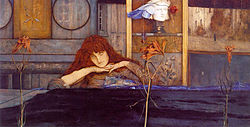 | |
 Khnopff's I Lock the Door Upon Myself, 1891, Smarthistory[8] Khnopff's I Lock the Door Upon Myself, 1891, Smarthistory[8] | |
| Khnopff's Jeanne Kéfer, Smarthistory[9] |
References
edit- Notes
- Citations
- ^ Pirard, Émile (2012). Fernand Khnopff (1858–1921) à Fosset, Ménil, Sprimont, Hérompont [Fernand Khnopff (1858–1921) at Fosset, Ménil, Sprimont, Hérompont] (Typescript, 105pp A4) (in French). Tillet.
{{cite book}}: CS1 maint: location missing publisher (link) - ^ Busine, Laurent (2003–2004). "To Sir Edward Burne-Jones from Fernand Khnopff". Fernand Khnopff 1858–1921 (Exhibition catalogue). Brussels; Salzburg; Boston: Royal Museums for Fine Arts of Belgium; Museum der Moderne; McMullen Museum of Art. pp. 45–52.
- ^ a b Fernand Khnopff et ses Rapports avec la Secession Viennoise [Fernand Khnopff and His Relationship with the Vienna Secession] (Exhibition catalogue) (in French). Brussels: Royal Museums for Fine Arts of Belgium. 1987.
- ^ Draguet, Michel (1995). Khnopff: 1858–1921. Monografieen over Moderne Kunst (in Dutch). Brussels: Snoeck-Dukaju & Zoon. p. 360. ISBN 978-90-5066-141-6.
- ^ "Villa Khnopff". ArtMagick. Archived from the original on 28 March 2006. Retrieved 28 March 2006.
- ^ Van Grieken, Joris (2003–2004). "Khnopff and the Théâtre Royal de la Monnaie". Fernand Khnopff 1858–1921 (Exhibition catalogue). Brussels; Salzburg; Boston: Royal Museums for Fine Arts of Belgium; Museum der Moderne; McMullen Museum of Art. pp. 65–69.
- ^ "Jeanne Kéfer (Getty Museum)". The J. Paul Getty in Los Angeles. Archived from the original on 1 October 2013.
- ^ "Khnopff's I Lock the Door Upon Myself, 1891". Smarthistory at Khan Academy. Archived from the original on 14 October 2014. Retrieved 28 March 2013.
- ^ "Khnopff's Jeanne Kéfer". Smarthistory at Khan Academy. Archived from the original on 11 October 2014. Retrieved 28 March 2013.
- Sources
- Berko, Patrick; Berko, Viviane (1981). Dictionary of Belgian Painters Born Between 1750 & 1875. Knokke: Laconti. pp. 387–389. ISBN 978-2-87008-023-8.
- Berko, Viviane (2011). 19th Century European Virtuoso Painters. Knokke. pp. 506, 138, 140, 142–143. ISBN 978-90-74524-00-1.
{{cite book}}: CS1 maint: location missing publisher (link) - Verhaeren, Émile (1887). Quelques Notes sur l'Oeuvre de Fernand Khnopff [Some Notes on the Work of Fernand Khnopff] (in French). Brussels: Editions Veuve Monnom.
- Fernand Khnopff 1858–1921 (Exhibition catalogue). Paris; Brussels; Hamburg: Musée des Arts décoratifs; Royal Museums for Fine Arts of Belgium; Hamburger Kunsthalle. 1979–1980.
- Delevoy, Robert L.; de Croës, Catherine; Ollinger-Zinque, Gisèle (1987). Fernand Khnopff (2nd revised and augmented ed.). Brussels: Lebeer-Hossmann. OCLC 18193987.
- Fernand Khnopff et ses Rapports avec la Secession Viennoise [Fernand Khnopff and His Relationship with the Vienna Secession] (Exhibition catalogue) (in French). Brussels: Royal Museums for Fine Arts of Belgium. 1987.
- Howe, Jeffery (1982). The Symbolist Art of Fernand Khnopff. Ann Arbor: UMI Research Press. ISBN 978-0-8357-1317-7.
- Draguet, Michel (1995). Khnopff, ou l'Ambigu Poétique [Khnopff, or the Poetic Ambiguity] (in French). Brussels; Paris: Crédit Communal; Flammarion. ISBN 978-2-08-012454-8.
- Fernand Khnopff (1858–1921) (Exhibition catalogue). Brussels; Salzburg; Boston: Royal Museums for Fine Arts of Belgium; Museum der Moderne; McMullen Museum of Art. 2003–2004.
- Pirard, Émile (2012). Fernand Khnopff (1858–1921) à Fosset, Ménil, Sprimont, Hérompont [Fernand Khnopff (1858–1921) at Fosset, Ménil, Sprimont, Hérompont] (Typescript, 105pp A4) (in French). Tillet.
{{cite book}}: CS1 maint: location missing publisher (link)
External links
edit
- I Lock the Door Upon Myself at Arcadian Dreams
- Exhibition Review of 'Fernand Khnopff (1858–1921)' (Nineteenth-Century Art Worldwide)
- Obsession: My Lifetime with Fernand Khnopff (Jeffery Howe) Archived 14 February 2006 at the Wayback Machine
- Villa Khnopff (ArtMagick)
- Ten Dreams Galleries