






A national personification is an anthropomorphic personification of a state or the people(s) it inhabits. It may appear in political cartoons and propaganda. In the first personifications in the Western World, warrior deities or figures symbolizing wisdom were used (for example the goddess Athena in ancient Greece), to indicate the strength and power of the nation. Some personifications in the Western world often took the Latin name of the ancient Roman province. Examples of this type include Britannia, Germania, Hibernia, Hispania, Lusitania, Helvetia and Polonia.

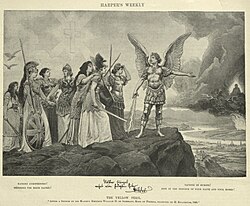
Examples of personifications of the Goddess of Liberty include Marianne, the Statue of Liberty (Liberty Enlightening the World), and many examples of United States coinage. Another ancient model was Roma, a female deity who personified the city of Rome and her dominion over the territories of the Roman Empire.[1] Roma was probably favoured by Rome's high-status Imperial representatives abroad, rather than the Roman populace at large. In Rome, the Emperor Hadrian built and dedicated a gigantic temple to her as Roma Aeterna ("Eternal Rome"), and to Venus Felix, ("Venus the Bringer of Good Fortune"), emphasising the sacred, universal and eternal nature of the empire.[2] Examples of representations of the everyman or citizenry in addition to the nation itself are Deutscher Michel, John Bull and Uncle Sam.[3]
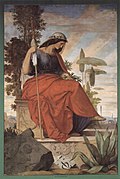
Italia turrita (lit. 'Turreted Italy'), the allegorical personification of Italy, appears as of a young woman with her head surrounded by a mural crown completed by towers (hence turrita or "with towers" in Italian). It is often accompanied by the Stella d'Italia ('Star of Italy'), which is the oldest national symbol of Italy, since it dates back to the Graeco-Roman tradition,[4] from which the so-called Italia turrita e stellata ('turreted and starry Italy'), and by other additional attributes, the most common of which is the cornucopia. The allegorical representation with the towers, which draws its origins from ancient Rome, is typical of Italian civic heraldry, so much so that the mural crown is also the symbol of the cities of Italy. The origin of the turreted woman is linked to the figure of Cybele, a deity of fertility of Anatolian origin, in whose representations she wears a wall crown.[5] Its most classic aspect derives from the primordial myth of the Great Mediterranean Mother.
Gallery
edit-
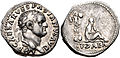 Iudaea Capta, "Judaea Taken", commemorative coin issued by the Roman emperor Vespasian (left) after the Jewish War
 -
-
 Britannia arm-in-arm with Uncle Sam symbolizes the British-American alliance in World War I. The two animals, the Bald eagle and the Barbary lion, are also national personifications of the two countries.
 -
 In this Allegory depicting the 1576 Pacification of Ghent by Adriaen Pietersz van de Venne, the seated women represent a short-lived unity among the embattled provinces of what would become the present-day Belgium and Netherlands.
 -
 1909 cartoon in Puck shows (clockwise) US, Germany, Britain, France and Japan engaged in naval race in a "no limit" game.
 -
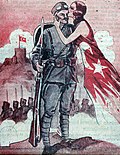
 Columbia depicted in an American Committee for Relief in the Near East poster defending an Armenian woman beneath her flag
 -
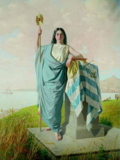
 The Liberty of Oudiné in memory of the Argentine centenary of the May Revolution (1810-1910)
 -
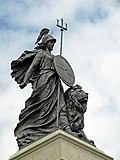
 Tomb of the Italian Unknown Soldier, under the statue of goddess Roma, at Altare della Patria, Rome. Above it can be seen the equestrian statue of Victor Emmanuel II of Savoy, the first king of a unified Italy
 -
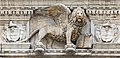 The winged Lion of Saint Mark at the Scuola Grande di San Marco, Venice. The open book holds the legend PAX TIBI MARCE EVANGELISTA MEVS (lit. 'Peace unto you, Mark, my Evangelist')
 -
 The Capitoline Wolf is a bronze sculpture depicting a scene from the legend of the founding of Rome. The sculpture shows a she-wolf suckling the mythical twin founders of Rome, Romulus and Remus.
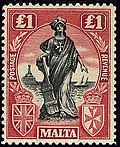
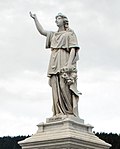
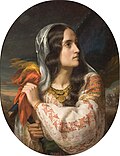
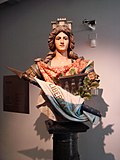
Personifications by country or territory
edit



































See also
edit- Mural crown
- National animal, often personifies a nation in cartoons.
- National emblem, for other metaphors for nations.
- National god, a deity that embodies a nation.
- National patron saint, a Saint that is regarded as the heavenly advocate of a nation.
- Contemporary pop cultural
- Afghanis-tan, a manga originally published as a webcomic about Central Asia with personified countries.
- Polandball, a contemporary form of national personification in which countries are drawn by Internet users as stereotypic balls and shared as comics on online communities.[6]: 87
- Hetalia: Axis Powers, a manga and anime about personified countries interacting.[6]: 85–86
- Year Hare Affair
References
edit- ^ "Il Tempio di Venere e Roma" (in Italian). Retrieved 12 September 2023.
- ^ Mellor, Ronald J. (1991) [1981]. "The Goddess Roma". In Haase, Wolfgang; Temporini, Hildegard (eds.). Aufstieg und Niedergang der romischen Welt. de Gruyter. p. 956. ISBN 3-11-010389-3.
- ^ Eric Hobsbawm, "Mass-Producing Traditions: Europe, 1870-1914," in Eric Hobsbawm and Terence Ranger, eds., The Invention of Tradition (Cambridge, 1983), 263-307.
- ^ Rossi, Girolamo (2014). Lo scudo crociato. Un simbolo medievale nella comunicazione politica del Novecento (in Italian). Armando Editore. p. 38. ISBN 978-88-96817-06-3.
- ^ Bazzano, Nicoletta (2011). Donna Italia. L'allegoria della Penisola dall'antichità ai giorni nostri (in Italian). Angelo Colla Editore. p. 24. ISBN 978-88-96817-06-3.
- ^ a b c Song, Chenyang (2025). Nationalist and Popular Culture Practices on Social Media: A Digital Ethnography of Chinese Online Fandom Nationalists. Bielefeld: Transcript. ISBN 978-3-8376-7926-7.
- ^ White, Richard (2021). "The slippery symbols of Australia". State Library of New South Wales.
- ^ Ahmed, Salahuddin (2004). Bangladesh: Past and Present. APH Publishing. p. 310. ISBN 8176484695. Retrieved July 11, 2012.
- ^ "NATIONAL SYMBOLS". Bangladesh Tourism Board. Bangladesh: Ministry of Civil Aviation & Tourism. Archived from the original on 2016-12-28. Retrieved 2015-09-10.
- ^ Couvreur, Manuel; Deknop, Anne; Symons, Thérèse (2005). Manneken-Pis : Dans tous ses états. Historia Bruxellae (in French). Vol. 9. Brussels: Musées de la Ville de Bruxelles. ISBN 978-2-930423-01-2.
- ^ Emerson, Catherine (2015). Regarding Manneken Pis: Culture, Celebration and Conflict in Brussels. Leeds: Taylor & Francis Ltd. ISBN 978-1-909662-30-8.
- ^ "20th SEA Games 1999". 2001-03-02. Archived from the original on 2001-03-02. Retrieved 2024-06-20.
- ^ "Berita 2021c - Rekaan baju 'Dang Budiwati' imbau zaman gemilang Sukan SEA NBD". www.pelitabrunei.gov.bn. Retrieved 2024-06-20.
- ^ McGill, Robert (2017). War Is Here: The Vietnam War and Canadian Literature. McGill-Queen's Press. p. 37. ISBN 9780773551589. Retrieved 17 May 2019.
- ^ Barber, Katherine (2007). Only in Canada You Say: A Treasury of Canadian Language. Oxford University Press Canada. p. 70. ISBN 9780195427073.
- ^ "Library and Archives Canada". Library and Archives Canada.
- ^ "CHILE: 50 AÑOS DEL GOLPE. EL ÁNGEL DE LA LIBERTAD". Rascacielos. September 2023. Retrieved 15 June 2024.
- ^ "网民为什么会把中国称为"兔子"" [Why do Internet called China a "hare"?]. The Paper (in Chinese). 1 August 2015. Retrieved 8 October 2021.
- ^ Zhang, Shuyu (2025). "Manufacturing Consent and "Correct Collective Memory"". In Hillman, Ben; Ji, Fengyuan (eds.). The Communist Party of China: Understanding the Durability of the World's Most Powerful Political Organization. New York: Cambridge University Press. doi:10.1017/9781009668385. ISBN 978-1-009-66843-9.
- ^ "Animals in Cyprus". AZ Animals. Retrieved 2023-01-06.
- ^ Abdou, Mona. "Nahdet Misr: A Sculpture That Embodies Egypt At A Glance". Egyptian Streets. Retrieved 20 November 2021.
- ^ "Mahmoud Mukhtar: Egypt Awakened". University College London. Retrieved 10 April 2025.
- ^ Hassanabadi, Mahmoud. "Rostam: A Complex Puzzle: A New Approach to the Identification of the Character of Rostam in the Iranian National Epos Shāhnāme".
- ^ Dallmayr, Fred (25 August 1999). Border Crossings: Toward a Comparative Political Theory. Lexington Books. ISBN 9780739152546.
- ^ Heck, Isabel. "Le mythe de Siyâvosh: rapports entre l'épopée nationale de ferdowsi et des récits populaires en Iran (The myth of Siyâvosh: relationships between the national epic of Ferdowsi and popular stories in Iran)" (PDF) (in French). Retrieved 2024-02-08.
- ^ O'Rourke Murphy, M. & MacKillop, J. (2006). An Irish Literature Reader: Poetry, Prose, Drama.
- ^ "Discovering What's the National Animal of Ireland: A Cultural Emblem Revealed". 3 February 2024. Retrieved 2024-04-24.
- ^ Minahan, James B. (2009). The Complete Guide to National Symbols and Emblems. ABC-CLIO. p. 436. ISBN 9780313344978.
- ^ Blashfield, Jean F. (2009). Italy. Scholastic. p. 33. ISBN 9780531120996.
- ^ ""Saint Mark", Franciscan Media". Archived from the original on 8 October 2020. Retrieved 30 July 2018.
- ^ Liok Ee Tan (1988). The Rhetoric of Bangsa and Minzu. Monash Asia Institute. p. 14. ISBN 978-0-86746-909-7.
- ^ Melanie Chew (1999). The Presidential Notes: A biography of President Yusof bin Ishak. Singapore: SNP Publications. p. 78. ISBN 978-981-4032-48-3.
- ^ Minahan, James B. (2009). The Complete Guide to National Symbols and Emblems. Greenwood. p. 101. ISBN 978-0313344961.
- ^ Subba, Sanghamitra (29 January 2020). "Love it or hate it, it's abominable".
- ^ Phillips, Jock. "South African War memorial, Waimate".
- ^ Dingwall, R. "Southern Man (Dunedin Airport) Archived 2018-01-29 at the Wayback Machine", Otago Sculpture Trust, 19 November 2011. Retrieved 14 July 2017.
- ^ A Manifesto from the Provisional Government of Macedonia, 1881,
Our mother Macedonia became now as a widow, lonely and deserted by her sons. She does not fly the banner of the victorious Macedonian army
- ^ Bulgarian graphic representation of Bulgaria, East Rumelia and North Macedonia
- ^ Voortrekker Monument Archived 1 January 2009 at the Wayback Machine, http://www.voortrekkermon.org
- ^ Brownell, FG (1993). "Nasionale en Provinsiale Simbole". Nasionale Dier van Suid-Afrika: Springbok - Antidorcas Marsupialis. Retrieved 2025-03-03.
- ^ "Kunstschatten: Mama Sranan - Parbode Magazine". Archived from the original on 2016-04-14. Retrieved 2016-03-30.
- ^ Valance, Marc. (Baden, 2013) Die Schweizer Kuh. Kult und Vermarktung eines nationalen Symbols, p. 6 ff.
- ^ "John Bull, symbol of the English and Englishness". Historic UK. Retrieved 16 August 2024.
- ^ "Britannia and Liberty: Behind the Design". Royal Mint. Retrieved 6 August 2024.
Further reading
edit- Lionel Gossman. "Making of a Romantic Icon: The Religious Context of Friedrich Overbeck's 'Italia und Germania.'" American Philosophical Society, 2007. ISBN 0-87169-975-3. [1]
External links
edit