





Portugal,[g] officially the Portuguese Republic,[h] is a country located on the Iberian Peninsula in Southwestern Europe. It is a unitary republic made up by mainland Portugal and two autonomous regions, with Lisbon as both its capital and largest city. It has a total population of over 10.7 million. The mainland is bordered by Spain to the north and east, with Madeira and the Azores in the Atlantic Ocean. The mainland includes the westernmost point of continental Europe.
Portuguese Republic
| |
|---|---|
| Anthem: "A Portuguesa" "The Portuguese" | |
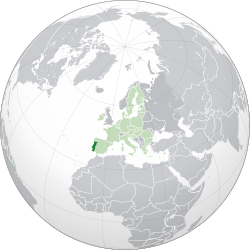 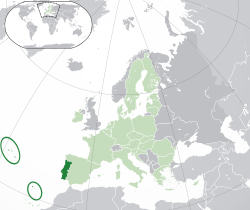 Location of Portugal
Portugal within the European Union | |
| Capital and largest city | Lisbon 38°46′N 9°9′W / 38.767°N 9.150°W |
| Official languages | Portuguese |
| Recognised national languages | Portuguese Sign Language |
| Recognised regional languages | Mirandese |
| Demonym | Portuguese |
| Government | Unitary semi-presidential republic[1] |
| António José Seguro | |
| Luís Montenegro | |
• Speaker | José Pedro Aguiar-Branco |
| Legislature | Assembly of the Republic |
| Establishment | |
• County | 868 |
| 24 June 1128[a] | |
| 25 July 1139 | |
| 4–5 October 1143 | |
| 23 May 1179 | |
| 1 December 1640 | |
| 23 September 1822 | |
• Republic | 5 October 1910 |
| 25 April 1974 | |
| 25 April 1976[b] | |
| Area | |
• Total | 156,597 km2 (60,462 sq mi)[c] (92nd) |
• Land | 92,225 km2 (35,608 sq mi)[5] |
• Water | 64,372 km2 (24,854 sq mi)[6] |
• Water (%) | 1.2 (2015)[3] |
| Population | |
• 2024 estimate |  10,749,635[7] (87th) 10,749,635[7] (87th) |
• 2021 census |  10,343,066[8] 10,343,066[8] |
• Density | 116.6/km2 (302.0/sq mi) |
| GDP (PPP) | 2026 estimate |
• Total |  $567.632 billion[9] (51st) $567.632 billion[9] (51st) |
• Per capita | $52,841[9] (42nd) |
| GDP (nominal) | 2026 estimate |
• Total | $380.637 billion[9] (45th) |
• Per capita | $35,434[9] (41st) |
| Gini (2025) |  30.9[10] 30.9[10]medium inequality |
| HDI (2023) | 0.890[11] very high (40th) |
| Currency | Euro[d] (€) (EUR) |
| Time zone | UTC+0 and -1[f] |
• Summer (DST) | UTC+1 and +0[e] |
| Date format | yyyy-mm-dd[12] |
| Calling code | +351 |
| ISO 3166 code | PT |
| Internet TLD | .pt |

The western Iberian Peninsula has been inhabited since prehistoric times, with the earliest signs of settlement dating to 5500 BC. Portugal was initially established as a county of the Kingdom of León in 868, and formally as a kingdom in 1179, resulting from the Reconquista against the Muslims. The kingdom later became one of the main participants of the Age of Discovery, made several seminal advancements in nautical science, and was among the first European countries to explore and discover new territories and sea routes, establishing settlements, colonies, and trading posts. After the kingdom became a republic in 1910, Portugal lived under a dictatorship from 1926 until the dictatorship's overthrow in 1974 enabled the full establishment of democracy in 1976.
It is a semi-presidential constitutional unitary republic and multi-party representative democracy with four separate sovereignty bodies: president, government, parliament, and judiciary. It has a unicameral national legislature known as the Assembly of the Republic. Portugal has developed a complex system to manage its territory, even though the mainland continues to remain highly centralised.
A developed country, Portugal has an advanced economy that chiefly relies upon services, industry, and tourism. Shaped by the various civilisations that have crossed its territory, Portugal developed a specific culture with a worldwide influence that allowed Portuguese to become the world's fifth-most spoken native language with more than 250 million native speakers. A member of numerous international organizations, Portugal maintains an active role in international political, cultural, economic, and military affairs.
Etymology
editThe word Portugal derives either from Latin Portus Cale, meaning 'port of Cale', or Latin Portus Gale, 'warm harbour', itself the origin of Porto. Cale was a town on the Douro. The second derivation would have referred to the fact that the harbour at Porto is always free of ice.[14] The meaning and origin of the word Cale is unclear. The usual explanation is that it is an ethnonym derived from the Gallaeci peoples, who occupied the north-west of the Iberian Peninsula.[15][i]
Around 136 BC, the Romans, during the Second Punic War, conquered Cale from the Carthaginians, renaming it Portus Cale.[18][19] During the Middle Ages, the region around Portus Cale became known by the Visigoths as Portucale and by the Suebi as Parochiale.[19] The name Portucale evolved into Portugale during the 7th and 8th centuries, and by the 9th century it was used to refer to the region between the Douro and Minho rivers. By the 11th and 12th centuries, Portugale, Portugallia, Portugallo, or Portugalliae were already referred to as Portugal.[20][21]
History
editPrehistory
editThe region has been inhabited by humans since approximately 400,000 years ago.[j] Later Neanderthals roamed the northern Iberian peninsula, and a humanoid tooth has been found at the Nova da Columbeira cave in Estremadura.[23] Homo sapiens sapiens arrived in what is now Portugal around 35,000 years ago and subsequently spread rapidly,[24] with the onset of the Neolithic dating to approximately 5400 BC.[25] In southern Portugal, Iron Age inscribed stele have been found, representing the earliest known evidence of writing on the Iberian Peninsula.[26] Pre-Celtic tribes inhabited Portugal. The Lusitanians occupied central, inland regions. Celts mainly inhabited the north and centre of Portugal, leaving lasting traces in the language and culture.[27]
Antiquity and early Middle Ages
edit
Romans first invaded the Iberian Peninsula in 218 BC.[28] The Carthaginians, Rome's opponent in the Punic Wars, were expelled from the peninsula in 206 BC after the Battle of Ilipa.[29][30] Within 200 years, almost the entire Iberian Peninsula had been annexed to the Roman Republic, facing resistance from local tribes, notably the Lusitanians led by Viriathus.[31][32]
In 409, with the decline of the Roman Empire, the Iberian Peninsula was invaded by Germanic tribes.[33] Western Iberia was initially integrated into the Suebian Kingdom, with its capital at Braga.[34] The Visigoths eventually defeated the Suebi and ruled the entire peninsula until the early 8th century.[35][36] In 711, the Iberian Peninsula was invaded from the south by the Umayyad Caliphate who expanded rapidly in the peninsula and most of it became part of al-Andalus in 726.[37][38][39][40] The land that is now Portugal was part of the Umayyad Caliphate until the caliphate's collapse in 750.[41] That year the western part of the caliphate gained its independence under Abd al-Rahman I, with the establishment of the Emirate of Córdoba,[k] which lasted until 1031, with its dissolution into 23 small kingdoms.[44][45][46] Most of present-day Portugal fell into the hands of the Taifa of Badajoz, and in 1022 the Taifa of Seville. Those petty kingdoms were conquered by the Almoravids in 1086, then by the Almohads in 1147.[47][48]
Invasions from the north also occurred in this period, with Vikings raiding the coast, including Lisbon, between the 9th and 11th centuries.[49][50] The Viking raids resulted in the establishment of small Norse settlements on the coastline between Douro and Minho.[51]
Reconquista
edit
The Reconquista was a series of military campaigns by northern Iberian Christian polities against Muslim-ruled al-Andalus.[52] It begun in 718 with the Battle of Covadonga which lead to the establishment of the Kingdom of Asturias following the defeat of the Umayyad forces by Visigothic nobleman, Pelagius.[53][54]
In 868, Porto was conquered from the Moors by Vímara Peres, a knight and nobleman, on the orders of King Alfonso III of Asturias, with Peres becoming the first Count of Portugal.[55][56][57] Finding many towns in the region deserted, Peres decided to rebuild and repopulate them.[58]
With the forced abdication of Alfonso III in 910, the Kingdom of Asturias split into three separate kingdoms, which were reunited in 924 under the crown of León.[59] The first County lasted until 1071, when the Kingdom of Galicia took over the region following the Battle of Pedroso.[60] In 1096, Alfonso VI of León refounded the county and bestowed it on Henry of Burgundy, who married to Alfonso's illegitimate daughter, Teresa of León.[61]
Independence
edit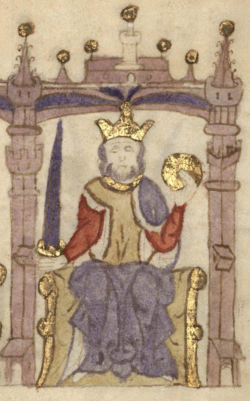
After the death of Count Henry, in 1112, a dispute erupted, culminating in the Battle of São Mamede, in 1128, where Afonso Henriques defeated the forces of his mother Countess Teresa and her lover Fernão Peres de Trava, establishing himself as sole leader of the county and achieving de facto independence.[62] Afonso's campaigns were successful, and in 1139, he was victorious in the Battle of Ourique, and took the title of King of Portugal.[63] In 1143, Afonso was recognised as Afonso I, king of Portugal, by King Alfonso VII of León, and in 1179 by Pope Alexander III, with the papal bull Manifestis Probatum.[64]
Afonso Henriques and his successors, aided by military monastic orders, continued pushing south until the capture of Algarve in 1249.[65][66] With minor readjustments, Portugal's borders have since remained the same, making it one of the oldest established international borders in Europe.[67]
In 1348-49 Portugal, as with the rest of Europe, was devastated by the Black Death.[68] In 1373, Portugal, during the reign of King Ferdinand I, in the midst of the Fernandine Wars, made an alliance with England, which would be later strengthened by the signing of the Treaty of Windsor,[69] making it the oldest standing alliance in the world.[70][71]
Age of Discovery
edit
In 1383, John I of Castile and Beatrice of Portugal, the only surviving legitimate child of Ferdinand I of Portugal, claimed the throne of Portugal. John of Aviz led a revolt against them and defeated the Castilians in the Battle of Aljubarrota, with the House of Aviz becoming the ruling house that led Portugal into the limelight of European politics and culture.[72][73][74]
Portugal spearheaded the European exploration of the world under the sponsorship of Prince Henry the Navigator,[75][76] and made several seminal advancements in nautical science.[l] The Portuguese explored the Indian Ocean, established trade routes in most of southern Asia, and sent the first direct European maritime trade and diplomatic missions to China and Japan.[75][78] In 1415, Portugal acquired its first colonies by conquering Ceuta.[79] Throughout the 15th century, Portuguese explorers sailed the coast of Africa, establishing trading posts for commodities that ranged from gold to slavery.[80]
The Treaty of Tordesillas, signed in 1494, divided the newly located lands outside Europe between Portugal and Spain along a line west of Cape Verde. In 1500, Gaspar Corte-Real reached modern-day Canada.[81][m] In 1500, Pedro Álvares Cabral landed in Brazil and claimed it for Portugal.[83][84][85] Portuguese sailors set out to reach eastern Asia, landing in Taiwan, Japan, Timor, Flores, and the Moluccas.[75][n]
Between 1519 and 1522, Ferdinand Magellan organised a Spanish expedition to the East Indies that resulted in the first circumnavigation of the globe.[91] The Treaty of Zaragoza, signed in 1529, divided the Pacific Ocean between Spain and Portugal.[92]
Iberian Union and Restoration
edit
A succession crisis followed the deaths of King Sebastian and his grand-uncle King Henry, both of whom were without direct male heirs.[93][94] Philip II of Spain claimed the throne in 1580, under the pretext that his mother, Isabella of Portugal, was a Portuguese princess, and he was crowned king of Portugal,[95][96] forming a personal union of the two kingdoms,[o] depriving Portugal of an independent foreign policy and leading to its involvement in the Eighty Years' War.[98][99]
The Dutch-Portuguese War resulted in the loss of Portugal's Indian Ocean trade monopoly between 1595 and 1663.[100] On 15 December 1640, John, Duke of Braganza, was proclaimed king following an uprising spearheaded by disgruntled nobles on 1 December, ending 60 years of the Iberian Union under the House of Habsburg, and beginning the rule of the House of Braganza.[101] Following its defeat in the Portuguese Restoration War, Spain recognised Afonso VI as king of Portugal.[102] The reign of John V saw an influx of gold into the royal treasury, supplied largely by the royal fifth and a gold rush that saw one of the largest movements of people from Europe to an American colony.[p][104]
Lisbon was struck by a major earthquake on 1 November 1755.[105][q] Following the earthquake, King Joseph I gave his prime minister, Sebastião José de Carvalho e Melo, 1st Marquis of Pombal, overarching powers, with Pombai becoming an enlightened despot.[107]
Constitutional monarchy
edit
In 1807, Portugal refused Napoleon's demand to join the Continental System of embargo against the United Kingdom;[108] an invasion led by French General Junot followed, and Lisbon was captured in 1807.[109] During the Napoleonic invasions, the Portuguese royal family transferred the court to Rio de Janeiro, in Brazil, making it the capital between 1808 and 1821.[110] British intervention in the Peninsular War helped support Portuguese independence, and all French troops were expelled by 1812.[111]
In 1820, a constitutionalist insurrection began in Porto, which forced King John VI and his court to return to mainland Portugal in 1821. The death of John in 1826 led to a succession crisis. His eldest son, Pedro I of Brazil, briefly succeeded as Pedro IV of Portugal, but neither the Portuguese nor the Brazilians wanted a reunified monarchy. Consequently, Pedro abdicated the Portuguese crown in favour of his 7-year-old daughter, Maria da Glória.[112][113]
Dissatisfaction at Pedro's constitutional reforms led the "absolutist" faction of landowners and the church to proclaim his brother Miguel king in February 1828. This led to the Liberal Wars, in which Pedro forced Miguel to abdicate in favour of Maria and to go into exile in 1834.[114] Under the constitutional monarchy, the country faced economic crises, political instability, and several coups d'état.[115] At the same time it expanded its colonies in Africa, but this culminated in the 1890 British Ultimatum, which thwarted Portugal's imperialist ambitions and represented a devastating blow to the monarchy.[116][117]
First Republic and Estado Novo
edit
In 1908, King Carlos I and his son and heir, Luís Filipe, Prince Royal, were assassinated by republican sympathizers.[118] In 1910, the monarchy was replaced with a republic.[119] During World War I, Portugal fought for the Allies; however, the war hurt its weak economy.[120][121]
Political instability and economic weaknesses created chaos and unrest during the First Republic.[122] These conditions led to its overthrow in 1926 and the establishment of the Ditadura Nacional, which evolved into the right-wing dictatorship of the Estado Novo, under António de Oliveira Salazar, in 1933.[123]
Portugal remained neutral in World War II.[124] New economic development projects and relocation of mainland citizens into the overseas provinces in Africa were initiated.[125] However, indigenous peoples already second-class citizens, were sidelined by those development projects,[126] which led to the emergence of independence movements, in the 1960s,[127] culminating in 1961 in the Portuguese Colonial War, which lasted until 1974.[128]
Return to democracy
edit
On 25 April 1974, the Carnation Revolution overthrew the Estado Novo beginning the transition to democracy, and the beginning of the dissolution of its colonial empire until 1999.[129][130][131] Portugal was governed by a succession of provisional governments, with a lot of social and political tension, during the Ongoing Revolutionary Process (PREC), until the legislative election of 1976.[132] After the transition to democracy, Portugal fluctuated between socialism and neoliberalism.[133]
In 1986, Portugal joined the European Economic Community (EEC), which led to a considerable growth of its economy.[134] The 2010–2014 Portuguese financial crisis led to an international bailout and intense austerity policies, resulting in lasting social impacts.[135][136]
Geography
edit
Portugal comprises a mainland territory located on the Iberian Peninsula in Southwestern Europe, commonly referred to as Continental Portugal, as well as the two archipelagos of Madeira and the Azores on the Atlantic Ocean. The country is situated between latitudes 30° and 42° N, and longitudes 32° and 6° W.[137][138][139] Portugal encompasses a total area of 156,597 km2 (60,462 sq mi), of which 64,372 km2 (24,854 sq mi) consists of territorial sea and internal waters, while the country's land area amounts to 92,225 km2 (35,608 sq mi).[5][6][r] Portugal's exclusive economic zone extends over 1,727,408 km2 (666,956 mi2), making it the third-largest in the European Union and the twentieth-largest in the world.[6] The country’s highest point is the summit of Mount Pico, located on Pico Island in the Azores, which rises to an elevation of 2,351 metres (7,713 ft) above sea level.[141][s] Despite the country's size, Portugal exhibits a diverse array of geomorphological landscapes as a result of its long geological evolution, shaped by two Wilson cycles, its position relative to plate boundaries, and climatic variability that produced distinct morphoclimatic zones.[143]
Continental Portugal is 67% forests and 24% agricultural. The Portuguese mainland is predominantly low-altitude, with over 70% of the territory lying below 400 metres (1,300 ft) and less than 12% rising above 700 metres (2,300 ft) of elevation. Its geography is structured by the Tagus River, which enters from Spain and flows into the Tagus Estuary, as 95% of areas exceeding 400 metres (1,300 ft) are situated to the north of the river while the regions south of the Tagus, encompassing Alentejo and the Algarve, have 62% of the lands below 200 metres (660 ft). The territory north of the Tagus is marked by mountains and plateaus incised by river valleys, whereas the south is distinguished by rolling plains.[144][145]
The Madeira archipelago comprises the islands of Madeira and Porto Santo, together with the Desertas and Savage Islands, all of which are of volcanic origin. Approximately one third of Madeira Island lies above 1,000 metres (3,300 ft) in elevation, and its landscape is characterised by a dense network of deep valleys with slopes rising several hundred metres, as well as streams that originate in the island’s centre and diverge towards the coast, sustained by abundant rainfall. The steep gradient and very high rainfall is a cause of flash floods with high sediment transport.[146]
The Azores is an archipelago composed of nine volcanic islands which, from west to east, are Flores, Corvo, Faial, Pico, São Jorge, Graciosa, Terceira, São Miguel, and Santa Maria. The islands retain much of their volcanic landforms, most visibly in volcanic cones and in the lakes that shape the scenery of the islands especially São Miguel, Flores, Terceira, Pico, and Corvo. Although rainfall is abundant, most streams in the Azores are temporary, and the predominance of agricultural land use further accentuates the torrential nature of the river regime during periods of intense precipitation.[147][144]
Climate
edit


The climate of Portugal is mainly Mediterranean. While the mainland and Madeira show a Mediterranean climate, the Azores mainly have a temperate oceanic climate. Portugal has a diverse variety of regional climates for a country of its size.[148]
The Iberian Peninsula is located at the southern margin of the temperate zone and at the northern margin of the subtropical high-pressure zone. Additionally, Portugal's climate is influenced by the seasonal latitudinal shift of the jet stream, which directly impacts the trajectory of a polar front. Typically in the winter, the jet stream moves southwards and Portugal comes under the influence of the polar front, producing colder temperatures. When the polar front moves northward, Portugal comes under the influence of the stable atmospheric conditions that bring milder weather during the summer.[148]
The high altitude zones of the Azorean islands have a temperate maritime climate while the western Azores have a humid subtropical climate. In parts of the Beja District and on Porto Santo Island the climate is semi-arid. In the Selvagens Islands the climate is that of a hot desert. Portugal is one of the warmest countries in Europe: the average temperature in mainland Portugal varies from 10–12 °C (50.0–53.6 °F) in the mountainous interior north to 17–19 °C (62.6–66.2 °F) in the south and on the Guadiana river basin, with variations from the highlands to the lowlands.[149] Wildfires are a major issue, with Portugal, on average, having the highest percentage of burned area in the European Union,[150][151][152] and its coastal area being vulnerable to climate change and severe weather.[153][152][154]
Biodiversity
edit
Portugal is located on the Mediterranean basin, the 3rd most diverse hotspot of flora in the world.[156] It is home to 6 terrestrial ecoregions - Azores temperate mixed forests, Cantabrian mixed forests, Madeira evergreen forests, Iberian sclerophyllous and semi-deciduous forests, Northwest Iberian montane forests, and Southwest Iberian Mediterranean sclerophyllous and mixed forests.[157] Over 22% of its land area is included in the Natura 2000 network.[158][159] Eucalyptus, cork oak, and maritime pine together make up 71% of the total forested area of continental Portugal.[160] The Portuguese west coast is part of the four major Eastern Boundary Upwelling Systems of the ocean.[161] 73% of the freshwater fish occurring in the Iberian Peninsula are endemic, the largest out of any region in Europe.[162] Some protected areas of Portugal are the Southwest Alentejo and Vicentine Coast Natural Park, which is one of the last examples of wild coast still remaining in Europe,[163] and the Montesinho Natural Park, which hosts some of the only populations of Iberian wolf and Iberian brown bear.[164]
Geographical and climatic conditions facilitate the introduction of exotic species that later turn out to be invasive and destructive to the native habitats. Around 20% of the total number of extant species in continental Portugal are exotic.[165] Portugal is the 2nd country in Europe with the highest number of threatened animal and plant species.[166] The country as a whole is an important stopover for migratory bird species.[167][168][169] The mammalian species of Portugal such as deer, Iberian ibex, wild boar, red fox, Iberian wolf, and Iberian lynx were once widespread throughout the country, but intense hunting, habitat degradation, and growing pressure from agriculture and livestock largely reduced their populations in the 19th and 20th centuries.[170] Others species, such as the Portuguese ibex, became extinct, however some mammalian species have been re-expanding their native range.[171]
Government and politics
edit

Portugal has been a semi-presidential representative democratic republic since the ratification of the Constitution of 1976.[172][173] The Constitution makes for a separation of powers among four sovereignty bodies: the president, the government, the Assembly of the Republic, and the courts.[174][175]
The head of state of Portugal is the president who is elected to a five-year term by direct, universal suffrage.[176][177] The president exercises representative functions, holds significant governmental authority, and is able to shape media and public opinion in ways that constrain the political and policy agendas of the government and parliament; in addition, the office carries supervisory and reserve powers, includes ex officio supreme command of the armed forces, and is advised by the Council of State.[178][179][180] The president of Portugal is António José Seguro; he took office after winning the second round of the 2026 Portuguese presidential election.[181][182]


Portugal's legislative body is the Assembly of the Republic, an unicameral parliament.[183] It consists of a single chamber with a minimum of 180 seats and a maximum of 230, elected by popular vote every four years or when dissolved.[184][185][186][187] The members of parliament represent the whole country and not the constituencies for which they are elected.[188] There is universal suffrage for adults over 18 years of age, with a secret ballot for all elected offices.[189] As the head of government, the prime minister leads the Council of Ministers which includes ministers and secretaries of state that have full executive powers,[190][191] and is appointed by the president in light of electoral results after consulting with the parties with seats in the Assembleia da República.[192] Portugal's prime minister is Luís Montenegro who took office after AD – PSD/CDS Coalition winning enough seats to form a minority government following the 2024 Portuguese legislative election.[193][194] Portugal operates a multi-party system of competitive legislatures at the national, regional, and local levels. The Assembly of the Republic is dominated by three political parties, the Social Democratic Party (PSD), Chega (CH), and the Socialist Party (PS), while the PSD and PS continue to be the dominant parties in the regional parliaments and at the local level.[t] There have been recent trends towards autocratisation.[196][197]
Portugal has a civil law system based on Roman law and on Canon Law and influenced by German civil law.[198] The Constitution is the supreme law of Portugal.[199] In the Portuguese legal system, private civil law and criminal law are codified in the Código Civil and the Código Penal respectively.[200][201] In Portugal, courts are organised into several levels, among the judicial, administrative, and fiscal branches. The institution of last appeal is the Supreme Court of Justice. The Constitutional Court determines the constitutionality of the laws.[202]
Administrative divisions
editContinental Portugal is agglomerated into 18 districts, while the archipelagos of the Azores and Madeira are governed as autonomous regions; the largest units, established since 1976, are either mainland Portugal and the autonomous regions of Portugal (Azores and Madeira).[203] Administratively, Portugal is divided into 308 municipalities (municípios or concelhos). Operationally, the municipalities, and freguesias, along with the national government, are the only legally local administrative units identified by the government of Portugal.[204]
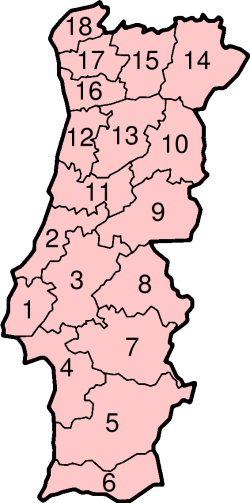
| District | Municipalities[205] | Parishes[206] | Pop. (2024)[207] |
Area (km2)[208] |
Density (/km2)[209] | |
|---|---|---|---|---|---|---|
| 1 | Lisbon | 16 | 141 | 2,390,715 | 2,816 | 849 |
| 2 | Leiria | 16 | 116 | 486,583 | 3,506 | 139 |
| 3 | Santarém | 21 | 150 | 446,393 | 6,718 | 66 |
| 4 | Setúbal | 13 | 60 | 916,859 | 5,214 | 176 |
| 5 | Beja | 14 | 84 | 149,546 | 10,263 | 15 |
| 6 | Faro | 16 | 76 | 492,747 | 4,997 | 99 |
| 7 | Évora | 14 | 75 | 153,430 | 7,393 | 21 |
| 8 | Portalegre | 15 | 72 | 103,566 | 6,084 | 17 |
| 9 | Castelo Branco | 11 | 128 | 180,889 | 6,627 | 27 |
| 10 | Guarda | 14 | 245 | 142,210 | 5,535 | 26 |
| 11 | Coimbra | 17 | 161 | 423,432 | 3,974 | 107 |
| 12 | Aveiro | 19 | 174 | 734,762 | 2,801 | 262 |
| 13 | Viseu | 24 | 282 | 357,841 | 5,010 | 71 |
| 14 | Bragança | 12 | 226 | 122,360 | 6,599 | 19 |
| 15 | Vila Real | 14 | 200 | 184,707 | 4,307 | 43 |
| 16 | Porto | 18 | 275 | 1,860,255 | 2,332 | 798 |
| 17 | Braga | 14 | 371 | 867,537 | 2,706 | 321 |
| 18 | Viana do Castelo | 10 | 213 | 234,645 | 2,219 | 106 |
| Autonomous Region of Azores | 19 | 156 | 241,718 | 2,322 | 104 | |
| Autonomous Region of Madeira | 11 | 54 | 259,440 | 801 | 324 | |
| Total Portugal | 308 | 3,259 | 10,749,635 | 92,225 | 117 | |
Within the European Union administrative system (NUTS), Portugal is divided into nine regions: the Azores, Alentejo, Algarve, Central Region, Lisbon, Madeira, North Region, Oeste e Vale do Tejo, and Setúbal Peninsula.[210] With the exception of the Azores and Madeira, NUTS areas are subdivided into 24 subregions.[211]
Foreign relations
edit
A member state of the United Nations since 1955,[212] Portugal is a member of almost all major international organizations,[213] and is among the countries that founded NATO in 1949,[214] the OECD in 1961,[215] EFTA in 1960,[216] and the Community of Portuguese Language Countries (CPLP) in 1996, an international organisation of countries where Portuguese is an official language.[217]
Portugal has a stable foreign policy that is the result of its history, geography, and specific foreign policy choices. It is structured around six principal regional and policy priorities: Europe, NATO and relations with the United Kingdom and with the United States, the Portuguese-speaking world, the importance of and support for Portuguese communities abroad, the internationalization of the national economy, and the strengthening of multilateralism. Portugal regards the success of European integration as paramount and is prepared, where a consensus exists among European Union member states, to endorse policies that go against with the country's national interests;[218] it also supports general disarmament, the dismantling of political-military blocs, and the creation of a collective security system aimed at establishing an international order grounded in peace and justice among peoples.[219]
Portugal has two territorial disputes, both of which are with Spain: the Spanish town of Olivenza which is claimed by Portugal since the 19th century, and the Portuguese Savage Islands which have been claimed by Spain since 1911.[220][221] Despite causing moments of tension between the two countries,[222] the relationship between the two countries remains excellent.[223]
Military
edit
The Portuguese Armed Forces consist of three branches commanded by the Estado-Maior-General das Forças Armadas (Armed Forces General Staff) – Marinha (Navy), Exército (Army), and Força Aérea (Air Force).[224] The Portuguese military serves as a self-defence force, takes part in humanitarian and peace missions undertaken by the international organisations to which Portugal belongs, and cooperates in civil defence missions.[225][226][227] In recent years, the Portuguese military have carried out several NATO and European Union missions worldwide.[u] The Portuguese military budget in 2023 was more than $4 billion, representing 1.48% of GDP.[229]
As of 2025, the three branches numbered 23,589 military personnel.[230] Until 1999, military service was compulsory for men at age 18 becoming officially suspended during peace time and replaced by one mandatory day of sensibilization about the Armed Forces called Dia da Defesa Nacional (National Defence Day).[231] Since 1992 women may serve in all branches of the armed forces.[232] The Portuguese military became fully professional in 2004.[233]
In addition to the three branches of the armed forces, there is the National Republican Guard, a gendarmerie force, comprising 23,287 personnel in 2023,[234] under the authority of both the Defence and the Interior ministries.[235] The Guard has provided detachments for international operations in Iraq and East Timor.[236] The United States maintains a military presence, with 770 troops in the Lajes Air Base at Terceira Island, in the Azores.[237]
Law enforcement
edit
In Portugal, prosecution is conducted by the Public Prosecution Service which is headed by the prosecutor general.[238] The main police organisations of Portugal are the National Republican Guard (GNR), a gendarmerie; the Public Security Police (PSP), a civilian police force that works in urban areas; and the Judicial Police (PJ), a highly specialised criminal investigation organization that is overseen by the Public Prosecution Service.[239]
Portugal has 49 correctional facilities run by the Directorate-General for Reintegration and Prison Services (DGRSP).[240] The facilities include seventeen central prisons, four special prisons, twenty-seven regional prisons, and one Cadeia de Apoio (Support Detention Centre).[241] As of 2025, the prison population stood at 12,193 inmates, about 0.11% of the country's entire population,[242] with the incarceration rate steadily declining between 2013 and 2021.[243][244]
Human rights
editPortugal has a tradition of a humanistic criminal justice.[245] The Portuguese Constitution defines the country as being one that is based on human dignity.[246] It abolished capital punishment and life imprisonment in the 19th century,[245] and forbids extradition in the case of either sentence possibly being imposed.[247][248] Portugal is the only country that considers any type of punishment for the duration of a convict's natural life a violation of human rights.[249] The Portuguese Penal Code provides for a wide range of non-custodial sentences, with the aim of keeping a prison sentence a punishment of last resort. Portuguese penitentiary laws have traditionally been progressive, and based on rehabilitation as the main goal of the implementation of such a sentence.[245]
Since the 2000s, numerous laws strengthening LGBT rights were passed in Portugal.[v][w][x][y][z][aa] In 2001, Portugal became the first country in the world to decriminalize the personal possession and consumption of all drugs.[258] Portugal faces issues such as police brutality,[259] racism, and discrimination against Romani people,[260][261][262][263] migrant slavery,[264][265] restrictions on freedom of association and collective bargaining,[266] violations of wage, hour, and overtime laws,[267] and treatment inside of prisons.[268]
Economy
edit
Portugal is an high-income country with an advanced economy that follows the Mediterranean model.[269][270][271] The country's economic policy is framed by strategic guidelines called Major Plan Options, which are subsequently implemented through the State Budget.[272][273][274] Portugal has the EU's 14th-largest economy by nominal GDP and the 12th-largest economy by PPP-adjusted GDP.[275][276] Its PPP-adjusted GDP per capita stood at to 81% of the EU average in 2025.[277] As of 2024, the country's service sector contributes the most for its economic output followed the industrial sector and its agricultural sector.[278] In 2025, Portugal unemployment rate was 5.8%.[279] As of 2024, its poverty rate after social transfers is 15.4% of the population while in 2023, the at-risk-of-poverty rate before social transfers stood at 40.3%.[280][281] The percentage of the Portuguese population suffering from moderate or severe food insecurity between 2022 and 2024 was on average 11.9%, which makes Portugal the third-highest country in Southern Europe for this indicator where the average stands at 5.9%.[282] The national debt of Portugal is estimated at 89.5% relative to GDP as of 2025.[283]
Portugal is part of the European single market which represents more than 450 million consumers.[284] Portugal replaced the escudo with the euro, in 2002.[285] Its monetary policy is set by the European Central Bank.[286] The country has been a part of the Eurozone since its inception.[287] Portugal's central bank is the Banco de Portugal and it is part of the European System of Central Banks.[288] In 2024, Portugal had a combined share of exports and imports that amounted to 90% of its total GDP.[289] In 2025, Portugal's main export markets were Spain at 26% and Germany at 13.9%.[290] Its main exports are machinery and mechanical appliances, vehicles and other transportation equipment, base metals, and plastics.[291] Portugal's main import markets in 2026 were Spain at 32.9% and Germany at 11.9%.[292] Portugal's main imports are machinery and mechanical appliances, chemical products, agricultural products, and mineral fuels.[291]
Since the 1990s, Portugal's economic model has been based on public consumption and economic development focused on exports, private investment and the development of its high-tech sector. Consequently, business services have overtaken more traditional industries such as wine and cork in export earnings.[293] The PSI, Portugal's stock market index operated by the Euronext Lisbon, includes 16 major Portugal-based companies. Preeminent Portuguese companies include Sonae, Mota-Engil, Corticeira Amorim, The Navigator Company and EDP.[294]
The European Innovation Scoreboard 2025, ranked Portugal-based innovation as 16th, with increases in R&D, government support, and resource productivity.[295] Portugal was ranked 31st on the Global Innovation Index in 2025.[296] Among the largest non-state-run research institutions are the Gulbenkian Institute of Molecular Medicine, the International Iberian Nanotechnology Laboratory, and the Champalimaud Foundation, which is one of the leading research centres for neuroscience and oncology in the world.[297]
Agriculture and fishery
edit
The Portuguese agriculture sector accounts for 2.9% of the country's total GDP as of 2024.[278] Only 10.1% of Portugal's land is suitable for cultivation as of 2023.[298] Despite this, the presence of very distinct edaphoclimatic and agroecological conditions in the northern, central, and southern regions of Portugal enables the cultivation of various agricultural products such wheat, maize, rice with each one having an important role in the primary sector,[299] and resulting in an agricultural self-sufficiency rate of about 81% as of 2012.[300]
Portugal ranks sixth in the world in seafood consumption per capita with each Portuguese consuming on average 59.36 kilos of fish in 2020.[301] The high fish consumption in Portugal is due to tradition and cultural roots, politics, dynamics of the fish market system, and geography which makes fisheries and the consumption of seafood products extremely valuable. While Portugal captured 185,000 metric tons of fish in 2019, down from the 222,000 metric tons in 2010, fish and seafood represent the single highest import of biocapacity from abroad, amounting to 1,600,000 global hectares in total.[302]
Industry and services
edit
Portugal's industry accounts for 21.2% of the country's total GDP as of 2024, down from an annual average of 26% over the period between 1953 and 1973.[278][303] The lower contribution of manufacturing to Portugal's economy has lead to lower real GDP growth rates between 1974 and 2019 than during the period between 1950 and 1973.[303] As of 2025, Portugal's automobile industry produced the biggest share of the country's exportations.[291] The automobile industry accounts for 20.2% of the country manufacturing exports and 82.8% of the total value of its exportations employing 43.247 workers in 2020.[304]
Portugal's service sector accounted for 76.5% of the country's total economic output as of 2024.[278] Tourism, retail, and telecommunication are all major industries.[294] Tourism is an important industry representing 11.4% of the Portugal's total GDP as of 2024.[305] The country ranks highly in tourism rankings.[ab][ac][ad] Portugal attracted 29 million international tourists in 2024,[309] ranking fifteenth in the world in that year for inbound tourism.[310]
Infrastructure
edit
Portugal has a 14,342 km (8,912 mi) road network, of which 3,113 km (1,934 mi) are part of a system of 48 motorways, making it the 8th largest motorway system among 42 European countries as of 2024.[312][313] The country has 37 civil airports,[314] of which five are international airports.[ae] A national railway system is administered by Comboios de Portugal (CP).[316] Rail transport of passengers and goods is made using the 2,526 km (1,570 mi) of railway lines in service as of 2024.[317] The major seaports are located in Sines, Leixões, Lisbon, Setúbal, Aveiro, Figueira da Foz, and Faro.[318]
As of 2023, oil made up 44% of Portugal's total energy supply while the country produced 82% of its energy from renewable sources.[319] In 2021, the country phased out coal-fired generation and energy imports have since outpaced electricity exports.[320] Portugal has been developing renewable energies such as hydropower and wind power most notably the world's first commercial wave power farm, the Aguçadoura Wave Farm in the Aguçadoura test site where it was tested in 2008 and in 2009,[321][322] and investing in public transport and electric vehicles.[323][324]
Demographics
edit
Portugal has a population of 10,749,635, of whom 9,205,938 are Portuguese nationals and the remainder are foreign residents at 1,543,697, as of 2024.[325] Portugal is steadily aging and has the world's third-highest proportion of elderly citizens, comprising nearly one-fourth of its entire population.[326] With a female share of the population at 52.2%, the country has the fourth-highest proportion of females in the European Union and one of the world's highest.[327][328]
Portugal has a fertility rate of 1.4, which is bellow the replacement rate of 2.1, is one of the world's lowest.[325] The country has had a fertility rate below the replacement rate of 2.1 since the 1980s that has lead to the country having a median age of 47.3, one of the highest in the world.[329][325][330] As of 2024, 24.3% of the population is aged 65 or older.[325] Despite of the effects of net migration, due to low fertility rates Portugal's population is projected to drop to 8.3 million by 2100.[331]
Historically a country of emigration,[332] Portugal has been a net recipient of immigrants since 1993 except between 2011 and 2016 during the Portuguese financial crisis.[333][334][325] Since 2016, Portugal has experienced a marked increase in immigration, with the proportion of non-nationals in the total population rising from 3.5 per cent to 9.8 per cent by 2024, the largest concentrations living in the Algarve and the Lisbon metropolitan area, and with 24.5 per cent of all births registered in 2024 being to foreign-born women.[335][336][337] In Portugal, White Portuguese constitute the largest racial and ethnic group, representing 84.2% of the population, followed by multiracial Portuguese at 3.4%, Black Portuguese at 2.2%, Asian Portuguese at 0.7%, and the Romani at 0.6%.[336]
In 2023, 88% of the Portuguese population lived in urban areas.[338] The capital city, Lisbon, has a population of 575,739 as of 2024. It is part of Lisbon metropolitan area, the biggest metropolitan area of Portugal with 3 million people.[339]
| Rank | Name | Region | Pop. | Rank | Name | Region | Pop. | ||
|---|---|---|---|---|---|---|---|---|---|
| 1 | Lisbon | Lisbon | 575,739 | 11 | Oeiras | Lisbon | 177,866 | ||
| 2 | Sintra | Lisbon | 400,947 | 12 | Seixal | Lisbon | 176,883 | ||
| 3 | Vila Nova de Gaia | North | 312,984 | 13 | Gondomar | North | 169,388 | ||
| 4 | Porto | North | 252,687 | 14 | Guimarães | North | 156,513 | ||
| 5 | Cascais | Lisbon | 222,339 | 15 | Odivelas | Lisbon | 156,278 | ||
| 6 | Loures | Lisbon | 209,877 | 16 | Coimbra | Central | 146,899 | ||
| 7 | Braga | North | 203,519 | 17 | Maia | North | 144,664 | ||
| 8 | Almada | Lisbon | 183,643 | 18 | Vila Franca de Xira | Lisbon | 140,711 | ||
| 9 | Amadora | Lisbon | 181,607 | 19 | Santa Maria da Feira | North | 140,568 | ||
| 10 | Matosinhos | North | 181,046 | 20 | Vila Nova de Famalicão | North | 136,704 | ||
Religion
edit- Catholicism (80.2%)
- Protestantism (2.10%)
- Other Christian (2.40%)
- Other religion (1.13%)
- No religion (14.1%)
Portugal is a secular state since 1911,[342] and it guarantees religious freedom.[af] Despite not having any official religion, the Catholic Church has a long history in the country.[345][346] According to the 2021 Census, 80.2% of the Portuguese population are Catholic, while 14.7% are nonreligious.[341] The country has small Protestant, Latter-day Saints, Muslim, Hindu, Sikh, Eastern Orthodox Church, Jehovah's Witnesses, Baháʼí, Buddhist, Jewish, and Spiritist communities. Influences from African Traditional Religion and Chinese Traditional Religion are also felt among many people, particularly in fields related to Traditional Chinese Medicine and Traditional African Herbal Medicine.[ag]
Even though Portugal has deep ties with Christianity, as of 2019 the majority of its people were shown to be tolerant towards followers of other faiths, with the Muslim community perceiving itself as thoroughly integrated into Portugal and believing that the country provided conditions conducive to smooth integration.[348]
Languages
edit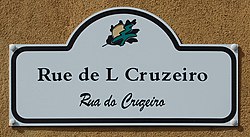
Portuguese is the official language of Portugal.[349] Mirandese is also recognised as a co-official regional language in some municipalities of northeastern Portugal; it is part of the Astur-Leonese group of languages.[350] An estimated 6,000 to 7,000 Mirandese speakers has been documented for Portugal.[351] Furthermore, a particular dialect known as Barranquenho, spoken in Barrancos, is also officially recognised and protected in Portugal since 2021.[352] Minderico, a sociolect of the Portuguese language, is spoken by around 500 people in the town of Minde.[353]
According to the EF English Proficiency Index, as of 2025, Portugal has a very high proficiency level in English, having the sixth-highest proficiency score in the world.[354]
Education
edit
The educational system is divided into preschool (for those under age six), basic education (nine years, in three stages, compulsory), secondary education (three years, compulsory since 2010), and higher education (subdivided into university and polytechnic education). Universities are usually organised into faculties. Institutes and schools are also common designations for autonomous subdivisions of Portuguese higher education institutions.[355]
Portuguese universities have existed since 1290. The University of Coimbra, the oldest Portuguese university,[356] was first established in Lisbon before moving to Coimbra. Historically, within the scope of the Portuguese Empire, the Portuguese founded the oldest engineering school in the Americas (the Real Academia de Artilharia, Fortificação e Desenho of Rio de Janeiro) in 1792, as well as the oldest medical college in Asia (the Escola Médico-Cirúrgica of Goa) in 1842. Presently, the largest university in Portugal is the University of Lisbon.[357]
The Bologna process has been adopted by Portuguese universities and polytechnical institutes in 2006. Higher education in state-run educational establishments is provided on a competitive basis, a system of numerus clausus is enforced through a national database on student admissions. However, every higher education institution offers also a number of additional vacant places through other admission processes for sportsmen, mature applicants (over 23 years old), international students, foreign students from the Lusosphere, degree owners from other institutions, students from other institutions (academic transfer), former students (readmission), and course change, which are subject to specific standards and regulations set by each institution or course department.[358]
Health
edit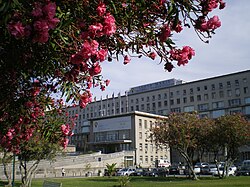
In 2025, Portugal's healthcare system was ranked as the 23rd best in the world.[360] The health system is characterised by three coexisting systems: the National Health Service (SNS), special social health insurance schemes for certain professions (health subsystems), and voluntary private health insurance. The SNS provides universal coverage. In addition, about 55% of the population is covered by the health subsystems,[361] 43% by private insurance schemes, and another 12% by mutual funds.[362][363]
Similarly to other Western European countries, most Portuguese die from noncommunicable diseases.[364] Portugal's infant mortality rate stood at 2,25 deaths per 1,000 live births as of 2024.[365] A Eurostat opinion-poll in 2023 found that 55.4% of adults rated their health as good or very good, the third lowest such rating in the European Union.[366] The largest university hospital in the country is Hospital de Santa Maria, in Lisbon.[367]
Despite its economic development, the average Portuguese height is among the shortest in Europe since around 1890.[368] A driving factor was modest real wage growth, given late industrialisation and economic growth compared to the European core, and delayed human capital formation.[369]
Culture
edit
Portugal has developed a specific culture due to, initially before its existence, the influence from various civilisations that have crossed Europe, especially the Mediterranean,[371] and later, during the period of Portugal's engagement in the Age of Discovery, which introduced cultural elements from outside of the European continent.[372]
Portugal is well known for its heritage and architecture, sacred sites, summer festivals, poetry, its music (especially the fado), and cuisine (especially its wine).[373] As of 2026, UNESCO inscribed 17 properties in Portugal on the World Heritage List.[374] There are 13 public holidays in Portugal;[375] 10 June is the national day of Portugal, celebrated as the Dia de Portugal, de Camões e das Comunidades Portuguesas (Portugal, Camões, and Portuguese Communities Day).[376]
Art and architecture
edit

The history of visual art in Portugal dates back into the Paleolithic. The earliest evidence showing an attempt at depicting motion was found at the Prehistoric Rock Art Sites in the Côa Valley and Siega Verde.[379]
Over time, foreign and native influences, together with developments in manufacturing, have led to the creation and development of a number of crafts that are typical of Portugal, the most notable of which being the azulejo, talha dourada, and Portuguese pavement,[380][381][382] which formed the basis of some Portuguese architectural styles, such as the Pombaline style. Historically, religion, specifically Christianity, had an influential role in Portuguese art, as it was a recurrent theme widely employed in many art forms, such as in painting.[383]
Throughout the country's history, artwork in Portugal was typically done by local artists who, depending on location, followed different variations in style, giving Portugal a diverse array of artistic styles throughout the country, an example of this being the thatch houses of Santana, in Madeira.[384]
Literature
edit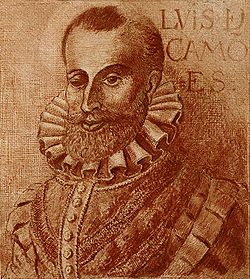
Portugal has a literary tradition that predates the Portuguese language going back into the early 13th century.[385] Portuguese literature developed through song as well as the written page known as cantigas.[386] The cantigas drew practitioners from all social ranging from King Denis I to Martin Codax who was a minstrel.[387] The earliest work of Portugal's literature is the Ora faz ost’o senhor de Navarra, a cantiga de escárnio e maldizer written in Galician–Portuguese by João Soares de Paiva at around the year 1200.[388]
Portuguese literature developed under the influence of both European geopolitical developments and broader European literary traditions. The Hundred Years' War helped foster the development of Portuguese chronicles by Fernão Lopes, which constitute a valuable record of some of Europe’s earliest encounters with peoples beyond the continent.[389] European medieval chivalric literature, together with didactic religious literature transmitted through adaptations and partial translations, contributed to the development of Portuguese poetry in the work of Pedro Afonso, Count of Barcelos, particularly in his Book of Lineages.[387] Portuguese literature flourished during the Age of Discovery, its most notable example being Os Lusíadas by Luís Vaz de Camões.[390] Modern Portuguese literature took shape through the work of Almeida Garrett, one of the early founders of Portuguese Romanticism.[391] Portugal has one Nobel Prize–winning author—José Saramago (1998).[392]
Music
edit
The history of music in Portugal dates back to the 6th century. The earliest record of a singer in Portugal is from the year 525.[394]
Portuguese music initially consisted mostly of liturgical music and troubadourism.[395] Over time, new folk traditions together with the influence of foreign cultures and the creation of new instruments, especially guitars, led to a diverse variety of regional folk music such as the fado, the Coimbra fado, Desgarrada, and Madeira's folk music.[396][397] Popular music in Portugal after the Carnation Revolution has been heavily influenced by American trends, which has led into the evolution of Hip-hop tuga and popularization of Rock.[398][399]
Historically, Portugal has been a country of emigration which has heavily influenced the Pimba in the 20th century and led to the introduction of Portuguese music into other cultures such as the ukelele in Hawaii in the 19th century.[400][401]
Holidays
edit
Officially, Portugal has 13 national, government-recognised holidays. Public holidays in Portugal are regulated by the Labour Code.[402] Besides the national holidays, there are 3 regional holidays celebrated only in Madeira and the Azores and 2 facultative holidays. The national holidays in Portugal are: New Year's Day on January 1, Good Friday on a Friday between March 20 and April 23, Easter on a Sunday between March 22 and April 25, Freedom Day on April 25, International Workers' Day on May 1, Feast of Corpus Christi on a Thursday between May 21 and June 24, Portugal Day on June 10, Assumption Day on August 15, Implementation of the Republic Day on October 5, All Saints' Day on November 1, Restoration of the Independence Day on December 1, Feast of the Immaculate Conception on December 8, and Christmas Day on December 25.[402] The regional holidays in Madeira are Madeira Day on July 1, and 1st Octave Day on December 26.[403][404] The Azores celebrate Azores Day on a Monday between May 11 and June 14.[405] Optional holidays in Portugal are the Entrudo and one municipal holiday allowed per concelho.[406]
Cuisine
edit
Portuguese cuisine is influenced by both the Mediterranean and Atlantic diets.[407] Seafood, brassicas, potatoes, bread, dairy, and olive oil are traditional staples.[408] Bacalhau has such broad presence in Portugal that is considered a national dish, along with pastel de nata.[409][410][411] Traditional Portuguese sweets are known as conventual sweets. Large quantities of sugar and eggs are used.[412]
Popular Portuguese beverages include its wines, a craft that was introduced in Portugal by the Romans, and of which are such notable examples as Port and Madeira.[413] Beer has been brewed in Portugal beginning in Lusitania.[414] Tea has been produced on São Miguel Island since the 19th century.[415]
Sport
edit
Football is the most popular sport in Portugal. There are several football competitions ranging from local amateur to world-class professional level. All-time greats Eusébio, Luís Figo, and Cristiano Ronaldo are symbols of Portuguese football history.[416][417] The Portugal national football team has won one UEFA European Championship title: the UEFA Euro 2016, with a 1–0 victory in the final over France, the tournament hosts.[418] In addition, Portugal finished first in the UEFA Nations League in 2018–19 and 2024–25,[419][420] second in the Euro 2004,[421] third in the 1966 FIFA World Cup,[422] and fourth in the 2006 FIFA World Cup.[423] The country's top-level football league, the Primeira Liga, ranks 6th in the UEFA ranking as of 2026.[424]
Road cycling, especially Volta a Portugal, is a popular sport.[425] In motorsport, Portugal is noted for the Rally of Portugal,[426] and the Estoril and Algarve Circuits, as well as the revived Porto Street Circuit, which held a stage of the WTCC every two years, between 2007 and 2013.[427]
Portugal has three major water sports: swimming, water polo, and surfing.[428] Annually, the country hosts one of the stages of the World Surf League men's and women's Championship Tour, and the MEO Rip Curl Pro Portugal at the Supertubos in Peniche.[429] Northern Portugal has its own original martial art, Jogo do Pau, in which fighters use staffs to confront one or several opponents.[430]
See also
edit

Notes
edit- ^ The modern day concept of sovereignty or declaration of independence did not exist at the time, nor was established any notion of its recognition. Portugal was recognised as a kingdom with its own King in 1179 by the Pope who was the ultimate authority in Europe at the time. The way Europe was seen at the time was as a Res publica christiana.[2]
- ^ Portuguese Constitution adopted in 1976 with several subsequent minor revisions, between 1982 and 2005
- ^ The territory of Portugal includes its land, internal waters, and territorial sea.[4]
- ^ The Escudo before 2002
- ^ In mainland Portugal and Madeira
- ^ Only in Azores
- ^ European Portuguese pronunciation: [puɾtuˈɣal] ⓘ
- ^ Portuguese: República Portuguesa, IPA: [ʁɛˈpuβlikɐ puɾtuˈgezɐ]
- ^ One theory proposes Cale is a derivation of the Celtic word for 'port'.[16] Another is that Cala was a Celtic goddess, or that it may have come from Portus Gallus, 'port of the Gauls'.[17]
- ^ The earliest human trace found in Portugal is the 400,000-year-old Aroeira 3, a Homo heidelbergensis skull discovered in the Cave of Aroeira in 2014.[22]
- ^ Ater 929, the Caliphate of Córdoba[42][43]
- ^ The Portuguese devised the volta do mar navigational technique, which enabled safe roundtrip voyages in open sea; this was a major turning point in world history, as it meant that voyagers could now return from long distant places, marking a leap from coastal hugging to deep-sea, long-range navigation, which consequently contributed to further advancements in nautical science and cartography, without that discovery European colonial empires could not have been established.[77]
- ^ It has been conjectured that the Canadian town of Portugal Cove-St. Philip's was founded by the Portuguese however there little evidence for the claim.[82]
- ^ Although some scholars claim that Portugal may have discovered Australia in 1521,[86][87][88] it lacks generally accepted evidence.[89][90]
- ^ Portugal continued to be independent during the Iberian Union.[97]
- ^ Most estimates place the number of Portuguese migrants to Colonial Brazil during the gold rush of the 18th century at 600,000.[103]
- ^ It had an estimated magnitude between 7.7 and 9.0, with casualties ranging from 12,000 to 50,000.[106]
- ^ The territory of Portugal includes its land, internal waters, and territorial sea.[140]
- ^ The highest peak in mainland Portugal is Torre in Serra da Estrela, at an elevation of 1,993 metres (6,539 ft).[142]
- ^ Other parties include the Liberal Initiative, the Left Bloc, the Unitary Democratic Coalition (Portuguese Communist Party and Ecologist Party "The Greens"), LIVRE, the CDS – People's Party and the People Animals Nature.[195]
- ^ Namely in Afghanistan, Iraq, Lebanon, Bosnia and Herzegovina, Kosovo, Mali, Central African Republic, Somalia, Mozambique and East Timor.[228]
- ^ In 2003, Portugal added an anti-discrimination employment law on the basis of sexual orientation.[250]
- ^ In 2004, sexual orientation was added to the Constitution as part of the protected from discrimination characteristics.[251]
- ^ In 2010, Portugal became the sixth country in Europe and eighth in the world to legalise same-sex marriage at the national level.[252]
- ^ LGBT adoption was legalized in 2016[253] as has female same-sex couple access to medically assisted reproduction.[254]
- ^ In 2017 the Law of Gender Identity,[255] simplified the legal process of gender and name change for transgender people, making it easier for minors to change their sex marker in legal documents.[256]
- ^ In 2018, the right to gender identity and gender expression self-determination became protected, intersex minors became protected by law from unnecessary medical procedures "until the minor gender identity manifests" and the right of protection from discrimination on the basis of sex characteristics became protected by the same law.[257]
- ^ In 2014, Portugal was elected The Best European Country by USA Today.[306]
- ^ In 2017, Portugal was voted Europe's Leading Destination by the World Travel Awards.[307]
- ^ In 2017, Portugal was voted World's Leading Destination by the World Travel Awards[308]
- ^ Three international airports are located on the mainland – Lisbon (the busiest in the country), Porto, and Faro airports – with Funchal airport on Madeira, and Ponta Delgada airport in the Azores.[315]
- ^ Religious freedom was also reaffirmed by the 1940 Concordata (later amended in 1971) between Portugal and the Holy See and the 2001 Religious Freedom Act.[343][344]
- ^ Chinese medical science is well known in Portugal and is widely accepted by the people. Portugal is the first European Union country that specifically provided legislation for acupuncture and Chinese medical science.[347]
References
edit- ^ "Constituição da República Portuguesa". Assembly of the Republic. Retrieved 11 December 2025.
- ^ Almeida, João Marques de (2003). "The Peace of Westphalia and the Idea of Respublica Christiana". Lisbon: Instituto Português de Relações Internacionais. Archived from the original on 6 June 2010. Retrieved 28 February 2026.
- ^ "Surface water and surface water change". Organisation for Economic Co-operation and Development (OECD). Archived from the original on 24 March 2021. Retrieved 11 October 2020.
- ^ Diário da República. "Lexionário - Mar territorial" [Lexicon — Territorial Sea]. Diário da República Eletrónico (in European Portuguese). Lisbon: Imprensa Nacional – Casa da Moeda, S. A. Retrieved 22 February 2026.
- ^ a b "Carta Administrativa Oficial de Portugal" [Official Administrative Map of Portugal]. Direção-Geral do Território (in European Portuguese). Lisbon. 18 February 2026. Archived from the original on 21 February 2026. Retrieved 22 February 2026.
- ^ a b c "Maritime Zones under Portuguese Sovereignty and / or Jurisdiction - DGRM". DGRM. Lisbon: Directorate-General for Natural Resources, Safety and Maritime Services. Archived from the original on 15 May 2025. Retrieved 22 February 2026.
- ^ "População residente aumenta, mas envelhecimento continua a agravar-se - 2024". INE. 18 June 2025. Retrieved 18 June 2025.
- ^ "Censos 2021 - Principais tendências ocorridas em Portugal na última década". Statistics Portugal - Web Portal. 23 November 2022. Archived from the original on 23 November 2022. Retrieved 23 November 2022.
- ^ a b c d "World Economic Outlook Database (April 2026 Edition)". www.imf.org. International Monetary Fund. 14 April 2026.
- ^ "Gini coefficient of equivalised disposable income – EU-SILC survey". ec.europa.eu. Eurostat. Retrieved 22 April 2025.
- ^ "Human Development Report 2025" (PDF). United Nations Development Programme. 6 May 2025. Archived (PDF) from the original on 6 May 2025. Retrieved 6 May 2025.
- ^ Guimarães, Paula; Martins, Susana (March 2005). "Guia de estilo" [Style guide] (PDF). Eurocid - Informação europeia ao cidadão (in European Portuguese). Centro de Informação Europeia Jacques Delors. p. 41. Archived (PDF) from the original on 16 January 2026. Retrieved 6 December 2025.
- ^ "List of left- & right-driving countries". WorldStandards.
- ^ Rooms, Adrian (1 August 1997). Placenames of the world origins and meanings of the names for over 5000 natural features, countries, capitals, territories, cities, and historic sites. McFarland, Jefferson, NC. p. 290. ISBN 978-0786401727. LCCN 96038011. OCLC 1036800824. Retrieved 9 April 2026 – via Wayback Machine.
- ^ Magarinhos, Luís (15 April 2011). "Origem e significado dos nomes de Portugal e Galiza" [Origin and meaning of the names of Portugal and Galicia] (PDF). Actas do III Congreso Internacional sobre a cultura celta: Os celtas da Europa atlántica. III Congresso Internacional sobre a Cultura Celta: Os Celtas da Europa Atlântica (in European Portuguese). Narón, Galicia. pp. 537–546. Archived from the original on 5 March 2026. Retrieved 28 February 2026.
- ^ Pezron, Paul (2000). Celtic Linguistics. Taylor & Francis. ISBN 978-0-415-20479-8. Archived from the original on 10 October 2023. Retrieved 22 August 2010.
- ^ "Manuel géographique et statistique de l'Espagne et du Portugal ..." Buisson. 11 April 2018. Archived from the original on 2 February 2024. Retrieved 17 November 2020 – via Google Books.
- ^ Magarinhos, Luís (15 April 2011). "Origem e significado dos nomes de Portugal e Galiza" [Origin and meaning of the names of Portugal and Galicia] (PDF). Actas do III Congreso Internacional sobre a cultura celta: Os celtas da Europa atlántica. III Congresso Internacional sobre a Cultura Celta: Os Celtas da Europa Atlântica (in European Portuguese). Narón, Galicia. p. 543. Archived from the original on 5 March 2026. Retrieved 28 February 2026.
- ^ a b Silva, António Manuel S. P. (2010). "Ocupação da época romana na cidade do Porto. Ponto de situação e perspectivas de pesquisa" [Roman-period occupation in the city of Porto: current state of knowledge and research perspectives] (PDF). Gallaecia: revista de arqueoloxía e antigüidade (in European Portuguese). 29. Santiago de Compostela: Universidade de Santiago de Compostela: 213–262. ISSN 0211-8653. Retrieved 26 April 2026.
- ^ "Portugallia: description de Portugal". Universidade de Coimbra. Archived from the original on 19 February 2026. Retrieved 7 December 2025.
- ^ "Portugalliae que olim Lusitania nouissima et exactissima descriptio". Universidade de Coimbra. Archived from the original on 3 February 2026. Retrieved 7 December 2025.
- ^ Daura, Joan; Sanz, Montserrat; Arsuaga, Juan Luis; Hoffmann, Dirk L.; Quam, Rolf M.; Ortega, María Cruz; Santos, Elena; Gómez, Sandra; Rubio, Angel (13 March 2017). "New Middle Pleistocene hominin cranium from Gruta da Aroeira (Portugal)". Proceedings of the National Academy of Sciences (Research article). 114 (13). United States National Academy of Sciences: 3397–3402. Bibcode:2017PNAS..114.3397D. doi:10.1073/pnas.1619040114. PMC 5380066. PMID 28289213.
- ^ Zilhão, João; Cardoso, João Luís; Pike, Alistair W. G.; Weninger, Bernhard (2011). "Gruta Nova da Columbeira (Bombarral, Portugal): Site stratigraphy, age of the Mousterian sequence, and implications for the timing of Neanderthal extinction in Iberia: Gruta Nova da Columbeira (Bombarral, Portugal): Fundplatz-Stratigraphie, Alter der Moustérien-Schichtenfolge, und Schlussfolgerungen für die Chronologie des Aussterbens der Neanderthaler auf der Iberischen Halbinsel". Quartär – Internationales Jahrbuch zur Erforschung des Eiszeitalters und der Steinzeit. 58. Hugo Obermaier Gesellschaft für Erforschung des Eiszeitalters und der Steinzeit e.V. (published 20 October 2021): 93–112. doi:10.7485/QU58_05. ISSN 2749-9995. Archived from the original on 8 January 2024. Retrieved 18 April 2026.
- ^ Disney, Anthony R. (June 2009). A History of Portugal and the Portuguese Empire (PDF). Vol. 1: Portugal. Cambridge University Press. p. 5. ISBN 978-0-511-65027-7. Archived (PDF) from the original on 16 November 2025. Retrieved 18 April 2026 – via University of Lisbon.
- ^ Zilhão, João (13 November 2001). "Radiocarbon evidence for maritime pioneer colonization at the origins of farming in west Mediterranean Europe". Proceedings of the National Academy of Sciences (Research article). 98 (24). United States National Academy of Sciences: 14180–14185. Bibcode:2001PNAS...9814180Z. doi:10.1073/pnas.241522898. PMC 61188. PMID 11707599.
- ^ Luján, Eugenio R. (1 May 2020). "El sudoeste de la Península Ibérica" [The Southwest of the Iberian peninsula]. Palaeohispanica. Revista sobre lenguas y culturas de la Hispania antigua (in Spanish) (20). Institución "Fernando el Católico": 561–589. doi:10.36707/palaeohispanica.v0i20.394. ISSN 1578-5386. OCLC 50139643. Retrieved 18 April 2026.
- ^ Sims-Williams, Patrick (August 2020). "An Alternative to 'Celtic from the East' and 'Celtic from the West'" (PDF). Cambridge Archaeological Journal (Research Article). 30 (3). Cambridge University Press: 511–529. doi:10.1017/S0959774320000098. Archived (PDF) from the original on 14 February 2025.
- ^ Richardson, John S. (7 September 2009). "Chapter 1: Spain and Roman imperialism". Hispaniae. Cambridge University Press. pp. 1–10. doi:10.1017/CBO9780511518591. ISBN 9780511518591. Archived from the original on 18 April 2025. Retrieved 18 April 2026.
- ^ Zimmermann, Klaus (2015) [2011]. "Roman Strategy and Aims in the Second Punic War". In Hoyos, Dexter (ed.). A Companion to the Punic Wars. Oxford: Wiley-Blackwell. p. 293. ISBN 978-1-405-17600-2.
- ^ Miles, Richard (2011). Carthage Must be Destroyed. London: Penguin. p. 303. ISBN 978-0-14-101809-6.
- ^ Keay, Simon J. (1988). Roman Spain. University of California Press. p. 25. ISBN 0520063805. LCCN 87035722. OCLC 17300435.
- ^ Livermore, H. V. (1947). A History Of Portugal. Cambridge, United Kingdom: Cambridge University Press. pp. 5–9. Retrieved 16 April 2026 – via Wayback Machine.
- ^ Disney, Anthony R. (June 2009). A History of Portugal and the Portuguese Empire (PDF). Vol. 1: Portugal. Cambridge University Press. pp. 34–37. ISBN 978-0-511-65027-7. Archived (PDF) from the original on 16 November 2025. Retrieved 18 April 2026 – via University of Lisbon.
- ^ Sánchez, Fernando López (2015). "The Suevic Kingdom: Why Gallaecia?". Culture and Society in Medieval Galicia. The Medieval and Early Modern Iberian World. Vol. 58. Brill. pp. 176–209. doi:10.1163/9789004288607_006. ISBN 978-90-04-28860-7.
- ^ Lenski, Noel (27 January 2022). "Chapter 12: Slavery among the Visigoths". In de Wet, Chris L.; Kahlos, Maijastina; Vuolanto, Ville (eds.). Slavery in the Late Antique World, 150 – 700 CE. Cambridge: Cambridge University Press. pp. 251–280. doi:10.1017/9781108568159.014. ISBN 9781108568159.
- ^ Collins, Roger (29 June 2000). "Chapter 2: Visigothic Spain 409–711". In Carr, Raymond (ed.). Spain: A History. Oxford: Oxford University Press. pp. 39–62. doi:10.1093/oso/9780198206194.003.0003. ISBN 9781383010701.
- ^ Lapidus, Ira Marvin (2002). A history of Islamic societies (2nd ed.). Cambridge: Cambridge University Press. p. 310. ISBN 9780521770569. Retrieved 19 April 2026 – via Wayback Machine.
- ^ Leitão, André de Oliveira (2008). "Do Garb al-Ândalus ao «segundo reino» da «Coroa de Portugal»: território, política e identidade" [From Ġarb al-Ândalus to the 'second kingdom' of the 'Crown of Portugal': territory, politics and identity]. Clio (Journal article) (in European Portuguese). 16/17. Lisbon: University of Lisbon Centre for History: 69–104. hdl:10451/38199. ISSN 0870-4104. Retrieved 18 April 2026.
- ^ Porter, J. M. B. (2010). Rogers, Clifford J. (ed.). The Oxford encyclopedia of medieval warfare and military technology. Vol. 1. New York: Oxford University Press. p. 13. ISBN 978-0-19-533403-6. LCCN 2009042630. OCLC 437300064.
- ^ Donner, Fred M. (1999). "Chapter 1: Muhammad and the Caliphate". In Esposito, John L. (ed.). The Oxford History of Islam. New York: Oxford University Press. p. 21. ISBN 978-0-19-988041-6. Retrieved 18 April 2026 – via Wayback Machine.
- ^ Wolf, Kenneth Baxter (2011). Conquerors and Chroniclers of Early Medieval Spain. Translated Texts for Historians. Vol. 9 (2nd ed.). Liverpool: Liverpool University Press. p. 133. ISBN 978-0-85323-554-5. OCLC 783942572.
- ^ Barton, Simon (2004). A History of Spain (1st ed.). Palgrave Macmillan. p. 38. ISBN 978-0-333-63257-4.
- ^ Reilly, Bernard F. (1993). Written at New York, NY, USA. The Medieval Spains. Cambridge Medieval Textbooks. Cambridge: Cambridge University Press. p. 84. ISBN 978-0-521-39436-9. LCCN 92023379.
- ^ Hughes, Aaron W. (2013). Muslim Identities: An Introduction to Islam. Columbia University Press. p. 108. ISBN 978-0-231-53192-4. OCLC 833763900.
- ^ Barton, Simon (2004). A History of Spain. Palgrave Macmillan. p. 57. ISBN 978-0-333-63257-4.
- ^ Chejne, Anwar G. (1974). Muslim Spain: Its History and Culture. Minneapolis: The University of Minnesota Press. pp. 43–49. ISBN 978-0-8166-0688-7.
- ^ Disney, Anthony R. (June 2009). A History of Portugal and the Portuguese Empire (PDF). Vol. 1: Portugal. Cambridge University Press. pp. 55–58. ISBN 978-0-511-65027-7. Archived (PDF) from the original on 16 November 2025. Retrieved 18 April 2026 – via University of Lisbon.
- ^ Bennison, Amira K. (August 2016). The Almoravid and Almohad Empires. The Edinburgh History of the Islamic Empires. Edinburgh: Edinburgh University Press. p. 2. ISBN 9780748646821.
- ^ Scheen, Rolf (1996). "Vikings raids on the Spanish Peninsula". Militaria. Revista de cultura militar (8). Madrid: Complutense University of Madrid: 67–88. ISSN 1988-3315. Archived from the original on 21 January 2025. Retrieved 18 April 2026.
- ^ Christys, Ann (27 August 2015). Vikings in the south : voyages to Iberia and the Mediterranean. Studies in Early Medieval History (1st ed.). London: Bloomsbury Academic. p. 97. doi:10.5040/9781474213790. ISBN 978-1-4742-1379-0. OCLC 906575918.
- ^ Marques, André Evangelista; Barroca, Mário Jorge; Amaral, Luís Carlos (December 2018). "Capítulo 8: As incursões vikings no Norte de Portugal" [Chapter 8: Viking incursions in northern Portugal] (PDF). Mil Anos da Incursão Normanda ao Castelo de Vermoim [Thousand Years of the Norman Raid on Vermoim Castle] (PDF) (in European Portuguese). Porto: CITCEM – Transdisciplinary Research Centre for Culture, Space and Memory. pp. 143–184. doi:10.21747/9789898351975/mil. hdl:10362/113163. ISBN 978-989-8351-97-5. Archived (PDF) from the original on 12 February 2026. Retrieved 19 April 2026.
- ^ Caraccioli, Mauro José (2021). "1: Narratives of Conquest and the Conquest of Narrative". Writing the New World. The Politics of Natural History in the Early Spanish Empire. University Press of Florida. pp. 14–38. ISBN 978-1-68340-170-4. JSTOR j.ctv1gt9419.6. Retrieved 15 April 2026.
La Reconquista: a 700-year military and cultural campaign against the Moorish Caliphates of Southern Iberia that culminated in the joint reign of Ferdinand of Aragon and Isabella of Castile as Reyes Católicos.
- ^ Williams, Mark (2004). The Story of Spain. San Mateo, CA: Golden Era Books. p. 60. ISBN 978-0-97069-692-2.
- ^ Livermore (1969), pp. 32–33
- ^ de Almeida Fernandes, A. (1997). "O Conde Vímara Peres" [The Count Vímara Peres]. Paróquias suevas e dioceses visigóticas [Suebi parishes and Visigothic dioceses] (in European Portuguese). ROCHA. pp. 195–219. ISBN 972-9474-11-7. Archived from the original on 24 June 2021. Retrieved 6 July 2020 – via academia.edu.
- ^ Livermore, Harold (6 December 2024). The Origins of Spain and Portugal. Taylor & Francis. doi:10.4324/9781003563938-19. ISBN 978-1-040-26004-3.
- ^ Livermore, H. V. (2004). Portugal: A Traveller's History. Boydell Press. p. 127. ISBN 978-1-84383-063-4.
- ^ Martínez Lema, Paulo (28 September 2018). ""Ad populandum": toponímia e repovoamento no sul da Galiza alto-medieval" [“Ad populandum”: Toponymy and repopulation in early medieval southern Galicia]. Revista de Filología Románica (in European Portuguese). 35. Madrid: Complutense University of Madrid: 141–165. doi:10.5209/RFRM.61690. ISSN 0212-999X. Archived from the original on 6 February 2024. Retrieved 20 April 2026.
- ^ Collins, Roger (1983). Early Medieval Spain. New York: St. Martin's Press. p. 238. ISBN 0-312-22464-8.
- ^ Costa, Avelino de Jesus da (1956). "A restauração da diocese de Braga em 1070" [The restoration of the Diocese of Braga in 1070]. Lusitania Sacra (in European Portuguese) (1). Lisbon: Centre of Religious History Studies at Universidade Católica Portuguesa: 17–28. doi:10.34632/lusitaniasacra.1956.8221. ISSN 0076-1508. Archived from the original on 13 September 2024. Retrieved 20 April 2026.
- ^ Carvalho Correia, Francisco (2008). O Mosteiro de Santo Tirso de 978 a 1588 : a silhueta de uma entidade projectada no chao de uma história milenária [The Monastery of Santo Tirso from 978 to 1588: the silhouette of an entity cast upon the ground of a millenary history] (in European Portuguese). Vol. 1. Santiago de Compostela: Universidade de Santiago de Compostela: Servizo de Publicacións e Intercambio Científico. p. 202. hdl:10347/2416. ISBN 978-84-9887-038-1. Archived from the original on 20 April 2026. Retrieved 20 April 2026.
{{cite book}}: CS1 maint: publisher location (link) - ^ Payne, Stanley G. (1973). "Chapter Six: The Emergence of Portugal". A history of Spain and Portugal. Vol. 1. Madison, Wisconsin: University of Wisconsin Press. p. 116. ISBN 0-299-06270-8. Retrieved 20 April 2026 – via Wayback Machine.
- ^ Payne, Stanley G. (1973). "Chapter Six: The Emergence of Portugal". A history of Spain and Portugal. Vol. 1. Madison, Wisconsin: University of Wisconsin Press. p. 117. ISBN 0-299-06270-8. Retrieved 20 April 2026 – via Wayback Machine.
- ^ Brian Jenkins, Spyros A. Sofos, Nation and identity in contemporary Europe Archived 5 April 2023 at the Wayback Machine, p. 145, Routledge, 1996, ISBN 0-415-12313-5
- ^ Wilson, Jonathan (18 December 2019). "'Neither age nor sex sparing': the Alvor massacre 1189, an anomaly in the Portuguese Reconquista?". Journal of Medieval Iberian Studies. 12 (2): 199–229. doi:10.1080/17546559.2019.1704043.
- ^ Martins, José António (16 February 2017). "O Reino do Algarve de pleno direito" [The Kingdom of the Algarve in its own right] (PDF) (in European Portuguese). CCDR-Alg. Archived (PDF) from the original on 31 January 2026. Retrieved 10 April 2026.
- ^ García, Eusebio Medina (2006). "Orígenes históricos y ambigüedad de la frontera hispano-lusa (La Raya)" [Historical origins and ambiguity of the Hispano-Portuguese border (La Raya)] (PDF). Revista de estudios extremeños (in Spanish). 62 (2). Badajoz: Centro de Estudios Extremeños: 713–723. ISSN 0210-2854. Archived from the original (PDF) on 6 February 2026. Retrieved 20 April 2026.
- ^ Oliveira da Silva, André Filipe (2021). A Peste Negra em Portugal Os casos do Entre-Douro-e-Minho e do Entre-Tejo-e-Odiana [The Black Death in Portugal: the cases of Entre-Douro-e-Minho and Entre-Tejo-e-Odiana] (PDF) (Thesis) (in European Portuguese). Porto: University of Porto. p. 678. hdl:10216/137710. Archived (PDF) from the original on 31 May 2023. Retrieved 20 April 2026.
- ^ Winslett, Matthew (August 2008). The Nadir of Alliance: The British Ultimatum of 1890 and Its Place in Anglo-Portuguese Relations, 1147–1945 (Master of arts in history thesis). Supervising Professor: Douglas Richmond. The University of Texas at Arlington. p. 14. Archived from the original on 12 April 2025. Retrieved 20 April 2026.
This treaty has been the cornerstone of both nations' relations with each other ever since. This is particularly true in regards to the Portuguese. The various treaties that follow it build upon the promises made at Windsor and never abrogate its terms, especially in the case of guarantees of territorial defense and military aid.
- ^ Fergusson, George; Trowbridge, Benjamin (9 May 2016). "History's Unparalleled Alliance: the Anglo-Portuguese Treaty of Windsor, 9th May 1386". History of Government. gov.uk. Archived from the original on 7 June 2024. Retrieved 20 April 2026.
- ^ Grose, Clyde L. (August 1930). "The Anglo-Portuguese Marriage of 1662". The Hispanic American Historical Review. 10 (3). Duke University Press: 313–352. doi:10.2307/2506378. ISSN 0018-2168. JSTOR 2506378. Archived from the original on 11 June 2020.
- ^ Diffie, Bailey Wallys (1960). "Chapter Eight: An Old Road and a New". Prelude to Empire: Portugal Overseas Before Henry the Navigator. Lincoln, Nebraska: University of Nebraska Press. pp. 73–75. ISBN 978-0-8032-5049-9. LCCN 60-14301. Retrieved 20 April 2026.
{{cite book}}: ISBN / Date incompatibility (help) - ^ Forgeng, Jeffrey L. (5 July 2016). The Book of Horsemanship by Duarte I of Portugal. Armour and Weapons. Boydell & Brewer. pp. 47–154. ISBN 978-1-78204-628-8. OCLC 961824873 – via Cambridge Core.
- ^ Santiago de Carvalho, Mário (2013). "Uma modernidade perdida. Da melancolia à alegria racional na antropologia do homem superior, segundo D. Duarte" [A lost modernity. From melancholy to rational joy in the anthropology of superior man, according to D. Duarte]. Revista filosófica de Coimbra (in Spanish). 22 (43): 187–206. Archived from the original on 27 November 2024. Retrieved 17 April 2026.
- ^ a b c Russell-Wood, A. J. R. (1998). "Chapter 1: Portugal and the 'Age of Discoveries'". The Portuguese Empire, 1415-1808: A World on the Move. Johns Hopkins University Press. pp. 8–11. doi:10.1353/book.77743. ISBN 978-1-4214-4120-7.
- ^ Casimiro, Tânia Manuel (2020). "Globalization, trade, and material culture: Portugal's role in the making of a multicultural Europe (1415–1806)". Post-Medieval Archaeology. 54 (1): 1–17. doi:10.1080/00794236.2020.1750239. hdl:10362/98047.
In the Early Modern age, Portugal was among the first European countries to engage in overseas trade and colonial ventures.
- ^ Dartnell, Lewis (14 May 2019). Origins: How Earth's History Shaped Human History. Basic Books. pp. 218–222. ISBN 978-1-5416-1789-6. OCLC 1101101039.
- ^ Edmonds, Richard Louis (29 August 2002). "China and Europe since 1978: An Introduction". China and Europe Since 1978: A European Perspective. The China Quarterly Special Issues. New York: Cambridge University Press. p. 1. ISBN 9780521524032.
- ^ Newitt, Malyn (2004). A History of Portuguese Overseas Expansion 1400–1668. Routledge. p. 20. ISBN 978-1134553044.
- ^ Axelson, Eric; Boxer, C. R. (June 1970). "The Portuguese Seaborne Empire 1415-1825". The Geographical Journal. 136 (2). The Royal Geographical Society: 296–298. Bibcode:1970GeogJ.136..296A. doi:10.2307/1796339. eISSN 1475-4959. ISSN 0016-7398. JSTOR 1796339.
- ^ Vigneras, L.-A. (1979) [1966]. "Corte-Real, Gaspar". In Brown, George Williams (ed.). Dictionary of Canadian Biography. Vol. I (1000–1700) (online ed.). University of Toronto Press. Archived from the original on 15 February 2026. Retrieved 20 April 2026.
- ^ Poole, Cyrill F.; Cuff, Robert, eds. (1993). Encyclopedia of Newfoundland and Labrador, volume 4 [Extract: letter P]. Vol. 4. St. John's, Newfoundland and Labrador: Harry Cuff Publications Ltd. pp. 408–409. Archived from the original on 26 October 2025. Retrieved 20 April 2026.
- ^ Vianna, Hélio (1994). História do Brasil: período colonial, monarquia e república (in Brazilian Portuguese) (15th ed.). São Paulo: Melhoramentos. p. 44. ISBN 85-06-01999-0. Retrieved 21 April 2026 – via Wayback Machine.
- ^ Bueno, Eduardo (1998). A viagem do descobrimento: a verdadeira história da expedição de Cabral (in Brazilian Portuguese). Rio de Janeiro: Objetiva. p. 45. ISBN 978-85-7302-202-5.
- ^ Bueno, Eduardo (1998). A viagem do descobrimento: a verdadeira história da expedição de Cabral (in Brazilian Portuguese). Rio de Janeiro: Objetiva. pp. 106–108. ISBN 978-85-7302-202-5.
- ^ Tremlett, Giles (22 March 2007). "Another nail in Cook's coffin as map suggests he was pipped by Portugal". The Guardian. Archived from the original on 17 January 2014. Retrieved 31 January 2014.
- ^ Debusmann, Bernd (15 January 2014). "Kangaroo in 400-year-old manuscript could change Australian history". The Daily Telegraph. London. Archived from the original on 10 January 2022. Retrieved 31 January 2014.
- ^ Perry, Michael (21 March 2007). "Map proves Portuguese discovered Australia: new book". Reuters. Archived from the original on 2 January 2014. Retrieved 31 January 2014.
- ^ Tweeddale, Alistair (2000). "More about maps" (PDF). The Skeptic. 20 (3). Roseville, Australia: Australian Skeptics: 58–62. ISSN 0726-9897. Retrieved 15 February 2021.
- ^ Richardson, William Arthur Ridley (1989). The Portuguese Discovery of Australia, Fact or Fiction?. Occasional Lecture Series No. 3. Canberra: National Library of Australia. p. 6. ISBN 978-0-642-10481-6. Retrieved 5 March 2022 – via Flinders University.
- ^ Miller, Gordon (2011). Voyages: To the New World and Beyond (1st ed.). University of Washington Press. p. 30. ISBN 978-0-295-99115-3.
- ^ Elton, Geoffrey Rudolph, ed. (1990). The New Cambridge Modern History. Vol. 2. Cambridge University Press. p. 632. ISBN 9780521345361. LCCN 89009938.
- ^ Livermore, H. V. (1969). A History Of Portugal. Cambridge, United Kingdom: Cambridge University Press. p. 158. ISBN 9780521095716. OCLC 1200570453. Retrieved 20 April 2026 – via Wayback Machine.
- ^ McMurdo, Edward (1889). The history of Portugal, from the Commencement of the Monarchy to the Reign of Alfonso III. London: Sampson Low, Marston, Searle, & Rivington. pp. 216–224. Retrieved 20 April 2026 – via Wayback Machine.
- ^ Oliveira Marques, António Henrique R. de (July 1972). History of Portugal. Columbia University Press. p. 322. ISBN 978-0-231-03159-2.
- ^ Fausto, Boris (2014). A Concise History of Brazil. Cambridge Concise Histories. Cambridge University Press. p. 40. ISBN 978-1-107-63524-1.
- ^ Marques, Antonio Henrique R. de Oliveira (1976). History of Portugal. Columbia University Press. pp. 315–317. ISBN 978-0-231-08353-9. Retrieved 20 April 2026 – via Wayback Machine.
- ^ Marques, Antonio Henrique R. de Oliveira (1976). History of Portugal. Columbia University Press. p. 315. ISBN 978-0-231-08353-9. Retrieved 20 April 2026 – via Wayback Machine.
- ^ Aleixandre Tena, Francisca (1967). "La revolución portuguesa de 1640" [The Portuguese revolution of 1640]. Saitabi: Revista de la Facultat de Geografia i Història (in Spanish) (17). Valencia, España: 95–96. eISSN 2444-7862. ISSN 0210-9980. Archived from the original on 17 January 2024. Retrieved 20 April 2026.
- ^ Newitt, Malyn (5 November 2004). A History of Portuguese Overseas Expansion 1400-1668. doi:10.4324/9780203324042. ISBN 978-1-134-55304-4.
- ^ Livermore, H. V. (1947). A History Of Portugal. Cambridge, United Kingdom: Cambridge University Press. pp. 279–280. Retrieved 20 April 2026 – via Wayback Machine.
- ^ Livermore, H. V. (1947). A History Of Portugal. Cambridge, United Kingdom: Cambridge University Press. p. 322. Retrieved 20 April 2026 – via Wayback Machine.
- ^ Instituto Brasileiro de Geografia e Estatística, Centro de Documentação e Disseminação de Informações (2007). "Capítulo 3: Presença portuguesa: de colonizadores a imigrantes" [“Chapter 3: Portuguese presence: from colonizers to immigrants]. Brasil: 500 anos de povoamento [Brazil: 500 years of Settlement] (PDF) (in Brazilian Portuguese). Rio de Janeiro: self-published. p. 66. ISBN 978-85-240-3940-9. Archived (PDF) from the original on 6 July 2024. Retrieved 20 April 2026.
- ^ Leslie Bethell (1986). "The Cambridge history of Latin America: Colonial Latin America". Cambridge University Press. p.47. ISBN 0-521-24516-8
- ^ Maxwell, Kenneth (1990). "Pombal: The Paradox of Enlightenment and Despotism". In Scott, H. M. (ed.). Enlightened Absolutism: Reform and Reformers in Later Eighteenth-Century Europe. Problems in Focus (1st ed.). London: Bloomsbury Academic. pp. 75–118. doi:10.1007/978-1-349-20592-9_4. ISBN 978-0-333-43961-6.
- ^ "Historical Depictions of the 1755 Lisbon Earthquake". Nisee.berkeley.edu. 12 November 1998. Archived from the original on 11 March 2011. Retrieved 6 May 2012.
- ^ Lopes, Miguel Pereira (29 October 2017). "Leading by fear and by love: Niccolò Machiavelli and the enlightened despotism of the Marquis of Pombal in the eighteenth century Portugal". Management & Organizational History. 12 (4). Routledge: 374–390. doi:10.1080/17449359.2017.1397027. eISSN 1744-9367. ISSN 1744-9359.
- ^ Oman, Charles William Chadwick (1992). A History of the Peninsular War. Vol. I. Clarendon Press. p. 7. Retrieved 21 April 2026.
- ^ Oman, Charles William Chadwick (1992). A History of the Peninsular War. Vol. I. Clarendon Press. pp. 26–31. Retrieved 21 April 2026.
- ^ Cavalcanti, Nireu Oliveira (2007). "A reordenação urbanística da nova sede da Corte" [The urban reorganization of the new seat of the Court]. Revista do Instituto Histórico e Geográfico Brasileiro (in Brazilian Portuguese) (436). Rio de Janeiro: Instituto Histórico e Geográfico Brasileiro: 149–199. eISSN 2526-1347. ISSN 0101-4366. Archived from the original on 7 October 2025. Retrieved 21 April 2026.
- ^ Ertl, Alan W. (2008). Toward an Understanding of Europe: A Political Economic Precis of Continental Integration. Boca Raton, Florida: Universal Publishers, Inc. p. 303. ISBN 978-1-59942-983-0.
- ^ Barman, Roderick J. (1988). "Chapter 3: Stumbling into Independence, 1820-1822". Brazil: the forging of a nation, 1798-1852. Stanford, California: Stanford University Press. pp. 65–68. ISBN 0-8047-1437-1. OCLC 612533527. Retrieved 21 April 2026 – via Wayback Machine.
- ^ Federal Research Division, Library of Congress (January 1993). "War of the Two Brothers". In Solsten, Eric (ed.). Portugal: a country study (PDF). Constitutionalism. Area handbook series (2d ed.). Washington D.C., United States: U.S. Government Printing Office. ISBN 0-8444-0776-3. ISSN 1057-5294. OCLC 44354987. Retrieved 7 December 2025.
- ^ Birmingham, David (2018). A Concise History of Portugal (3rd ed.). Cambridge University Press. pp. 116–119. doi:10.1017/9781108539951. ISBN 978-1-108-42419-6.
- ^ Birmingham, David (2018). A Concise History of Portugal (3rd ed.). Cambridge University Press. pp. 117–145. doi:10.1017/9781108539951. ISBN 978-1-108-42419-6.
- ^ Nowell, Charles E. (March 1947). "Portugal and the Partition of Africa". The Journal of Modern History. 19 (1). Chicago, Illinois: University of Chicago Press: 1–17. doi:10.1086/237079. eISSN 1537-5358. ISSN 0022-2801. JSTOR 1875649.
- ^ Livermore, H.V. (1997). "Lord Salisbury's Ultimatum" (PDF). British Historical Society of Portugal Annual Report. 24. Lisbon: 147–171. Archived (PDF) from the original on 20 September 2025. Retrieved 21 April 2026.
- ^ Wheeler, Douglas Lamphier (1978). Republican Portugal: A Political History, 1910–1926. Madison, Wisconsin: University of Wisconsin Press. pp. 43–45. ISBN 0299074501. Retrieved 21 April 2026 – via Wayback Machine.
- ^ Wheeler, Douglas Lamphier (1978). Republican Portugal: A Political History, 1910–1926. Madison, Wisconsin: University of Wisconsin Press. p. 48. ISBN 0299074501. Retrieved 21 April 2026 – via Wayback Machine.
- ^ Presidency of the Republic (12 March 1916). Lei n.º 491 [Law No. 491] (PDF) (in European Portuguese). Diário do Governo. No. 47/1916, Series I. Retrieved 21 April 2026.
- ^ Comité de Datação dos Ciclos Económicos Portugueses (30 May 2023). Recessões do período 1910-1919: a recessão externa da I Guerra Mundial [“Recessions in the period 1910–1919: the external recession of the First World War] (PDF) (Report) (in European Portuguese). Lisbon: Fundação Francisco Manuel dos Santos. Retrieved 21 April 2026.
- ^ Sardica, José Miguel (2011). "The memory of the portuguese First Republic throughout the twentieth century" (PDF). e-Journal of Portuguese History (Article). 9 (1). University of Porto & Brown University: 63–89. hdl:10400.14/18175. ISSN 1645-6432. Archived from the original on 27 May 2013. Retrieved 21 April 2026.
- ^ "Portugal". Longman Companion to European Decolonisation in the Twentieth Century (1st ed.). Routledge. 1998. pp. 45–46. doi:10.4324/9781315845296-16. ISBN 978-1-315-84529-6.
- ^ Leite, Joaquim da Costa (1998). "Neutrality by Agreement: Portugal and the British Alliance in World War II". American University International Law Review. 14 (1): 185–199. Retrieved 21 April 2026.
- ^ Humbaraci, Arslan; Muchnik, Nicole (1974). Portugal's African wars: Angola, Guinea Bissao, Mozambique. New York: Third Press. pp. 161–165. ISBN 9780893880729. LCCN 72-93676. Retrieved 21 April 2026 – via Wayback Machine.
- ^ Moutinho, Mário C. (April 2000). O «Indígena» no Pensamento Colonial Português – 1895-1961 [The indigenous peoples in the Portuguese colonial thought – 1895-1961] (PDF) (in European Portuguese). Lisbon: Edições Universitárias Lusófonas. ISBN 978-972-8296-58-2. LCCN 2001354975. Archived (PDF) from the original on 8 August 2025. Retrieved 2 February 2026.
- ^ Nunes, António Lopes Pires (December 2005). Angola 1961 – Da Baixa do Cassange a Nambuangongo [Angola 1961 – From Baixa do Cassange to Nambuangongo] (in European Portuguese). Vol. 3. Lisbon: Prefácio. pp. 59–64. ISBN 9789728816360.
- ^ Lloyd-Jones, Stewart (November 2001). "Portugal's history since 1974" (PDF). CPHRC Working Papers. 2 1. Lisbon: ISCTE – University Institute of Lisbon: 1–16. Archived (PDF) from the original on 17 October 2014. Retrieved 21 April 2026.
- ^ National Salvation Junta (25 April 1974). Suplemento [Suplement] (PDF) (in European Portuguese). Diário do Governo. No. 97/1974, Series I. Retrieved 21 April 2026.
- ^ Minter, William; Cann, John P. (September 1998). "Counterinsurgency in Africa: The Portuguese Way of War, 1961-1974". African Studies Review. 41 (2): 182. doi:10.2307/524850. JSTOR 524850.
- ^ "Cerimónia de transferência da soberania de Macau". RTP Arquivo. 19 December 1999. Retrieved 6 December 2025.
- ^ Maxwell, Kenneth (1995). The making of Portuguese democracy. Cambridge University Press. pp. 147–160. ISBN 9780521460774.
- ^ Maxwell, Kenneth (1995). The making of Portuguese democracy. Cambridge University Press. pp. 160–167. ISBN 9780521460774.
- ^ Maxwell, Kenneth (1995). The making of Portuguese democracy. Cambridge University Press. pp. 177–179. ISBN 9780521460774.
- ^ Pedroso, Paulo (April 2014). Portugal and the global crisis: the impact of austerity on the economy, the social model and the performance of the state (PDF) (Study). Berlin: Friedrich-Ebert-Stiftung. ISBN 978-3-86498-840-0. Retrieved 21 April 2026.
- ^ Fonseca, Gabriela; Lourenço, Daniela; Francisco, Rita; Crespo, Carla; Relvas, Ana Paula (31 August 2023). "Families Navigating Macroeconomic Hard Times: The Experiences of Portuguese Emerging Adults and Their Parents in the Aftermath of the Great Recession" (PDF). Journal of Child and Family Studies (Original Paper). 33 (1). Springer US: 314–326. doi:10.1007/s10826-023-02650-9. ISSN 1573-2843. Retrieved 21 April 2026.
- ^ "Infraestrutura Geodésica: Portugal Continental" [Geodetic Infrastructure: Continental Portugal]. Direção-Geral do Território (in European Portuguese). Lisbon. 18 February 2026. Archived from the original on 19 February 2026. Retrieved 22 February 2026.
- ^ "Infraestrutura Geodésica: Açores" [Geodetic Infrastructure: Azores]. Direção-Geral do Território (in European Portuguese). Lisbon. 18 February 2026. Archived from the original on 19 February 2026. Retrieved 22 February 2026.
- ^ "Infraestrutura Geodésica: Madeira" [Geodetic Infrastructure: Madeira]. Direção-Geral do Território (in European Portuguese). Lisbon. 18 February 2026. Archived from the original on 19 February 2026. Retrieved 22 February 2026.
- ^ Diário da República. "Lexionário - Mar territorial" [Lexicon — Territorial Sea]. Diário da República (in European Portuguese). Lisbon: Imprensa Nacional – Casa da Moeda, S. A. Retrieved 22 February 2026.
- ^ Geological Services of Portugal (1962). "Pico Island, scale 1:50 000". geoPortal do LNEG. Laboratório Nacional de Energia e Geologia, I.P. Retrieved 22 February 2026.
- ^ Instituto Geológico e Mineiro and Instituto de Conservação da Natureza (1999). "Simplified Geological Map of Serra da Estrela Natural Park, scale 1:75 000". geoPortal do LNEG. Laboratório Nacional de Energia e Geologia, I.P. Retrieved 22 February 2026.
- ^ Vieira, Gonçalo; Luís, Zêzere José; Mora, Carla (2018). Landscapes and Landforms of Portugal. Springer International Publishing. p. 28. ISBN 978-3-319-03640-3.
- ^ a b Institute for Nature Conservation and Forests (January 2021). "Portugal Perfil Florestal" [Portugal: Forest Profile] (in European Portuguese). Lisbon: self-published. p. 1. Archived from the original on 2 September 2025. Retrieved 21 April 2026.
- ^ Vieira, Gonçalo; Luís, Zêzere José; Mora, Carla (2018). Landscapes and Landforms of Portugal. Springer International Publishing. pp. 13–25. ISBN 978-3-319-03640-3.
- ^ Vieira, Gonçalo; Luís, Zêzere José; Mora, Carla (2018). Landscapes and Landforms of Portugal. Springer International Publishing. pp. 25–26. ISBN 978-3-319-03640-3.
- ^ Vieira, Gonçalo; Luís, Zêzere José; Mora, Carla (2018). Landscapes and Landforms of Portugal. Springer International Publishing. pp. 26–28. ISBN 978-3-319-03640-3.
- ^ a b Mora, Carla; Vieira, Gonçalo (2020). "The Climate of Portugal". Landscapes and Landforms of Portugal. World Geomorphological Landscapes. pp. 33–46. doi:10.1007/978-3-319-03641-0_2. ISBN 978-3-319-03640-3.
- ^ Beck, Hylke E.; McVicar, Tim R.; Vergopolan, Noemi (23 October 2023). "Köppen-Geiger maps for 1901–2099 based on constrained CMIP6 projections" (PDF). Scientific Data. 10 (1). Nature Publishing Group: 724–740. doi:10.1038/s41597-023-02549-6. ISSN 2052-4463. PMC 10593765. PMID 37872197. Archived (PDF) from the original on 23 October 2023. Retrieved 22 April 2026.
- ^ "EFFIS Estimates for European Union - Forest Fires Emergency". 2023. Retrieved 22 September 2024.
- ^ "Extreme wildfires are ramping up in these countries as climate warms". euronews. 25 June 2024. Retrieved 11 March 2025.
- ^ a b IEA (20 August 2021). "Portugal Climate Resilience Policy Indicator – Analysis". IEA. Retrieved 11 March 2025.
- ^ World Bank Climate Change Knowledge Portal. "Portugal". climateknowledgeportal.worldbank.org. Retrieved 11 March 2025.
- ^ "Portugal counts multi‑billion‑euro damage after Storm Kristin tears off roofs". Reuters. 2 February 2026. Retrieved 15 March 2026.
- ^ Environment - Office of the Secretary of State for Spatial Planning and Nature Conservation (27 April 2017). "Despacho n.º 3578/2017, de 27 de abril" [Order No. 3578/2017, of April 27]. Diário da República Eletrónico (in European Portuguese). Lisbon: Imprensa Nacional – Casa da Moeda, S. A. Retrieved 28 February 2026.
- ^ Mittermeier, Russell A.; et al. (December 2004). Hotspots Revisited. Earth's Biologically Richest and Most Endangered Terrestrial Ecoregions. Vol. 392. Cemex. p. 33. ISBN 968-6397-77-9.
- ^ Dinerstein, Eric; Olson, David; Joshi, Anup; Vynne, Carly; et al. (June 2017). "An Ecoregion-Based Approach to Protecting Half the Terrestrial Realm". BioScience. 67 (6): 534–545. doi:10.1093/biosci/bix014. PMC 5451287. PMID 28608869.
- ^ "1 - Portugal, Biodiversidade e Capital Natural Uma Leitura Atual". Diário da República Eletrónico. Diário da República. Archived from the original on 14 April 2021. Retrieved 19 March 2021.
- ^ Institute for Nature Conservation and Forests (January 2021). "Portugal Perfil Florestal" [Portugal: Forest Profile] (in European Portuguese). Lisbon: self-published. p. 4. Archived from the original on 2 September 2025. Retrieved 21 April 2026.
- ^ Sousa Uva, José; Pacheco Faias, Sónia (2015). Inventário Florestal Nacional [National Forest Inventory] (Report) (in European Portuguese) (6th ed.). Lisbon: Institute for Nature Conservation and Forests (published 28 June 2019). p. 3. Archived from the original on 7 May 2023. Retrieved 21 April 2026.
- ^ Correia, Paulo Filipe Alexandre. "Study of an upwelling event in the Portuguese coast" (PDF). Archived (PDF) from the original on 14 April 2021. Retrieved 22 March 2021.
- ^ Rodeles, Amaia A.; Galicia, David; Miranda, Rafael (11 October 2016). "Iberian fish records in the vertebrate collection of the Museum of Zoology of the University of Navarra". Scientific Data. 3 160091. Bibcode:2016NatSD...360091R. doi:10.1038/sdata.2016.91. PMC 5058334. PMID 27727236.
- ^ Bastos, Maria Rosário; Dias, João A.; Baptista, Manuela; Batista, Carla (March 2012). "Ocupação do Litoral do Alentejo, Portugal: passado e presente" [Occupation of the Alentejo Coast, Portugal: past and present]. Revista de Gestão Costeira Integrada (in European Portuguese). 12 (1): 99–116. doi:10.5894/rgci307. ISSN 1646-8872.
- ^ "First brown bear sighting in Portugal in over a century". France 24. 9 May 2019. Archived from the original on 14 April 2021. Retrieved 23 March 2021.
- ^ de Almeida, João Domingues (20 December 2018). "New additions to the exotic vascular flora of continental Portugal" (PDF). Flora Mediterranea. 28. Fondazione Internazionale Pro Herbario Mediterraneo: 259–278. doi:10.7320/FlMedit28.259. ISSN 2240-4538. Archived (PDF) from the original on 22 March 2026. Retrieved 22 April 2026.
- ^ "IUCN Red List of Threatened Species". IUCN Red List. 2025. Retrieved 22 April 2026.
- ^ Catry, Teresa; Lourenço, Pedro M.; Granadeiro, José P. (16 October 2017). "Quantifying population size of migrant birds at stopover sites: Combining count data with stopover length estimated from stable isotope analysis". Methods in Ecology and Evolution. 9 (3). John Wiley & Sons, Ltd: 502–512. Bibcode:2018MEcEv...9..502C. doi:10.1111/2041-210X.12913. ISSN 2041-210X.
- ^ Belo, João R.; Dias, Maria P.; Jara, João; Almeida, Amélia; Morais, Frederico; Silva, Carlos; Valadeiro, Joaquim; Alves, José A. (8 February 2023). "Synchronous Declines of Wintering Waders and High-Tide Roost Area in a Temperate Estuary: Results of a 10-Year Monitoring Programme". Waterbirds (Paper). 45 (2). The Waterbird Society: 141–149. doi:10.1675/063.045.0204. eISSN 1938-5390. ISSN 1524-4695.
- ^ Godinho, Carlos (September 2018). Atlas das Aves Invernantes e Migradoras de Portugal 2011-2013 [Atlas of the Wintering and Migratory Birds of Portugal, 2011–2013] (PDF) (in European Portuguese). Lisbon: SPEA. p. 14. hdl:10174/26177. Archived (PDF) from the original on 7 April 2025. Retrieved 22 April 2026.
- ^ Bencatel, Joana; Sabino-Marques, Helena; Álvares, Francisco; Moura, André E.; Barbosa, A. Márcia, eds. (2019). Atlas de Mamíferos de Portugal [Atlas of the Mammals of Portugal] (in European Portuguese) (2nd ed.). Évora: University of Évora. pp. 70, 72, 96, 104, 112. ISBN 978-989-8550-80-4. Archived from the original on 5 March 2021. Retrieved 22 April 2025.
- ^ Bencatel, Joana; Sabino-Marques, Helena; Álvares, Francisco; Moura, André E.; Barbosa, A. Márcia, eds. (2019). Atlas de Mamíferos de Portugal [Atlas of the Mammals of Portugal] (in European Portuguese) (2nd ed.). Évora: University of Évora. pp. 215–231. ISBN 978-989-8550-80-4. Archived from the original on 5 March 2021. Retrieved 22 April 2025.
- ^ Article 296, Clause 2 (PDF), Constitution of Portugal. Part IV: Guaranteeing and revision of the Constitution, Final and transitional provisions, 12 August 2005, retrieved 22 April 2026,
The Constitution of the Portuguese Republic enters into force on 25 April 1976.
- ^ Martins, Ana (February 2006). "Presidential Elements in Government The Portuguese Semi-Presidential System: About Law in the Books and Law in Action". European Constitutional Law Review. 2 (1): 81–100. doi:10.1017/S1574019606000812. ProQuest 216313596.
- ^ Article 110, Clause 1 (PDF), Constitution of Portugal. Part III: Organisation of political power, Title I: General principles, 12 August 2005, retrieved 22 April 2026,
The President of the Republic, the Assembleia da República, the Government and the Courts are entities that exercise sovereignty.
- ^ Article 111, Clause 1 (PDF), Constitution of Portugal. Part III: Organisation of political power, Title I: General principles, 12 August 2005, retrieved 22 April 2026,
The entities that exercise sovereignty must respect the separation and interdependence laid down in the Constitution.
- ^ Article 121, Clause 1 (PDF), Constitution of Portugal. Part III: Organisation of political power, Title II: President of the Republic, Chapter I: Status, role and election, 12 August 2005, retrieved 22 April 2026,
The President of the Republic is elected by the universal, direct and secret suffrage of Portuguesecitizens who are registered to vote in Portuguese territory and, in accordance with the following paragraph, of Portuguese citizens who reside abroad.
- ^ Article 128, Clause 1 (PDF), Constitution of Portugal. Part III: Organisation of political power, Title II: President of the Republic, Chapter I: Status, role and election, 12 August 2005, retrieved 22 April 2026,
The term of office of President of the Republic is five years and ends upon installation of the new President elect.
- ^ Gomes, Ana Cláudia Nascimento; Albergaria, Bruno; Canotilho, Mariana Rodrigues (2021). Direito Constitucional: diálogos em homenagem ao 80º aniversário de J. J. Gomes Canotilho [Constitutional Law: dialogues in tribute to the 80th birthday of J. J. Gomes Canotilho] (in Brazilian Portuguese). Belo Horizonte, Minas Gerais: Fórum. p. 469. ISBN 978-65-5518-191-3.
- ^ Costa Pinto, António; Paris, André (11 May 2023). "Chapter 2: Portuguese Democracy at 50". Portugal Since the 2008 Economic Crisis (1st ed.). London: Routledge. p. 25. doi:10.4324/9781351046916-2. ISBN 9781351046916.
- ^ "Presidente da República". Diário da República. Retrieved 7 April 2024.
- ^ "Quanto recordes bateu Seguro e quantos ficaram por bater?". Renascença. 8 February 2026. Retrieved 9 February 2026.
- ^ "Seguro vence todos os distritos de Portugal e Ventura só deve ganhar no estrangeiro. 13 curiosidades sobre as presidenciais". Observador. 9 February 2026. Retrieved 9 February 2026.
- ^ Article 147 (PDF), Constitution of Portugal. Part III: Organisation of political power, Title III: Assembleia da República, Chapter I: Status, role and election, 12 August 2005, retrieved 22 April 2026,
The Assembleia da República is the assembly that represents all Portuguese citizens.
- ^ Article 148 (PDF), Constitution of Portugal. Part III: Organisation of political power, Title III: Assembleia da República, Chapter I: Status, role and election, 12 August 2005, retrieved 22 April 2026,
The Assembleia da República shall have a minimum of one hundred and eighty and a maximum of two hundred and thirty Members, as laid down by electoral law.
- ^ Article 153, Clause 1 (PDF), Constitution of Portugal. Part III: Organisation of political power, Title III: Assembleia da República, Chapter I: Status, role and election, 12 August 2005, retrieved 22 April 2026,
Without prejudice to the suspension or termination of any individual mandate, terms of office of Members of the Assembleia da República begin with the first sitting of the Assembly following elections and end with the first sitting following the subsequent elections.
- ^ Article 171, Clause 1 (PDF), Constitution of Portugal. Part III: Organisation of political power, Title III: Assembleia da República, Chapter III: Organisation and modus operandi, 12 August 2005, retrieved 22 April 2026,
The duration of each legislature is four legislative sessions.
- ^ Article 174, Clause 1 (PDF), Constitution of Portugal. Part III: Organisation of political power, Title III: Assembleia da República, Chapter III: Organisation and modus operandi, 12 August 2005, retrieved 22 April 2026,
Legislative sessions last for one year and begin on 15 September.
- ^ Article 152, Clause 2 (PDF), Constitution of Portugal. Part III: Organisation of political power, Title III: Assembleia da República, Chapter I: Status, role and election, 12 August 2005, retrieved 22 April 2026,
Members of the Assembleia da República represent the whole country and not the constituencies for which they are elected.
- ^ Article 10, Clause 1 (PDF), Constitution of Portugal. Fundamental principles, 12 August 2005, retrieved 15 April 2026,
The people exercise political power by means of universal, equal, direct, secret and periodic suffrage, referendum and the other forms provided for in the Constitution.
- ^ "Conselho de Ministros". Diário da República. Retrieved 7 April 2024.
- ^ "Primeiro-Ministro". Diário da República. Retrieved 7 April 2024.
- ^ Article 187, Clause 1 (PDF), Constitution of Portugal. Part III: Organisation of political power, Title IV: Government, Chapter II: Formation and accountability, 12 August 2005, retrieved 16 April 2026,
The President of the Republic appoints the Prime Minister after consulting the parties with seats in Assembleia da República and in the light of the electoral results.
- ^ "Luís Montenegro Primeiro-Ministro". XXIV Constitutional Government website. 2 April 2024. Retrieved 23 April 2024.
- ^ Vock, Ido (21 March 2024). "Luís Montenegro: Centre-right leader invited to form minority government". BBC. Archived from the original on 28 February 2026. Retrieved 16 April 2026.
- ^ "Composição dos Grupos Parlamentares/Partidos". Assembly of the Republic. Retrieved 7 April 2024.
- ^ Marina, Nord; Altman, David; Fernandes, Tiago; God, Ana Good (17 March 2026). "Democracy Report 2026 Watchlist" (PDF). In Lindberg, Staffan I. (ed.). Democracy Report 2026:Unraveling The Democratic Era? (PDF) (Report) (10th ed.). University of Gothenburg: V-Dem Institute. Archived (PDF) from the original on 20 March 2026. Retrieved 21 March 2026. p. 41:
The eight countries that are very close to becoming autocratizers are: Bulgaria, Cyprus, Namibia, Portugal, Russia, Sierra Leone, Sudan, and Vanuatu. Three of the eight countries are new on the Watchlist this year: Bulgaria, Portugal, and Vanuatu.
- ^ "Portugal | The Global State of Democracy". www.idea.int. Retrieved 6 October 2025.
Between 2019 and 2024, it experienced declines in multiple factors of Representation, Rights and Rule of Law.
- ^ Hamza, Gábor (2012). "Development and codification of private law in Portugal". Nordicum-Mediterraneum. 7 (1). Akureyri: University of Akureyri: 2–4. doi:10.33112/nm.7.1.21. ISSN 1670-6242. Archived from the original on 29 April 2018. Retrieved 24 April 2026.
- ^ Article 3, Clause 3 (PDF), Constitution of Portugal. Fundamental principles, 12 August 2005, retrieved 24 April 2026,
The validity of laws and other acts of the state, the autonomous regions, local government and any other public entities is dependent on their conformity with the Constitution.
- ^ Mączyński, Andrzej; Moura Vicente, Dário (22 September 2017). "Portugal". In Basedow, Jürgen; Rühl, Giesela; Ferrari, Franco; Asensio, Pedro de Miguel (eds.). Encyclopedia of Private International Law. Cheltenham: Edward Elgar Publishing. p. 2433. doi:10.4337/9781782547235.NP.4. ISBN 9781782547235. LCCN 2016949947.
- ^ Líbano Monteiro, Cristina (28 November 2024). "Portugal". In Caeiro, Pedro; Gless, Sabine; Mitsilegas, Valsamis; Costa, Miguel João; Snaijer, Janneke de; Theodorakakou, Georgia (eds.). Elgar Encyclopedia of Crime and Criminal Justice. Cheltenham: Edward Elgar Publishing. pp. 111–118. doi:10.4337/9781789902990.portugal. ISBN 9781789902990. LCCN 2024932274.
- ^ "Tribunais". Diário da República. Retrieved 7 April 2024.
- ^ "O que são as regiões autónomas?" (in Portuguese). Fundação Francisco Manuel dos Santos. Retrieved 7 December 2025.
- ^ "Subsetor da Administração Local - Entidades Autárquicas" (in Portuguese). Direção-Geral das Autarquias Locais. Retrieved 7 December 2025.
- ^ "Municípios Online by Marktest" (in Portuguese). Marktest. Retrieved 9 October 2025.
- ^ "Mapa do número de mandatos por órgão municipal" (PDF) (in Portuguese). Comissão Nacional de Eleições. 6 November 2025. Retrieved 2 October 2025.
- ^ "População residente (N.º) por Local de residência, Sexo e Grupo etário (Por ciclos de vida); Anual" (in Portuguese). Instituto Nacional de Estatística. 18 June 2025. Retrieved 18 June 2025.
- ^ "Superfície (km²) das unidades territoriais por Localização geográfica (Divisão administrativa a partir de 2013); Anual" (in Portuguese). Instituto Nacional de Estatística. 5 August 2025. Retrieved 2 October 2025.
- ^ "Densidade populacional (N.º/ km²) por Local de residência (NUTS - 2024); Anual" (in Portuguese). Instituto Nacional de Estatística. 5 August 2025. Retrieved 2 October 2025.
- ^ "Official Journal L 87/2023". eur-lex.europa.eu. Retrieved 13 January 2024.
- ^ "O que são NUTS?" (in Portuguese). Pordata. Retrieved 7 December 2025.
- ^ Castaño, David (September 2015). "Portugal e a ONU: a primeira aproximação" [Portugal and the UN: the first approach] (PDF). Relações Internacionais (in European Portuguese) (47). Lisbon: Instituto Português de Relações Internacionais: 9–38. ISSN 1645-9199. Archived (PDF) from the original on 8 February 2025. Retrieved 24 April 2026.
- ^ Pereira, Pedro Sanchez da Costa (2018). "Portuguese foreign policy – constraints and responses". In Belli, Benoni; Nasser, Filipe (eds.). The road ahead: the 21st-Century world order in the eyes of policy planners (PDF). Brasília: Fundação Alexandre de Gusmão. p. 281. ISBN 978-85-7631-776-0. Archived (PDF) from the original on 28 March 2023. Retrieved 24 April 2025.
- ^ Teixeira, Nuno Severiano (1999). "Portugal e a NATO: 1949-1999" [Portugal and Nato: 1949-1999] (PDF). Nação e Defesa. 2 (in European Portuguese) (89). Lisbon: Instituto de Defesa Nacional: 15–41. eISSN 2183-9662. ISSN 0870-757X. Archived (PDF) from the original on 25 June 2025. Retrieved 24 April 2026.
- ^ "Portugal and the OECD". OECD. Retrieved 6 December 2025.
- ^ Andresen-Leitão, Nicolau (2004). "O Convidado Inesperado: Portugal e a Fundação Da EFTA, 1956-1960" [The Unexpected Guest: Portugal and the Founding of EFTA, 1956–1960]. Análise Social (in European Portuguese). 39 (171). Lisbon: University of Lisbon, Institute of Social Sciences: 285–312. eISSN 2182-2999. ISSN 0003-2573. JSTOR 41012368.
- ^ Freixo, Adriano de (June 2006). "Dez anos da CPLP: as perspectivas de integração do mundo de língua portuguesa" [Ten Years of the CPLP: the prospects for the integration of the Portuguese-speaking world] (PDF). Cena Internacional (Article) (in Brazilian Portuguese). 8 (1). Rio de Janeiro: Instituto Metodista Bennett: 35–54. hdl:20.500.14330/CLA01000305636. ISSN 1518-1200. Archived (PDF) from the original on 15 July 2024. Retrieved 24 April 2026.
- ^ Pereira, Pedro Sanchez da Costa (2018). "Portuguese foreign policy – constraints and responses". In Belli, Benoni; Nasser, Filipe (eds.). The road ahead: the 21st-Century world order in the eyes of policy planners (PDF). Brasília: Fundação Alexandre de Gusmão. pp. 269–283. ISBN 978-85-7631-776-0. Archived (PDF) from the original on 28 March 2023. Retrieved 24 April 2025.
- ^ Article 7, Clause 2 (PDF), Constitution of Portugal. Fundamental principles, 12 August 2005, retrieved 24 April 2026,
Portugal advocates the abolition of imperialism, colonialism and any other forms of aggression, dominion and exploitation in the relations between peoples, as well as simultaneous and controlled general disarmament, the dissolution of the political-military blocs and the establishment of a collective security system, with a view to the creation of an international order that is capable of ensuring peace and justice in the relations between peoples.
- ^ "Portugal & Spain – the territorial disputes of Olivenza and the Savage Islands (Part II)". OneEurope. 11 February 2015. Archived from the original on 29 September 2017. Retrieved 29 September 2017.
- ^ Gómez Adeva, Ana (6 March 2017). "Las Islas Salvajes: la mar como punto de encuentro" (PDF). Instituto Espanõl de Estudios Estratégicos. Archived (PDF) from the original on 13 August 2023. Retrieved 24 December 2023.
- ^ "Spain reignites island tussle". The Portugal News. 31 December 2014. Archived from the original on 14 January 2024. Retrieved 24 December 2023.
- ^ "Spain". Diplomatic Portal. Retrieved 8 October 2022.
- ^ Lei Orgânica n.º 2/2021 [Organic Law No. 2/2021] (PDF) (Organic Law) (in European Portuguese). Assembleia da República. 9 August 2021. Capítulo I, Artigo 8º. Retrieved 25 April 2026.
- ^ Article 275, Clause 1 (PDF), Constitution of Portugal. Part III: Organisation of political power, Title X: National defence, 12 August 2005, retrieved 25 April 2026,
The Armed Forces are charged with the military defence of the Republic.
- ^ Article 275, Clause 5 (PDF), Constitution of Portugal. Part III: Organisation of political power, Title X: National defence, 12 August 2005, retrieved 25 April 2026,
The Armed Forces are charged, as laid down by law, with fulfilling the Portuguese state's international commitments in the military field and taking part in humanitarian and peace missions undertaken by the international organisations to which Portugal belongs.
- ^ Article 275, Clause 6 (PDF), Constitution of Portugal. Part III: Organisation of political power, Title X: National defence, 12 August 2005, retrieved 25 April 2026,
The Armed Forces may be charged, as laid down by law, with cooperating in civil defence missions, tasks concerning the fulfilment of basic needs and the improvement of people's quality of life, and technical and military cooperation actions within the ambit of the national cooperation policy.
- ^ "Onde Estamos Missões No Estrangeiro". Exército Portugal. Retrieved 7 December 2025.
- ^ "Defence Expenditure of NATO Countries (2014–2023)" (PDF). Archived (PDF) from the original on 15 July 2023. Retrieved 30 December 2023.
- ^ DIOEP - Departamento de Informação da Organização doEstado e do Emprego Público (14 November 2025). SIEP - Síntese estatística do emprego público [SIEP – Statistical Summary of Public Employment] (PDF) (Report) (in European Portuguese). Lisbon: DGAEP - Direção-Geral da Administração e Emprego Público. p. 7. ISSN 2182-7311.
- ^ Resende, José Manuel (1 June 2009). "O lugar do Dia da Defesa Nacional e a profissionalização das Forças Armadas: dilemas e desafios" [The place of National Defence Day and the professionalisation of the Armed Forces: dilemmas and challenges]. Forum Sociológico (in European Portuguese). Lisbon: CICS.NOVA – Interdisciplinary Centre of Social Sciences, NOVA School of Social Sciences and Humanities, NOVA University Lisbon. doi:10.4000/sociologico.103. ISSN 2182-7427. Retrieved 26 April 2026.
- ^ Committee on Women in the NATO Forces (1–6 June 2008). Portugal (PDF) (National report). Brussels: NATO. pp. 1–3. Retrieved 26 April 2026 – via Wayback Machine.
- ^ Committee on Women in the NATO Forces (1–6 June 2008). Portugal (PDF) (National report). Brussels: NATO. p. 1. Retrieved 26 April 2026 – via Wayback Machine.
- ^ "GNR ultrapassam Forças Armadas em número de efetivos". Correio da Manhã. 15 November 2023. Retrieved 7 December 2025.
- ^ "A Guarda Nacional Republicana tem funções de defesa ou de segurança?". Fundação Francisco Manuel dos Santos. Retrieved 7 December 2025.
- ^ "Missões Internacionais". Guarda Nacional Republicana. Retrieved 7 December 2025.
- ^ "Base Aérea N.º 4". Força Aérea. Retrieved 7 December 2025.
- ^ "O Ministério Público". Ministério Público Portugal. Retrieved 7 December 2025.
- ^ "Polícia Judiciária". gov.pt. 28 August 2024. Retrieved 5 August 2025.
- ^ "DGRSP > Justiça de adultos > Penas e medidas privativas de liberdade > Estabelecimentos prisionais" [DGRSP > Justice of adults > Sentences and restrictive measures of liberty > Correctional facilities]. DGRSP (in European Portuguese). 10 April 2024. Retrieved 28 February 2026.
- ^ "Portugal | World Prison Brief". prisonstudies.org. Archived from the original on 24 April 2019. Retrieved 24 April 2019.
- ^ "Prisões. Portugal tem 3,2 reclusos por cada guarda prisional. Um quarto dos presos tem 50 anos ou mais". observador.pt. 18 July 2025. Retrieved 5 August 2025.
- ^ Carvalho, Maria João Leote de; Gomes, Sílvia; Duarte, Vera; Oliveira, Raquel (2022). "População no sistema prisional português: evolução e tendências entre 2000 e 2017". Revista Crítica de Ciências Sociais. 127: 115–142. doi:10.4000/rccs.12883.
- ^ "Portugal registou quebra superior a 10% na população prisional". Rádio Renascença. 5 April 2022. Retrieved 5 August 2025.
- ^ a b c Promoting non-discriminatory alternatives toimprisonment across Europe (PDF) (Report). Coimbra, Portugal: University of Coimbra Institute for Legal Research (UCILeR). November 2021. p. 1. Retrieved 14 April 2026.
- ^ Article 1 (PDF), Constitution of Portugal. Fundamental principles, 12 August 2005, retrieved 15 April 2026,
Portugal is a sovereign Republic, based on the dignity of the human person and the will of the people and committed to building a free, just and solidary society.
- ^ Article 33, Clause 4 (PDF), Constitution of Portugal. Part I: Fundamental rights and duties, Title II: Rights, freedoms and guarantees, Chapter I: Personal rights, freedoms and guarantees, 12 August 2005, retrieved 15 April 2026,
Extradition for crimes that are punishable under the applicant state's law by a sentence or security measure which deprives or restricts freedom in perpetuity or for an undefined duration, is only permissible if the applicant state is a party to an international convention in this domain to which Portugal is bound, and offers guarantees that such a sentence or security measure will not be applied or executed.
- ^ Article 33, Clause 6 (PDF), Constitution of Portugal. Part I: Fundamental rights and duties, Title II: Rights, freedoms and guarantees, Chapter I: Personal rights, freedoms and guarantees, 12 August 2005, retrieved 15 April 2026,
The extradition or handing over of a person under any circumstances for political reasons, or for crimes which are punishable under the applicant state's law by death or by any other sentence that results in irreversible damage to physical integrity, is not permitted.
- ^ "Life imprisonment has no positive sense of reintegration". EU2021. Archived from the original on 6 August 2025. Retrieved 9 March 2021.
- ^ "Lei n.º 99/2003, de 27 de Agosto". pgdlisboa.pt. Archived from the original on 6 August 2020. Retrieved 8 December 2019.
- ^ "Lei n.º 1/2004, de 24 de Julho". pgdlisboa.pt. Archived from the original on 1 May 2020. Retrieved 8 December 2019.
- ^ "Diário da República, 1.ª série — N.º 105 — 31 May 2010" (PDF). Archived (PDF) from the original on 6 January 2014. Retrieved 14 September 2013.
- ^ "Lei n.º 2/2016 de 29 de fevereiro" (PDF). App.parlamento.pt. Archived (PDF) from the original on 27 September 2018. Retrieved 11 April 2017.
- ^ Renascença (13 May 2016). "Parlamento aprova barrigas de aluguer e Procriação Medicamente Assistida – Renascença". rr.sapo.pt. Archived from the original on 30 June 2019. Retrieved 11 April 2017.
- ^ "Governo entrega em janeiro projeto da nova Lei da Identidade de Género, que prevê a descida da idade legal e o fim do atestado médico obrigatório". Expresso.sapo.pt. Archived from the original on 4 July 2018. Retrieved 29 July 2018.
- ^ "Dário de Notícias: 375 pessoas mudaram de género no registo civil". Dn.pt. 1 July 2017. Archived from the original on 12 October 2018. Retrieved 29 July 2018.
- ^ "Lei 38/2018, 2018-08-07". Diário da República Eletrónico (in Portuguese). Archived from the original on 8 December 2019. Retrieved 8 December 2019.
- ^ Rêgo, Ximene; Oliveira, Maria João; Lameira, Catarina; Cruz, Olga S. (17 July 2021). "20 years of Portuguese drug policy - developments, challenges and the quest for human rights". Substance Abuse Treatment, Prevention, and Policy. 16 (1): 59. doi:10.1186/s13011-021-00394-7. PMC 8285857. PMID 34273972.
- ^ Rodrigues, Diana Rosa (12 March 2026). "Nine Portugal police officers detained as abuse probe widens". Euronews. Retrieved 15 April 2026.
- ^ Rodrigues, Carlos (24 May 1993). "Expulsão de ciganos em Ponte de Lima" [Expulsion of Romani from Ponte de Lima]. RTP (in European Portuguese). Retrieved 15 April 2026.
- ^ "Delinquência Dá Expulsão" [Delinquency brings expulsion]. Correio da Manhã (in European Portuguese). 18 July 2003. Retrieved 15 April 2026.
- ^ Pereira Bastos, José Gabriel (11 July 2019). "A paixão xenófoba de Bonifácio, a questão cigana e o racismo de Estado" [Bonifácio’s xenophobic obsession, the Romani question, and state racism]. Público (in European Portuguese). Retrieved 15 April 2026.
- ^ Flunser Pimentel, Irene (15 February 2021). "Hoje são os ciganos em Portugal. E amanhã?" [Today it’s the Romani in Portugal. And tomorrow?]. Público (in European Portuguese). Retrieved 15 April 2026.
- ^ Carvalho Reis, Joana (26 November 2022). "Organização Internacional para as Migrações nada surpreendida com rede desmantelada no Alentejo" [The International Organization for Migration is not at all surprised by the network dismantled in Alentejo]. Antena 1 (in European Portuguese). Retrieved 17 April 2026.
- ^ Marcelino, Valentina (27 December 2022). "Ana Rita Gil: "As alterações à lei potenciaram a imigração clandestina e a exploração laboral"" [Ana Rita Gil: ‘The amendments to the law encouraged illegal immigration and labour exploitation.’]. Diário de Notícias (in European Portuguese). Retrieved 17 April 2026.
- ^ United States Department of State - Bureau of Democracy, Human Rights, and Labor. "b. Worker Rights". Portugal 2024 Human Rights Report (PDF). Section 2. Liberty (Report). Country Reports on Human Rights Practices for 2024. United States Department of State. p. 3.
{{cite report}}: CS1 maint: multiple names: authors list (link) - ^ United States Department of State - Bureau of Democracy, Human Rights, and Labor. "b. Worker Rights". Portugal 2024 Human Rights Report (PDF). Section 2. Liberty (Report). Country Reports on Human Rights Practices for 2024. United States Department of State. p. 5.
{{cite report}}: CS1 maint: multiple names: authors list (link) - ^ European Committee for the Prevention of Torture and Inhuman or Degrading Treatment or Punishment (CPT) (21 October 2015). Visit report - Portugal - November 2024 (Report). self-published. pp. 15–21. CPT/Inf (2025) 32. Retrieved 17 April 2026.
- ^ "World Bank Country and Lending Groups". datahelpdesk.worldbank.org. World Bank. Retrieved 29 September 2019.
- ^ "World Economic Outlook Database, April 2019". IMF.org. International Monetary Fund. Retrieved 29 September 2019.
- ^ Gentilucci, Catia Eliana (July 2020). "The Mediterranean Model in European Economic Thought" (PDF). Athens Journal of Mediterranean Studies. 6 (3). Athens, Greece: Athens Institute for Education & Research: 181. doi:10.30958/ajms.6-3-1. Retrieved 16 April 2026.
- ^ Article 90 (PDF), Constitution of Portugal. Part II: Organisation of the economy, Title II: Plans, 12 August 2005, retrieved 23 April 2026,
The objective of economic and social development plans shall be to promote economic growth, the harmonious and integrated development of sectors and regions, the just division of the national product between persons and between regions, the coordination of the economic policy with the social, education and cultural policies, the defence of the rural world, the preservation of the ecological balance, the defence of the environment and the quality of life of the Portuguese people.
- ^ Article 105, Clause 2 (PDF), Constitution of Portugal. Part II: Organisation of the economy, Title IV: Financial and fiscal system, 12 August 2005, retrieved 23 April 2026,
The Budget shall be drawn up in harmony with the major planning options and in the light of legal and contractual obligations.
- ^ Article 105, Clause 3 (PDF), Constitution of Portugal. Part II: Organisation of the economy, Title IV: Financial and fiscal system, 12 August 2005, retrieved 23 April 2026,
The Budget shall be a single budget and shall set out expenditure in accordance with the respective organisational and functional classification, in such a way as to preclude the existence of secret appropriations and funds. It may also be structured by programmes.
- ^ "World Economic Outlook Database, April 2025". IMF. Retrieved 20 April 2024.
- ^ "Data Explorer". data.imf.org.
- ^ "Purchasing power parities and GDP per capita - preliminary estimate". ec.europa.eu. Eurostat. 27 March 2025. Retrieved 22 April 2025.
- ^ a b c d "Economy - About Portugal - Permanent Mission of Portugal to the United Nations". Permanent Mission of Portugal to the United Nations (article). Retrieved 16 April 2026.
- ^ "A taxa de desemprego situou-se em 5,8% - 4.º Trimestre de 2025". www.ine.pt. INE. 4 February 2026. Retrieved 5 February 2026.
- ^ Tavares, Inês; Carmo, Renato Miguel do (2025). "Tendências recentes da pobreza e da privação em Portugal: O agravamento na população idosa e nas mulheres" [Recent trends in poverty and deprivation in Portugal: The worsening situation among the elderly population and women]. Inequality Observatory (in European Portuguese). Lisbon: CIES-Iscte: 13. doi:10.15847/CIESODPobrezaPrivacao2024. Retrieved 18 March 2026.
- ^ "15,4% em risco de pobreza em 2024, menos 1,2 pontos percentuais do que em 2023 - 2025" (in Portuguese). INE. 11 December 2024. Retrieved 11 December 2024.
- ^ The State of Food Security and Nutrition in the World 2025 – Addressing high food price inflation for food security and nutrition (Report). Rome: FAO, IFAD, UNICEF, WFP and WHO. 2025. p. 120. doi:10.4060/cd6008en. eISSN 2663-807X. ISBN 978-92-5-139937-8. ISSN 2663-8061. Retrieved 2 February 2026.
- ^ "Procedimento dos Défices Excessivos - 2026". ine.pt. Statistics Portugal. 26 March 2026. Retrieved 26 March 2026.
- ^ "The European single market". European Commission. 5 July 2016. Archived from the original on 9 April 2020. Retrieved 16 April 2026.
- ^ European Central Bank (31 January 2023). "Initial changeover (2002)". European Central Bank. Retrieved 16 April 2026.
- ^ "What is monetary policy and what is it used for?". Banco de Portugal. Retrieved 16 April 2026.
- ^ European Commission. "What is the euro area? - Economy and Finance - European Commission". Economy and Finance. Retrieved 16 April 2026.
- ^ "Eurosystem/ESCB". Banco de Portugal. Retrieved 16 April 2026.
- ^ "Trade (% of GDP) - Portugal". World Bank Open Data. Retrieved 16 April 2026.
- ^ "Exportações de bens: total e por principais países parceiros comerciais". www.pordata.pt. Pordata. 2025. Retrieved 15 March 2026.
- ^ a b c "Statistics Portugal - Press Release 768240472". Official Portal - Statistics Portugal. Retrieved 16 April 2026.
- ^ "Importações de bens: total e por principais países parceiros comerciais". www.pordata.pt. Pordata. 2025. Retrieved 15 March 2026.
- ^ Financial Times Special Report: Investing in Portugal (PDF) (Report). The Financial Times Ltd. 5 December 2014. p. 4. Archived (PDF) from the original on 8 October 2015. Retrieved 16 April 2026.
- ^ a b "PSI Stocks". Retrieved 16 April 2026.
- ^ "Country profile Portugal". Retrieved 2 February 2026.
- ^ "Global Innovation Index 2025 - GII 2025 results". wipo.int. 2025. Retrieved 2 February 2026.
- ^ "Champalimaud Foundation Ranks 11th Worldwide and 5th in Europe in Global Neuroscience Research Among Non-Profit Institutions". Champalimaud Foundation. 11 October 2024. Retrieved 2 February 2026.
- ^ "Arable land (% of land area) - Portugal". World Bank Open Data. World Bank. Retrieved 17 April 2026.
- ^ Viana, Cláudia M.; Freire, Dulce; Abrantes, Patrícia; Rocha, Jorge (23 July 2021). "Evolution of Agricultural Production in Portugal during 1850–2018: A Geographical and Historical Perspective". Introduction. Land (Article). 10 (8). Multidisciplinary Digital Publishing Institute: 776. Bibcode:2021Land...10..776V. doi:10.3390/land10080776. ISSN 2073-445X. Retrieved 17 April 2026.
- ^ "Statistics Portugal - Press Release 151598422". Portal do INE. Statistics Portugal. 2 April 2013. Retrieved 17 April 2026.
- ^ "Fish and seafood consumption per capita". Our World in Data. Retrieved 10 July 2023.
- ^ Murthy, Adeline; Galli, Alessandro; Madeira, Catarina; Moreno Pires, Sara (2023). "Consumer Attitudes towards Fish and Seafood in Portugal: Opportunities for Footprint Reduction". Sustainability (Article). 15 (2). Multidisciplinary Digital Publishing Institute: 1363. Bibcode:2023Sust...15.1363M. doi:10.3390/su15021363. Retrieved 17 April 2026.
- ^ a b Ferraz, Ricardo (27 October 2024). "Manufacturing production as a source of growth: the case of Portugal". Economic Structures (Research). 13 (1) 19. Springer Berlin Heidelberg: 4. doi:10.1186/s40008-024-00339-w. ISSN 2193-2409.
- ^ A Indústria Automóvel em Portugal (Report). Directorate for Business Policy - Sectoral Policy Division. February 2022. p. 4. Retrieved 17 April 2026.
- ^ "VAB gerado pelo Turismo e Consumo do Turismo no Território Económico desaceleram em 2024, mas cresceram ligeiramente acima da economia nacional - 2024". Statistics Portugal. 1 August 2025. Retrieved 2 August 2025.
- ^ "Best European Country Winners: 2014 10 Best Readers' Choice Travel Awards". 10Best. 14 May 2014. Archived from the original on 6 June 2014. Retrieved 5 June 2014.
- ^ "World Travel Awards Elects Portugal as Europe's Leading Destination 2017". Worldtravelawards.com. Archived from the original on 11 December 2017. Retrieved 30 September 2017.
- ^ "World Travel Awards Elects Portugal as World's Leading Destination 2017". Worldtravelawards.com. Archived from the original on 11 December 2017. Retrieved 10 December 2017.
- ^ "Estatísticas do Turismo 2024: atividade turística manteve trajetória de crescimento". INE. 9 July 2025. Retrieved 9 July 2025.
- ^ "Global and regional tourism performance". UN Tourism. Retrieved 17 April 2026.
- ^ "Tunel do Marão". Infraestruturas de Portugal. May 2016. Retrieved 16 January 2024.
- ^ Instituto Nacional de Estatística, I.P. (November 2025). Estatísticas dos Transportes e Comunicações - 2024 (Report). Lisbon, Portugal: self-published. p. 12. ISBN 978-989-25-0723-1. ISSN 0377-2292. Retrieved 17 April 2026.
- ^ Eurostat (16 April 2026). "Total length of motorways". Eurostat. self-published. doi:10.2908/TTR00002. Retrieved 17 April 2026.
- ^ Instituto Nacional de Estatística, I.P. (November 2025). Estatísticas dos Transportes e Comunicações - 2024 (Report). Lisbon, Portugal: self-published. p. 56. ISBN 978-989-25-0723-1. ISSN 0377-2292. Retrieved 24 April 2026.
- ^ "10 Aeroportos em Portugal". ANA Aeroportos. Retrieved 9 December 2025.
- ^ "Visão, Missão e Valores". CP - Comboios de Portugal. Retrieved 9 December 2025.
- ^ Instituto Nacional de Estatística, I.P. (November 2025). Estatísticas dos Transportes e Comunicações - 2024 (Report). Lisbon, Portugal: self-published. p. 11. ISBN 978-989-25-0723-1. ISSN 0377-2292. Retrieved 17 April 2026.
- ^ "Movimento de embarcações de comércio (N.º) por Porto declarante e Tipo de fluxo das embarcações; Mensal". INE. 24 September 2025. Retrieved 9 December 2025.
- ^ "Portugal e Espanha lideram a transição energética: 82% de eletricidade limpa em 2024". Pplware Sapo (in Portuguese). 18 January 2025. Retrieved 2 February 2026.
- ^ "Apagão. "Portugal importa 30% da eletricidade de que necessita", critica-se nas redes sociais. É verdade?". Polígrafo (in Portuguese). 28 April 2025. Retrieved 2 February 2026.
- ^ "Parque de ondas não passou da fase de testes". RTP (in Portuguese). 12 December 2009. Retrieved 3 March 2026.
- ^ "Portugal - Countries & Regions". IEA. Retrieved 11 March 2025.
- ^ "Portugal's recovery and resilience plan - European Commission". commission.europa.eu. Retrieved 11 March 2025.
- ^ "Portugal's National Energy and Climate Plan for 2021-2030 - Climate Change Laws of the World". climate-laws.org. 2019. Retrieved 11 March 2025.
- ^ a b c d e Statistics Portugal (18 June 2025). "Estimates of resident population in Portugal 2024" (Press release). Lisbon, Portugal: self-published. Archived from the original on 10 February 2026. Retrieved 25 April 2026.
- ^ "Population ages 65 and above (% of total population)". World Bank Open Data. World Bank. Archived from the original on 23 March 2026. Retrieved 25 April 2026.
- ^ Comissão para a Cidadania e a Igualdade de Género (CIG) (23 December 2025). Igualdade de género em Portugal: Boletim Estatístico 2025 [Gender Equality in Portugal: Statistical Bulletin 2025] (PDF) (in European Portuguese). Lisbon: self-published. pp. 16–17. ISBN 978-972-597-449-0. Retrieved 25 April 2026.
- ^ "Population, female (% of total population)". World Bank Open Data. World Bank. Archived from the original on 1 March 2026. Retrieved 25 April 2026.
- ^ Surkyn, Johan; Lesthaeghe, Ron (17 April 2004). "Value Orientations and the Second Demographic Transition (SDT) in Northern, Western and Southern Europe: An Update" (PDF). Demographic Research (Research article). S3 3. Rostock: Max Planck Institute for Demographic Research: 45–86. doi:10.4054/DemRes.2004.S3.3. ISSN 1435-9871. Archived (PDF) from the original on 23 March 2006. Retrieved 25 April 2026.
- ^ "World Population Prospects: The 2024 Revision". Population Division Data Portal. United Nations, Department of Economic and Social Affairs, Population Division. 2024.
- ^ Statistics Portugal (30 September 2025). "Projections of resident population in Portugal 2025-2100" (Press release). Lisbon: self-published. ISSN 2184-4534. Retrieved 25 April 2026.
- ^ Federal Research Division, Library of Congress (January 1993). "Emigration". In Solsten, Eric (ed.). Portugal: a country study (PDF). Population. Area handbook series (2d ed.). Washington D.C., United States: U.S. Government Printing Office. ISBN 0-8444-0776-3. ISSN 1057-5294. OCLC 44354987. Archived from the original on 29 June 2011. Retrieved 25 April 2026.
- ^ Statistics Portugal (April 2004). "1. População e território" [1. Population and territory]. 30 anos de 25 de Abril: um retrato estatístico [30 Years of 25 April: a statistical portrait] (in European Portuguese). Lisbon: self-published. p. 8. ISBN 972-673-728-1. Retrieved 25 April 2026.
- ^ Pires, Rui Pena; Vidigal, Inês (March 2020). "Saldos migratórios, 2000-2017" [Net migration, 2000-2017] (PDF). OEm Fact Sheets (in European Portuguese) (10). Lisbon: Observatório da Emigração: 5, 6. doi:10.15847/CIESOEMFS102020. hdl:10071/20347. ISSN 2183-4385. Archived (PDF) from the original on 3 July 2020. Retrieved 25 April 2026.
- ^ "Population on 1 January by age, sex and broad group of citizenship". Eurostat. 9 April 2026. doi:10.2908/MIGR_POP2CTZ. Retrieved 25 April 2026.
- ^ a b Statistics Portugal (22 December 2023). "Survey on Living Conditions, Origins and Trajectories of the Resident Population 2023" (Press release). Lisbon, Portugal: self-published. Retrieved 25 April 2026.
- ^ Statistics Portugal (29 April 2025). "Statistics Portugal - Data Base - Indicator 0012437". self-published. Retrieved 25 April 2026.
- ^ Statistics Portugal (9 August 2024). "Statistics Portugal - Data Base - Indicator 0008856". self-published. Retrieved 25 April 2026.
- ^ Statistics Portugal (18 June 2025). "Statistics Portugal - Data Base - Indicator 0012918". self-published. Retrieved 25 April 2026.
- ^ "População residente (N.º) por Local de residência (NUTS - 2024), Sexo e Grupo etário; Anual". INE. 18 June 2025. Retrieved 18 June 2024.
- ^ a b INE (23 November 2022). "Resident population with 15 and more years old (No.) by Place of residence at Census date [2021] (NUTS - 2013) and Religion; Decennial". Statistics Portugal - Official Web Portal (article). Statistics Portugal. Retrieved 25 February 2026.
- ^ Ministry of Justice (21 April 1911). "Decreto, de 21 de abril" [Decree, of April 21]. Diário da República Eletrónico (in European Portuguese). Lisbon: Imprensa Nacional – Casa da Moeda, S. A. Retrieved 2 March 2026.
- ^ "Acordo da Concordata em Portugal". RTP. 9 February 2000. Retrieved 7 December 2025.
- ^ "Revisão da Concordata". RTP. 6 January 2000. Retrieved 7 December 2025.
- ^ Bloomer, Kristin C. (2017). "Introduction". Possessed by the Virgin: Hinduism, Roman Catholicism, and Marian Possession in South India. Vol. 1. pp. xxii–31. doi:10.1093/oso/9780190615093.003.0001. ISBN 978-0-19-061509-3.
- ^ Russo, David J. (2000). American History from a Global Perspective: An Interpretation. Greenwood Publishing Group. p. 314. ISBN 978-0-275-96896-0.
- ^ Song, Haoyan; Gao, Jingran; Jia, Hao (June 2021). "Usage and promotion on Chinese medicine in Portuguese-speaking countries". Pharmacological Research. 168 105591. doi:10.1016/j.phrs.2021.105591. PMID 33813028.
- ^ de Carvalho, Cátia Moreira; Neyroud, Peter; Pinto, Isabel R.; Pinto, Marta (March 2025). "The Portuguese Muslim community: integration and its role against radicalization". Security Journal. 38 (1) 17. doi:10.1057/s41284-025-00464-6. hdl:10216/172256.
- ^ Article 11, Clause 3 (PDF), Constitution of Portugal. Fundamental principles, 12 August 2005, retrieved 17 April 2026,
The official language is Portuguese.
- ^ "Discovering Mirandese". Terminology Coordination Unit. 26 May 2015. Archived from the original on 6 August 2020. Retrieved 5 July 2020.
- ^ "Linguagens Fronteiriças: Mirandês". Centro de Linguística da Universidade de Lisboa. Archived from the original on 23 September 2015.
- ^ Sousa, Guilhermina; Teles, Gonçalo (20 December 2021). "O barranquenho já tem proteção. Agora falta quem o ensine e quem o mantenha original" (in Portuguese). TSF. Archived from the original on 9 January 2022. Retrieved 9 January 2022.
- ^ Moutinho, Vera (27 September 2019). "Quem quer falar mirandês, barranquenho, minderico?". Público (in Portuguese). Archived from the original on 9 January 2022. Retrieved 9 January 2022.
- ^ EF English Proficiency Index (PDF) (Report) (2025 ed.). EF Education First. 2025. p. 9. Archived (PDF) from the original on 18 February 2026. Retrieved 9 April 2026.
- ^ "Sistema português de Ensino Superior". Universidade Católica Portuguesa (in Portuguese). Retrieved 7 December 2025.
- ^ "University of Coimbra". Top Universities. 16 July 2015. Archived from the original on 7 March 2020. Retrieved 16 March 2020.
- ^ "Sobre Nós". Lisbon University (in Portuguese). Retrieved 6 December 2025.
- ^ "Processo de Bolonha". Lisbon School of Economics & Management (in Portuguese). Retrieved 6 December 2025.
- ^ "A história do dermatologista que ganhou mais de 51.000€ num dia de trabalho no maior hospital público do país (e 400.000€ em 10 dias)". CNN Portugal. 26 May 2025. Retrieved 1 February 2026.
- ^ "Healthcare Index by Country in 2025". NUMBEO.
- ^ "Estudo Médis: Acesso digital melhora a perceção dos portugueses quanto ao SNS". eco.sapo.pt. 16 October 2024. Retrieved 19 October 2024.
- ^ "Maioria dos beneficiários da ADSE são mulheres e têm mais de 50 anos". expresso.pt. 7 March 2024. Retrieved 19 October 2024.
- ^ "Beneficiários da ADSE". pordata.pt. Archived from the original on 28 September 2023. Retrieved 15 January 2024.
- ^ "Óbitos por algumas causas de morte (%)". pordata.pt. Archived from the original on 28 March 2023. Retrieved 15 January 2024.
- ^ "Portugal Infant Mortality Rate 1950-2024". Archived from the original on 19 January 2024. Retrieved 19 January 2024.
- ^ "Self-perceived health statistics". Eurostat.
- ^ "Area of expertise". European Reference Networks. Archived from the original on 4 June 2019. Retrieved 11 February 2020.
- ^ "europe male height". Landgeist. 2024.
- ^ Stolz, Yvonne; Baten, Jörg; Reis, Jaime (2013). "Portuguese living standards, 1720–1980, in European comparison: heights, income, and human capital". Economic History Review. 66 (2): 545–578. doi:10.1111/j.1468-0289.2012.00658.x. hdl:10451/20518.
- ^ "Portuguese Rooster - A National Symbol Of Portugal". Be Portugal. 8 July 2026. Retrieved 10 April 2026.
- ^ "A influência dos romanos e dos mouros na cultura Portuguesa". Só pra Si (in Portuguese). 19 April 2022. Retrieved 6 December 2025.
- ^ "Influências de Portugal no mundo" [Portugal's influences in the world]. RTP Ensina (in Portuguese). 2012. Retrieved 6 December 2025.
- ^ "Portugal's Top 10 Cultural Features". www.visitportugal.com. Archived from the original on 14 November 2025. Retrieved 12 April 2026.
- ^ "World Heritage - List". UNESCO : Building Peace through Education, Science and Culture, communication and information. Archived from the original on 6 February 2026. Retrieved 26 February 2026.
- ^ Diário da República. "Lei n.º 8/2016, de 1 de abril" [Law No. 8/2016, of 1 April]. Diário da República (in European Portuguese). Lisbon: Imprensa Nacional – Casa da Moeda, S. A. Retrieved 26 February 2026.
- ^ Presidency of the Council of Ministers (27 April 2016). "Decreto-Lei n.º 20-A/2016" [Decree-Law No. 20-A/2016]. Diário da República (article) (in European Portuguese). Retrieved 12 April 2026.
- ^ Vermeersch, Eva; Rousaki, Anastasia; Lycke, Sylvia; Valadas, Sara; Nascimento, Virgínia Glória; Oliveira, Rita; Mendes, José; Campos, Susana; Caetano, Joaquim (3 March 2025). "Unravelling the mysteries of the fifteenth century 'Saint Vincent Panels' by combined in situ and micro-Raman spectroscopy". The European Physical Journal Plus (Regular Article). 140 (3) 187. Springer Berlin Heidelberg: 1. Bibcode:2025EPJP..140..187V. doi:10.1140/epjp/s13360-025-06104-7. hdl:1854/LU-01JNENWWAGFXQW1YMETBF60A46. ISSN 2190-5444. Retrieved 11 April 2026.
- ^ Redweik, Paula; de Sanjosé Blasco, José Juan; Sánchez-Fernández, Manuel; Atkinson, Alan D.; Martínez Corrales, Luís Francisco (21 April 2020). "Tower of Belém (Lisbon)–Status Quo 3D Documentation and Material Origin Determination". Sensors (Article). 20 (8) 2355. Basel, Switzerland: MDPI: 1. Bibcode:2020Senso..20.2355R. doi:10.3390/s20082355. ISSN 1424-8220. PMC 7219261. PMID 32326290. Archived from the original on 20 December 2025. Retrieved 11 April 2026.
- ^ International Council on Monuments and Sites (1 October 1998). Evaluation report of cultural properties - 1998 (PDF) (Evaluation report). ICOMOS Evaluation Volumes. Paris, France: self-published. p. 46. 44476. Retrieved 12 April 2026 – via PUBLICOMOS.
- ^ Sandu, Irina Crina Anca; Murta, Elsa; Neves, Eva Raquel; Pereira, Manuel; Sandu, Andrei Victor; Kuckova, Stepanka; Maurício, António (2016). "A comparative interdisciplinary study of gilding techniques and materials in two Portuguese Baroque "talha dourada" complexes". Estudos de Conservação e Restauro (4): 47–71. doi:10.34618/ecr.4.3080. Retrieved 13 April 2026.
- ^ Resende, Nuno (2022). "A arte da talha em madeira em Portugal: novas perspectivas" (PDF). Suportes do Património. Madeira (PDF). hdl:10216/147694. ISBN 978-989-9082-51-9.
- ^ Pereira, Sílvia R.M.; Conte, Gloria; Esteves, Lurdes; Pais, Alexandre N.; Mimoso, João M. (2023). "Evolution of azulejo glaze technology in Portugal from the 16th to the onset of the 19th century". Journal of the European Ceramic Society. 43 (8). Elsevier: 3804–3815. doi:10.1016/j.jeurceramsoc.2023.01.038. ISSN 0955-2219. Retrieved 13 April 2026 – via ScienceDirect.
- ^ Vermeersch, Eva; Rousaki, Anastasia; Lycke, Sylvia; Valadas, Sara; Nascimento, Virgínia Glória; Oliveira, Rita; Mendes, José; Campos, Susana; Caetano, Joaquim (3 March 2025). "Unravelling the mysteries of the fifteenth century 'Saint Vincent Panels' by combined in situ and micro-Raman spectroscopy". The European Physical Journal Plus (Regular Article). 140 (3) 187. Springer Berlin Heidelberg: 1, 2. Bibcode:2025EPJP..140..187V. doi:10.1140/epjp/s13360-025-06104-7. hdl:1854/LU-01JNENWWAGFXQW1YMETBF60A46. ISSN 2190-5444. Retrieved 11 April 2026.
- ^ Silva, Fátima Matos; Da Silva, Carlos Gouveia (2024). "The Baroque Religious Architecture of Paredes de Coura, Portugal, and the Transformation of the Territory". Religions. 15 (12). Multidisciplinary Digital Publishing Institute: 1563. doi:10.3390/rel15121563. ISSN 2077-1444. Retrieved 13 April 2026.
- ^ "Chapter 1: Eight Centuries of Portuguese Literature: An Overview". A Companion to Portuguese Literature. Monografías A. Vol. 282. Boydell & Brewer. 19 November 2009. p. 1. doi:10.1017/9781846157080.002. ISBN 978-184-6157-08-0. OCLC 1389178173.
- ^ Cordeniz, Vera Mónica Lopes Inácio (July 2010). As cantigas medievais Galeco-Portuguesas do repertório para canto acompanhado no séc. XX [The medieval Galician-Portuguese songs from the accompanied singing repertoire in the 20th century] (Master thesis) (in European Portuguese). Lisbon, Portugal: School of Social and Human Sciences of the NOVA University of Lisbon. pp. 43–46. hdl:10362/5503. Retrieved 18 April 2026.
- ^ a b "Chapter 1: Eight Centuries of Portuguese Literature: An Overview". A Companion to Portuguese Literature. Monografías A. Vol. 282. Boydell & Brewer. 19 November 2009. p. 2. doi:10.1017/9781846157080.002. ISBN 978-184-6157-08-0. OCLC 1389178173.
- ^ Cordeniz, Vera Mónica Lopes Inácio (July 2010). As cantigas medievais Galeco-Portuguesas do repertório para canto acompanhado no séc. XX [The medieval Galician-Portuguese songs from the accompanied singing repertoire in the 20th century] (Master thesis) (in European Portuguese). Lisbon, Portugal: School of Social and Human Sciences of the NOVA University of Lisbon. p. 43. hdl:10362/5503. Retrieved 18 April 2026.
- ^ "Chapter 1: Eight Centuries of Portuguese Literature: An Overview". A Companion to Portuguese Literature. Monografías A. Vol. 282. Boydell & Brewer. 19 November 2009. pp. 2–5. doi:10.1017/9781846157080.002. ISBN 978-184-6157-08-0. OCLC 1389178173.
- ^ "Chapter 1: Eight Centuries of Portuguese Literature: An Overview". A Companion to Portuguese Literature. Monografías A. Vol. 282. Boydell & Brewer. 19 November 2009. p. 7. doi:10.1017/9781846157080.002. ISBN 978-184-6157-08-0. OCLC 1389178173.
- ^ "Chapter 9: Almeida Garrett: Founder of Modern Portuguese Literature". A Companion to Portuguese Literature. Monografías A. Vol. 282. Boydell & Brewer. 19 November 2009. p. 109. doi:10.1017/9781846157080.002. ISBN 978-184-6157-08-0. OCLC 1389178173.
- ^ "The Nobel Prize in Literature 1998 - NobelPrize.org". NobelPrize.org. Retrieved 27 December 2025.
- ^ José Pedro Aguiar-Branco. "Projeto de Voto de Saudação n.º 370/XVI" [Motion of Tribute No. 370/XVI] (PDF) (in European Portuguese). Retrieved 14 April 2026.
- ^ Ferreira, Manuel Pedro (2014). "Da música em Portugal" [On music in Portugal]. Portuguese Journal of Musicology (in European Portuguese). 4 (Revista Portuguesa de Musicologia, v. 4/5 (1994-1995)). Lisbon: 171. doi:10.57885/rpmns.148. Retrieved 14 April 2026.
- ^ Ferreira, Manuel Pedro (2014). "Da música em Portugal" [On music in Portugal]. Portuguese Journal of Musicology (in European Portuguese). 4 (Revista Portuguesa de Musicologia, v. 4/5 (1994-1995)). Lisbon: 170–178. doi:10.57885/rpmns.148. Retrieved 14 April 2026.
- ^ De Carvalho, Pinto (1992). História do fado. Etnográfica Press. pp. 3–24. ISBN 978-972-20-0379-7. OCLC 10936444031. Retrieved 14 April 2026.
- ^ Wilson, Thomas M. (30 November 2023). Europe: An Encyclopedia of Culture and Society. Vol. 2. Bloomsbury Publishing USA. p. 739. ISBN 978-1-4408-5545-0. Retrieved 14 April 2026.
- ^ Carlos, João (14 April 2026). ""A história do hip-hop tuga" e as raízes africanas". dw.com (in Portuguese).
- ^ Abreu, Rui Miguel (25 January 2020). "BLITZ – 40 anos do boom do rock português. 40 canções que fizeram história" [BLITZ – 40 years of the Portuguese rock boom: 40 songs that made history]. Jornal blitz (in European Portuguese). Archived from the original on 7 March 2020. Retrieved 14 April 2026.
- ^ Elliott, Richard (2010). "4. New Citizens of the Fadista world". Fado and the Place of Longing: Loss, Memory and the City. Ashgate. p. 135. ISBN 9780754667957.
- ^ Nidel, Richard (2004). World Music: The Basics. Routledge. p. 312. ISBN 978-0-415-96800-3. Retrieved 14 April 2026.
- ^ a b "Subsection IX, article 234". Retrieved 16 April 2026.
- ^ "A Primeira Oitava é um feriado exclusivo da Madeira?". Retrieved 16 April 2026.
- ^ Lusa, Agência. "Parlamento da Madeira institui feriado regional do Dia da Autonomia em 2 de abril". Observador (in European Portuguese). Retrieved 12 December 2024.
- ^ "Decreto Regional n.º 13/80/A, de 21 de Agosto" (PDF). Retrieved 16 April 2026.
- ^ "Subsection IX, article 235". Retrieved 16 April 2026.
- ^ Guiné, Raquel P. F.; Florença, Sofia G.; Amaral, Ana Luisa; Costa, Cristina A. (2025). "Reference dietary patterns in Portugal: Mediterranean diet vs Atlantic diet". Open Agriculture. 10 20220406. De Gruyter. doi:10.1515/opag-2022-0406.
- ^ Amenabar, Teddy (19 February 2024). "What's the Atlantic diet? A variation on Mediterranean eating shows benefits". Washington Post.
- ^ Silva, António José Marques da (14–16 January 2015). "The fable of the cod and the promised sea. About Portuguese traditions of bacalhau". Heritages and Memories from the Sea. 1st International Conference of the UNESCO Chair in Intangible Heritage and Traditional Know-How: Linking Heritage (Conference Proceedings). Évora. p. 130. ISBN 978-989-99442-0-6. Retrieved 13 April 2026.
- ^ "Portuguese custard tarts (Pastéis de nata)". BBC Good Food. Archived from the original on 28 January 2023. Retrieved 16 January 2024.
- ^ Oliveira, Sónia; Fradinho, Patrícia; Mata, Paulina; Moreira-Leite, Bruno; Raymundo, Anabela (October 2019). "Exploring innovation in a traditional sweet pastry: Pastel de Nata". International Journal of Gastronomy and Food Science. 17 100160. doi:10.1016/j.ijgfs.2019.100160.
- ^ Saramago, Alfredo; Fialho, Manuel (1997). Doçaria dos conventos de Portugal [Portuguese convent sweets] (PDF) (in European Portuguese). Assírio & Alvim. pp. 37–222. ISBN 978-972-37045-0-1.
- ^ "O vinho na antiguidade clássica - Alguns apontamentos sobre Lousada" (PDF) (in Portuguese). Oppidum. Archived from the original (PDF) on 14 September 2018. Retrieved 24 May 2017.
- ^ Estreicher, Stefan K. (18 February 2025). "Wine and Portugal: A Brief History" (PDF). European Review. 33 (1). Cambridge University Press: 38–129. doi:10.1017/S1062798724000346. Retrieved 13 April 2026.
- ^ Moura, Mário Fernando de Oliveira (2019). Introdução da cultura do chá na ilha de São Miguel no século XIX (subsídios históricos) (Doctoral thesis). Ponta Delgada: University of the Azores. hdl:10400.3/5054. Retrieved 13 April 2026.
- ^ "Eusébio, Figo e CR7 na história da Bola de Ouro - Internacional - Jornal Record". Record. Retrieved 8 March 2024.
- ^ "Encontrar a melhor equipa de todos os tempos. Ronaldo, Figo e Eusébio nomeados". SIC Notícias (in Portuguese). 19 October 2020. Retrieved 8 March 2024.
- ^ "Palmarés na UEFA: clubes com mais títulos". UEFA.com (in Portuguese). 2016. Retrieved 7 December 2025.
- ^ "UEFA Nations League format and schedule approved". UEFA. 4 December 2014.
- ^ Pettit, Mark (8 June 2025). "Portugal vs Spain report: Seleção create history with shoot-out success". UEFA.com. Union of European Football Associations. Retrieved 8 June 2025.
- ^ Glendenning, Barry (4 July 2004). "Portugal 0–1 Greece". The Guardian. Archived from the original on 15 August 2018. Retrieved 29 August 2021.
- ^ "England 2-1 Portugal (26 Jul, 1966) Final Score - ESPN (UK)". ESPN United Kingdom. Archived from the original on 26 February 2026. Retrieved 26 February 2026.
- ^ "Portugal vs France 0-1 Semi-final 2006 FIFA World Cup Germany™". FIFA. Retrieved 26 February 2026.
- ^ "Member associations - UEFA rankings - Country coefficients". UEFA. 9 April 2026. Retrieved 11 April 2026.
- ^ "Volta a Portugal (2.1), Portugal Winners, podium, distance, average speed". bikeraceinfo.com. Retrieved 7 December 2025.
- ^ "Uma história com meio século". www.rallydeportugal.pt (in Portuguese). Retrieved 7 December 2025.
- ^ "Automobilismo: Circuito da Boavista (Porto)". www.rtp.pt (in Portuguese). Retrieved 7 December 2025.
- ^ "História". Federação Portuguesa de Surf. Retrieved 7 December 2025.
- ^ "Peniche: um paraíso para surfistas!". Center of Portugal. Retrieved 7 December 2025.
- ^ "31. O jogo do pau em Portugal - Etnográfica Press". OpenEdition Books. January 1995. Retrieved 7 December 2025.
Sources
edit- Grande Enciclopédia Universal. Durclub. 2004. ISBN 84-96330-00-1.
- Constituição da República Portuguesa [Constitution of the Portuguese Republic] (in European Portuguese) (VI Revisão Constitucional ed.). 2004.
- "State of the World Vine and Wine Sector in 2023" (PDF). OIV. International Organisation of Vine and Wine. April 2024. Retrieved 4 February 2025.
External links
edit Media from Commons
 News from Wikinews
 Quotations from Wikiquote
 Travel information from Wikivoyage
 Data from Wikidata
 Geographic data related to Portugal at OpenStreetMap
- National English language newspaper
- National Wine Website
- News about Portugal from the Portuguese American Journal
- Portugal at UCB Libraries GovPubs
- Portugal profile from the BBC News
- "Portugal". The World Factbook (2025 ed.). Central Intelligence Agency.
- Prestage, Edgar; Jayne, Kingsley Garland (1911). . Encyclopædia Britannica. Vol. 22 (11th ed.). p. 134–163.
- Portuguese Pamphlets Collection from the Rare Book and Special Collections Division at the Library of Congress
 Wikimedia Atlas of Portugal
- Government
- Official Parliament website
- Official Portuguese Government website (in English and Portuguese)
- Trade
- Travel