Bagian dari seri mengenai |
|---|
| Sejarah Ukraina |
 |
| Topik |
| Referensi |
|
|
Prasejarah Ukraina, sebagai bagian dari stepa Pontus di Eropa Timur, memainkan peran penting dalam peristiwa budaya Eurasia, termasuk penyebaran Zaman Tembaga dan Zaman Perunggu, migrasi Indo-Eropa, dan domestikasi kuda.[1][2][3]
Sebagai bagian dari Skithia di zaman kuno, Ukraina sebagian besar dihuni oleh Greuthungi, Getai, Goth, dan orang Hun pada Masa Migrasi, sementara bagian selatan Ukraina sebelumnya dijajah oleh Yunani dan kemudian Romawi. Pada Abad Pertengahan Awal, wilayah ini juga menjadi lokasi ekspansi Slavia awal. Daerah pedalaman memasuki sejarah tertulis dengan berdirinya negara abad pertengahan Rus Kiev, yang muncul sebagai negara yang kuat tetapi hancur selama Puncak Abad Pertengahan, dan dihancurkan oleh Kekaisaran Mongol pada abad ke-13.
Selama abad ke-14 dan ke-15, wilayah Ukraina saat ini berada di bawah kekuasaan empat kekuatan eksternal: Gerombolan Emas, Kekhanan Krimea, Keharyapatihan Lituania, dan Kemahkotaan Kerajaan Polandia. Dua yang terakhir kemudian bergabung menjadi Persemakmuran Polandia-Lituania setelah Persatuan Krewo dan Persatuan Lublin. Sementara itu, Kesultanan Utsmaniyah muncul sebagai kekuatan regional utama di dan sekitar Laut Hitam, melalui protektorat seperti Kekhanan Krimea, serta wilayah yang dikelola langsung.
Setelah pemberontakan Bangsa Kazaki pada tahun 1648 melawan Persemakmuran Polandia-Lituania, Hetman Pasukan Zaporizhia, Bohdan Khmelnytsky, menyetujui Perjanjian Pereyaslav pada Januari 1654. Sifat pasti hubungan yang ditetapkan oleh perjanjian ini antara Hetmanat Kazaki dan Rusia masih menjadi kontroversi di kalangan akademisi.[4] Perjanjian tersebut memicu Perang Rusia–Polandia (1654–1667) dan Perjanjian Hadiach yang gagal, yang seharusnya membentuk Persemakmuran Polandia-Lituania-Ruthenia. Akibatnya, melalui Perjanjian Perdamaian Abadi (1686), yang ditandatangani pada tahun 1686, bagian timur Ukraina (sebelah timur Sungai Dnieper) berada di bawah kekuasaan Rusia.[5] 146.000 rubel akan dibayarkan kepada Polandia sebagai kompensasi atas hilangnya Ukraina bagian kanan.,[6] dan para pihak sepakat untuk tidak menandatangani perjanjian terpisah dengan Kesultanan Utsmaniyah.[6] Perjanjian tersebut mendapat penentangan keras di Polandia dan baru diratifikasi oleh Sejm Polandia-Lituania pada tahun 1710.[6][7] The legal legitimacy of its ratification has been disputed.[8] Menurut Jacek Staszewski, perjanjian itu tidak dikonfirmasi oleh resolusi Sejm sampai sesi 1764.[9]
Selama Perang Besar di Utara, Hetman Ivan Mazepa bersekutu dengan Karl XII dari Swedia pada tahun 1708. Namun, Musim Dingin Hebat tahun 1709 sangat melemahkan tentara Swedia. Setelah Pertempuran Poltava pada akhir tahun 1709, terjadi penurunan kekuasaan Hetmanat, yang berpuncak pada pembubaran Hetmanat Cossack pada tahun 1760-an dan penghancuran Sich Zaporizhia pada tahun 1770-an. Setelah Pembagian Polandia (1772–1795) dan penaklukan Rusia atas Kekhanan Krimea, Kekaisaran Rusia dan Austria Habsburg menguasai semua wilayah yang membentuk Ukraina saat ini selama lebih dari seratus tahun. Nasionalisme Ukraina berkembang pada abad ke-19.
Sebuah periode kacau peperangan terjadi setelah Revolusi Rusia tahun 1917, serta perang secara bersamaan di bekas Kerajaan Galisia dan Lodomeria setelah pembubaran monarki Habsburg setelah Perang Dunia I. Perang Ukraina–Soviet (1917–1921) menyusul, di mana Tentara Merah Bolshevik menguasai wilayah tersebut pada akhir tahun 1919.[10] Kaum Bolshevik Ukraina, yang telah mengalahkan pemerintah nasional di Kyiv, mendirikan Republik Sosialis Soviet Ukraina, yang pada 30 Desember 1922 menjadi salah satu pendiri Republik di Uni Soviet. Kebijakan awal Soviet tentang bahasa Ukraina dan budaya Ukraina menjadikan bahasa Ukraina sebagai bahasa resmi administrasi dan sekolah. Kebijakan pada tahun 1930-an beralih ke Rusifikasi. Pada tahun 1932 dan 1933, jutaan orang di Ukraina, sebagian besar petani, meninggal karena kelaparan dalam kelaparan yang dahsyat, yang dikenal sebagai Holodomor. Diperkirakan 6 hingga 8 juta orang meninggal karena kelaparan di Uni Soviet selama periode ini, di antaranya 4 hingga 5 juta adalah orang Ukraina.[11]
Setelah Uni Soviet dan Jerman Nazi menginvasi Polandia pada September 1939, wilayah SSR Ukraina meluas ke barat. Blok Poros menduduki Ukraina dari tahun 1941 hingga 1944. Selama Perang Dunia II, unsur-unsur Tentara Pemberontak Ukraina berjuang untuk kemerdekaan Ukraina melawan Jerman dan Uni Soviet, sementara unsur-unsur lainnya berkolaborasi dengan Nazi, membantu mereka dalam melaksanakan Holocaust di Ukraina dan penindasan terhadap orang Polandia. Pada tahun 1953, Nikita Khrushchev, seorang suku Rusia dan mantan kepala Partai Komunis Ukraina, menggantikan Khrushchev sebagai kepala Partai Komunis Uni Soviet dan memungkinkan lebih banyak kebebasan politik dan budaya, yang menyebabkan Kebangkitan Ukraina. Pada tahun 1954 republik tersebut meluas ke selatan dengan penyera9 Krimea dari Rusia. Meskipun demikian, penindasan politik terhadap penyair, sejarawan, dan intelektual lainnya terus berlanjut, seperti di semua bagian Uni Soviet lainnya.
Ukraina kembali merdeka ketika Uni Soviet bubar pada tahun 1991. Hal ini memulai periode transisi menuju ekonomi pasar, di mana Ukraina mengalami resesi selama delapan tahun.[12] Namun selanjutnya, perekonomian mengalami peningkatan yang tinggi dalam pertumbuhan PDB hingga anjlok selama Resesi Besar.[13]
Krisis politik berkepanjangan dimulai pada 21 November 2013, ketika presiden Viktor Yanukovych menangguhkan persiapan untuk implementasi perjanjian asosiasi dengan Uni Eropa, dan memilih untuk menjalin hubungan yang lebih dekat dengan Rusia. Keputusan ini mengakibatkan protes Euromaidan dan kemudian, Kerusuhan Euromaidan Februari 2014. Yanukovych kemudian dimakzulkan oleh parlemen Ukraina pada Februari 2014. Pada 20 Februari, Perang Rusia-Ukraina dimulai ketika pasukan Rusia memasuki Krimea. Tak lama kemudian, kerusuhan pro-Rusia di Ukraina 2014 melanda wilayah Ukraina bagian Timur dan Selatan yang sebagian besar berbahasa Rusia, tempat Yanukovych memperoleh sebagian besar dukungannya. Sebuah referendum status Krimea tahun 2014 yang tidak diakui secara internasional diadakan di Republik Otonom Krimea yang sebagian besar beretnis Rusia, dan Krimea secara de facto dianeksasi oleh Rusia pada 18 Maret 2014. Perang di Donbas dimulai di Donetsk dan Luhansk di Ukraina yang melibatkan militer Rusia. Perang berlanjut hingga 24 Februari 2022, ketika Rusia melancarkan invasi besar-besaran ke sebagian besar wilayah negara tersebut.
Prasejarah
suntingPeriode Paleolitikum
sunting
Permukiman di Ukraina oleh anggota genus Homo telah didokumentasikan sejak prasejarah Paleolitikum yang jauh. Penemuan alat-alat batu berusia 1,4 juta tahun di Korolevo, yang terletak di Ukraina barat, menandai salah satu keberadaan hominin paling awal yang dapat dipastikan tanggalnya di Eropa. Alat-alat ini menawarkan wawasan penting tentang perilaku dan strategi adaptasi anggota awal genus Homo, kemungkinan besar Homo erectus, saat mereka berekspansi ke benua tersebut selama periode Paleolitikum Bawah.[14] Neanderthal dikaitkan dengan situs arkeologi Molodova (45.000–43.000 SM), yang mencakup tempat tinggal dari tulang mammoth.[15][16] Bukti terdokumentasi paling awal tentang manusia ditemukan di pemukiman Gravettia yang berasal dari tahun 32.000 SM di situs gua Buran-Kaya di Pegunungan Krimea.[17][18]
Zaman Neolitikum dan Perunggu
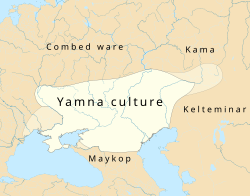
suntingPada akhir zaman Neolitikum, budaya Cucuteni-Trypillian berkembang pesat sekitar tahun 4.500–3.000 SM.[19] Orang-orang Zaman Tembaga dari budaya Cucuteni-Trypillian bermukim di bagian barat, dan budaya Sredny Stog lebih jauh ke timur, digantikan oleh budaya Yamna pada awal Zaman Perunggu ("Kurgan") di Stepa Pontus-Kaspia, dan oleh budaya Katacombe pada milenium ke-3 SM.
Zaman Besi dan zaman kuno klasik
suntingpemukiman Skithia, kolonisasi Yunani, dan dominasi Romawi
sunting

Selama Zaman Besi, bangsa-bangsa ini diikuti oleh orang Dacia serta orang nomaden seperti suku Kimmeri (budaya Novocherkassk arkeologis), bangsa Skithia, dan bangsa Sarmatia. Kerajaan Skithia ada di sini dari tahun 750 hingga 250 SM.[20] Dalam Kampanye Skithia Darius Agung pada tahun 513 SM, pasukan Persia Akhemeniyah menaklukkan beberapa Orang-orang Thrakia, dan hampir semua wilayah lain di sepanjang bagian Eropa Laut Hitam, seperti sebagian wilayah Bulgaria, Rumania, Ukraina, dan Rusia saat ini, sebelum kembali ke Anatolia.[21][22] Orang Yunani Krimea yang dijajah dan wilayah pesisir Ukraina lainnya pada abad ke-7 atau ke-6 SM selama periode Kuno.[23] Kerajaan Bosporos yang berbudaya Yunani berkembang pesat hingga diserbu dan diduduki oleh Goth dan Orang Hun pada abad ke-4 Masehi.[24] Dari tahun 62 hingga 68 Masehi, Kekaisaran Romawi sempat mencaplok kerajaan di bawah Kaisar Nero ketika ia menggulingkan raja Bosporan Tiberius Julius Cotys I.[25] Setelah itu Kerajaan Bosporos dijadikan Romawi negara pengekor dengan kehadiran militer Romawi pada pertengahan abad ke-1 Masehi.[26][27]
Kedatangan Bangsa Goth dan Hun
suntingPada abad ke-3 Masehi, Goth bermigrasi ke wilayah Ukraina modern sekitar tahun 250–375 Masehi, yang mereka sebut Oium, yang sesuai dengan budaya Chernyakhov arkeologis.[28] Bangsa Ostrogoth tetap berada di wilayah tersebut tetapi berada di bawah kekuasaan bangsa Hun sejak tahun 370-an. Di sebelah utara kerajaan Ostrogoth terdapat budaya Kyiv, yang berkembang pesat dari abad ke-2 hingga ke-5, ketika budaya ini juga dikuasai oleh bangsa Hun. Setelah mereka membantu mengalahkan Hun di pertempuran Nedao pada tahun 454, bangsa Ostrogoth diizinkan oleh Romawi untuk menetap di Panonia. Bersama dengan koloni Yunani Kuno lainnya yang didirikan pada abad ke-6 SM di pantai timur laut Laut Hitam, koloni Tyras, Olbia, dan Hermonassa terus berlanjut sebagai kota Romawi dan Bizantium (Romawi Timur) hingga abad ke-6 M. Pengaruh Gotik memudar pada akhir abad ke-5 Masehi, ketika Kekaisaran Romawi Timur menegaskan kembali kendali dan pengaruhnya atas wilayah tersebut.[29] Raja Hun Gordas memerintah kerajaan Bosporos pada awal abad ke-6 Masehi dan menjalin hubungan baik dengan kaisar Romawi Timur Yustianus I, tetapi kaisar tersebut menyerbu dan menduduki negara itu setelah Gordas terbunuh dalam pemberontakan pada tahun 527 Masehi.[30] Sampai abad ke-12 Masehi, kaisar-kaisar Romawi Timur mengklaim kekuasaan atas wilayah Selat Kerch.[31]
Slavia Awal
suntingDengan kekosongan kekuasaan yang tercipta setelah berakhirnya kekuasaan Hun dan Goth, Slavia Awal, setelah budaya Kyiv, mulai berekspansi ke sebagian besar wilayah yang sekarang menjadi Ukraina selama abad ke-5, dan meluas hingga ke Balkan sejak abad ke-6. Meskipun asal-usul Slavia Awal tidak diketahui secara pasti, banyak teori menunjukkan bahwa mereka mungkin berasal dari dekat Polesia.[32]
Pada abad ke-5 dan ke-6, Uni Antes (sebuah federasi suku) umumnya dianggap berada di wilayah yang sekarang menjadi Ukraina. Suku Antes adalah nenek moyang Orang Ukraina: Kroasia Putih, Suku Severia, Polan, Drevliany, Suku Dulebe, Suku Ulichia, dan Suku Tivertsi. Migrasi dari Ukraina ke seluruh Balkan membentuk banyak bangsa [[Slavia Selatan]. Migrasi ke utara, yang hampir mencapai Danau Ilmen, menyebabkan munculnya Slavia Ilmen, Suku Krivich, dan Suku Radimich, kelompok-kelompok leluhur Rusia. Setelah serangan Suku Avar Eurasia pada tahun 602 dan runtuhnya Uni Antes, sebagian besar suku-suku ini bertahan sebagai suku-suku terpisah hingga awal milenium kedua.[33]
Middle Ages
suntingEarly Middle Ages
suntingIn the 7th century, the territory of modern Ukraine was the core of the state of the Bulgars (often referred to as Old Great Bulgaria) with its capital city of Phanagoria. At the end of the 7th century, most Bulgar tribes migrated in several directions and the remains of their state were absorbed by the Khazars, a semi-nomadic people from Central Asia.[28]
The Khazars founded the Khazar kingdom near the Caspian Sea and the Caucasus. The kingdom included western Kazakhstan and parts of Crimea, eastern Ukraine, southern Russia and Azerbaijan. The Khazars dominated enough of the Pontic–Caspian steppe such that there was a Pax Khazarica in terms of trade, which allowed long distance trade to occur in safety, including groups like the Radhanite Jews who traded as far as China to Tabriz, as well as the trade networks that surrounded Volga Bulgaria. This attracted other traders such as the Vikings in the Viking Age who would found Kievan Rus'.[butuh rujukan]
Kievan Rus'
sunting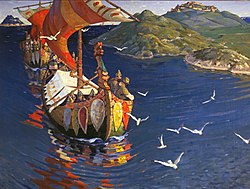
It is uncertain how the state of Kievan Rus' came to be, but the Varangian nobleman Oleh the Wise is generally credited with having established a principality at the city of Kyiv somewhere around the year 880.[a] Kyiv had already been established, but its origins are nebulous as well. According to archaeologists and historians such as Petro Tolochko (2007), Slavic settlement existed from the end of the 5th century in the area that later developed into the city.[35] Kyiv may have paid tribute to the Khazars before Oleh conquered it.[36][37] Tolochko and other scholars also theorise that 'Kyiv was not the center of any particular tribe but the intertribal center of a vast realm'; critical analysis of the Primary Chronicle, De Administrando Imperio and other sources suggests it may have been a cosmopolitan urban home to Slavic and non-Slavic groups, such as Scandinavian Varangians and Finno-Ugric peoples.[38] Slavic peoples that were reportedly native to Ukraine included Polans (or Polianians), Drevlyans, Severians, Ulichs, Tiverians, White Croats and Dulebes, but their precise identity and interrelationships are difficult to establish and verify, as the sources are vague, contradictory and at times inaccurate.[39]
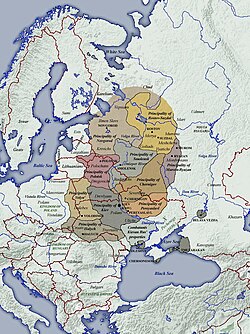
In the 10th and 11th century, Kyiv became one of the richest commercial centres of Europe, and the Kievan Rus' empire around it steadily expanded.[40] Initially a benefactor of the worship of Slavic deities such as Perun, Volodimer I converted to Orthodox Christianity in the 980s, tying the realm into a political and ecclesiastical alliance with the Byzantine Empire.[40] The reign of Yaroslav the Wise (m. 1019–1054) is generally regarded its zenith; Kievan Rus' was the most prosperous and powerful empire within Christendom.[40] Kievan Rus' was never a fully centralized state, but rather a loose aggregation of principalities ruled by members of the Rurik dynasty.[41] In the Late Middle Ages, it became known in the rest of Europe as Ruthenia (the Latin name for Rus'), especially for western principalities of Rus' after the Mongol invasion.[butuh rujukan]
Christianisation
sunting
While Christianity had made headway into the territory of modern Ukraine before the first ecumenical council, the Council of Nicaea (325) (particularly along the Black Sea coast, with the clearest evidence being the Christianization of the Crimean Goths) and, in western Ukraine during the time of the Empire of Great Moravia, the formal governmental acceptance of Christianity in Rus' occurred in 988. The major promoter of the Christianization of Kievan Rus' was the Grand-Duke Vladimir the Great whose grandmother, Princess Olga, was a Christian. Later the Kyivan ruler, Yaroslav I promulgated the Russkaya Pravda (Truth of Rus') which continued through the Lithuanian period of Rus'.[butuh rujukan]
In 1322, Pope John XXII established a diocese in Caffa (modern day Feodosia), which broke apart the Diocese of Khanbaliq (modern day Beijing), the only Catholic presence in the Mongol lands. For a few centuries it was the main see over an area from the Balkans to Sarai.[42]
Disintegration of Kievan Rus' and Mongol invasion
suntingConflict among the various principalities of Rus', in spite of the efforts of Grand Prince Vladimir Monomakh, led to decline, beginning in the 12th century. In Rus' propria, the Kyiv region, the nascent Rus' principalities of Halych and Volhynia extended their rule. In the north, the name of Moscow appeared in the historical record in the Principality of Suzdal, which gave rise to the nation of Russia. In the north-west, the Principality of Polotsk increasingly asserted the autonomy of Belarus. Kyiv was sacked by the Principality of Vladimir (1169) in the power struggle between princes and later by Cuman and Mongol raiders in the 12th and 13th centuries, respectively. Subsequently, all principalities of present-day Ukraine acknowledged dependence upon the Mongols (1239–1240). In 1240, the Mongols sacked Kyiv.
Galicia-Volhynia
sunting
A successor state to the Kievan Rus' on part of the territory of today's Ukraine was the Principality of Galicia-Volhynia. Previously, Vladimir the Great had established the cities of Halych and Volodymyr as regional capitals. The region was inhabited by the Dulebe, Tiverian and White Croat tribes[butuh rujukan]. Initially both Volhynia and Galicia were separate principalities, ruled by descendants of Yaroslav the Wise (Galicia by Rostislavich dynasty, and Volhynia initially by Igorevich and eventually by Iziaslavich dynasty).[43] During the rule Yaroslav Osmomysl (1153-1187) Galicia extended to the Black Sea.[43] Rulers of both principalites were trying to extend the rule over another. It was finally achieved by Roman the Great (1197-1205), who not only united both Galicia and Volhynia, but also extended his rule to Kyiv for a short period of time.[butuh rujukan]
His death was followed by a period of turmoil that lasted until his son Daniel regained the throne in 1238. Daniel managed to rebuild his father's state, including Kyiv. Daniel paid tribute to the Mongol khan, who appointed him baskak, responsible for collecting tribute from the Rus princes. In 1253 he was crowned by a papal delegation "King of Rus'" (Latin: rex Russiae); previously, the rulers of Rus' were termed "Grand Dukes" or "Princes."[butuh rujukan]
Late Middle Ages
suntingFrom the 13th century, the many parts of the coast of present-day Ukraine were dominated by the Republic of Genoa, which created numerous colonies around the Black Sea, most of them situated in today's Odesa Oblast. The Genoese colonies were well fortified, and there were garrisons in the fortresses and were used by the Genoese republic mainly for the purpose of dominating trade in the Black Sea. Genoa's dominance in the region would last until the 15th century.[44][45][46]
During the 14th century, Poland and Lithuania fought wars against the Mongol invaders, and eventually most of Ukraine passed to the rule of Poland and Lithuania. More particularly, Red Ruthenia, and part of Volhynia and Podolia became part of Poland. King of Poland adopted the tile of "lord and heir of Ruthenia" (Latin: Russiae dominus et Heres[47]). Lithuania took control of Polotsk, Volhynia, Chernihiv, and Kyiv following Battle of Blue Waters (1362/63), and the rulers of Lithuania then adopted the title of ruler of Rus'.[butuh rujukan]
After the downfall of Kyivan Rus' and Galicia–Volhynia, their political, cultural and religious life continued under Lithuanian control.[48] Ruthenian aristocrats, for example, the Olelkovich, joined the governing class of the Grand Duchy of Lithuania as members of the grand duke's privy council, senior military leaders, and administrators.[48] Despite Lithuanian being the native language of the ruling class, the main written languages within the Grand Duchy of Lithuania were Latin, Old Church Slavonic, as well as Ruthenian, with East Slavonic Chancery being replaced by Polish in the early modern period.[49]
Eventually, Poland took control of the southwestern region. Following the union between Poland and Lithuania, Poles, Germans, Lithuanians and Jews migrated to the region, forcing Ukrainians out of positions of power they shared with Lithuanians, with more Ukrainians being forced into Central Ukraine as a result of Polish migration, polonization, and other forms of oppression against Ukraine and Ukrainians, all of which started to fully take form.[butuh rujukan]
In 1490, due to increased oppression of Ukrainians at the hands of the Polish, a series of successful rebellions was led by Ukrainian Petro Mukha, joined by other Ukrainians, such as early Cossacks and Hutsuls, in addition to Moldavians (Romanians). Known as Mukha's Rebellion, this series of battles was supported by the Moldavian prince Stephen the Great, and it is one of the earliest known uprisings of Ukrainians against Polish oppression. These rebellions saw the capture of several cities of Pokuttya, and reached as far west as Lviv, but without capturing the latter.[50]
The 15th-century decline of the Golden Horde enabled the foundation of the Crimean Khanate, which occupied present-day Black Sea shores and southern steppes of Ukraine. Until the late 18th century, the Crimean Khanate maintained a massive slave trade with the Ottoman Empire and the Middle East,[51] exporting about 2 million slaves from Russia and Ukraine over the period 1500–1700.[52] It remained a vassal state of the Ottoman Empire until 1774, when it was finally dissolved by the Russian Empire in 1783.[butuh rujukan]
Early modern period
suntingPolish–Lithuanian Commonwealth
sunting
After the Union of Lublin in 1569 and the formation of the Polish–Lithuanian Commonwealth Ukraine fell under the Polish administration, becoming part of the Crown of the Kingdom of Poland. The period immediately following the creation of the Commonwealth saw a huge revitalisation in colonisation efforts. Many new cities and villages were founded & links between different Ukrainian regions, such as Halych Land and Volhynia were greatly extended.[53]
New schools spread the ideas of the Renaissance; Polish peasants arrived in great numbers and quickly became mixed with the local population; during this time, most Ukrainian nobles became Polonised and converted to Catholicism, and while most Ruthenian-speaking peasants remained within the Eastern Orthodox Church, social tension rose. Some of the Polonised nobility would heavily shape Polish culture, for example, Stanisław Orzechowski.[butuh rujukan]
Ruthenian peasants who fled efforts to force them into serfdom came to be known as Cossacks and earned a reputation for their fierce martial spirit. Some Cossacks were enlisted by the Commonwealth as soldiers to protect the southeastern borders of Commonwealth from Tatars or took part in campaigns abroad (like Petro Konashevych-Sahaidachny in the battle of Khotyn 1621). Cossack units were also active in wars between the Polish–Lithuanian Commonwealth and Tsardom of Russia. Despite the Cossack's military usefulness, the Commonwealth, dominated by its nobility, refused to grant them any significant autonomy, instead attempting to turn most of the Cossack population into serfs. This led to an increasing number of Cossack rebellions aimed at the Commonwealth.[butuh rujukan]
| Voivodeship | Square kilometers | Population (est.) | |
|---|---|---|---|
| Galicia | 45,000 | 446,000 | |
| Volhynia | 42,000 | 294,000 | |
| Podilia | 19,000 | 98,000 | |
| Bratslav | 35,000 | 311,000 | |
| Kyiv | 117,000 | 234,000 | |
| Belz (two regions) | Kholm | 19,000 | 133,000 |
| Pidliassia | 10,000 | 233,000 | |
Cossack era
sunting

The 1648 Ukrainian Cossack (Kozak) rebellion or Khmelnytsky Uprising, which started an era known as the Ruin (in Polish history as the Deluge), undermined the foundations and stability of the Commonwealth. The nascent Cossack state, the Cossack Hetmanate,[55] usually viewed as precursor of Ukraine,[55] found itself in a three-sided military and diplomatic rivalry with the Ottoman Turks, who controlled the Tatars to the south, the Commonwealth of Poland and Lithuania, and the Tsardom of Russia to the East.[butuh rujukan]
The Zaporozhian Host, in order to leave the Polish–Lithuanian Commonwealth, sought a treaty of protection with Russia in 1654.[55] This agreement was known as the Pereiaslav Agreement.[55] Commonwealth authorities then sought compromise with the Ukrainian Cossack state by signing the Treaty of Hadiach in 1658, but—after thirteen years of incessant warfare—the agreement was later superseded by the 1667 Polish–Russian Truce of Andrusovo, which divided Ukrainian territory between the Commonwealth and Russia. Under Russia, the Cossacks initially retained official autonomy in the Hetmanate.[55] For a time, they also maintained a semi-independent republic in Zaporizhzhia and a colony on the Russian frontier in Sloboda Ukraine.
In 1686, the Metropolitanate of Kyiv was annexed by the Moscow Patriarchate through the Synodal Letter of the Ecumenical Patriarch of Constantinople Dionysius IV.[butuh rujukan]
Russian Empire and Austria-Hungary
suntingDuring subsequent decades, Tsarist rule over central Ukraine gradually replaced 'protection'. Sporadic Cossack uprisings were now aimed at the Russian authorities, but eventually petered out by the late 18th century, following the destruction of entire Cossack hosts. After the Partitions of Poland in 1772, 1793 and 1795, the extreme west of Ukraine fell under the control of the Austrians, with the rest becoming a part of the Russian Empire. As a result of the Russo-Turkish Wars, the Ottoman Empire's control receded from south-central Ukraine, while the rule of Hungary over the Transcarpathian region continued. Ukrainian writers and intellectuals were inspired by the nationalistic spirit stirring other European peoples existing under other imperial governments and became determined to revive the Ukrainian linguistic and cultural traditions and re-establish a Ukrainian nation-state, a movement that became known as Ukrainophilism.[butuh rujukan]
Russia, fearing separatism, imposed strict limits on attempts to elevate the Ukrainian language and culture, even banning its use and study: in 1863, the Valuev Circular banned the use of Ukrainian in religious and educational literature, in 1876, the Ems Ukaz outlawed Ukrainian-language publications outright, as well as the import of texts published abroad in Ukrainian, the use of Ukrainian in theatrical productions and public readings, the use of Ukrainian in schools.[56] The Russophile policies of Russification and Panslavism led to an exodus of a number of Ukrainian intellectuals into Western Ukraine. However, many Ukrainians accepted their fate in the Russian Empire and some were able to achieve great success there.[butuh rujukan]
The fate of the Ukrainians was far different under the Austrian Empire where they found themselves in the pawn position of the Russian–Austrian power struggle for Central and Southern Europe. Unlike in Russia, most of the elite that ruled Galicia were of Austrian or Polish descent, with the Ruthenians being almost exclusively kept in peasantry. During the 19th century, Russophilia was a common occurrence among the Slavic population, but the mass exodus of Ukrainian intellectuals escaping from Russian repression in Eastern Ukraine, as well as the intervention of Austrian authorities, caused the movement to be replaced by Ukrainophilia, which would then cross over into the Russian Empire. With the start of World War I, all those supporting Russia were rounded up by Austrian forces and held in a concentration camp at Talerhof where many died.[butuh rujukan]
Sejarah Modern
sunting
Ukraina abad ke-17 dan ke-18
suntingUkraina muncul sebagai konsep sebuah bangsa, dan orang Ukraina sebagai sebuah kebangsaan, dengan Kebangkitan Nasional Ukraina pada pertengahan abad ke-18, setelah pemberontakan petani tahun 1768/1769 dan pembagian Persemakmuran Polandia-Lituania yang akhirnya terjadi. Galisia jatuh ke Kekaisaran Austria, dan sisa Ukraina ke Kekaisaran Rusia.
Meskipun Ukraina tepi kanan termasuk dalam Persemakmuran Polandia-Lituania hingga akhir tahun 1793, Ukraina bagian kiri (tepi sungai kiri) telah dimasukkan ke dalam Ketsaran Rusia pada tahun 1667 (berdasarkan Perjanjian Andrusovo). Pada tahun 1672, Podolia diduduki oleh Kesultanan Utsmaniyah Turki, sementara Kyiv dan Bratslav berada di bawah kendali Hetman Petro Doroshenko hingga tahun 1681, ketika mereka juga direbut oleh Turki, tetapi pada tahun 1699 Perjanjian Karlowitz mengembalikan wilayah tersebut ke Persemakmuran.
Sebagian besar Ukraina jatuh ke Kekaisaran Rusia di bawah pemerintahan Yekaterina yang Agung; Kekhanan Krimea dianeksasi oleh Rusia pada tahun 1783, menyusul emigrasi umat Kristen dari Krimea pada tahun 1778, dan pada tahun 1793 Ukraina bagian kanan dianeksasi oleh Rusia dalam pembagian Polandia kedua.[57]
Para penulis dan intelektual Ukraina terinspirasi oleh semangat nasionalisme yang membangkitkan bangsa-bangsa Eropa lainnya yang berada di bawah pemerintahan kekaisaran lain. Rusia, karena takut akan separatisme, memberlakukan batasan ketat pada upaya untuk mengangkat budaya dan bahasa Ukraina, bahkan melarang penggunaan dan studinya. Kebijakan Rusofilia berupa Rusifikasi dan Pan-slavisme menyebabkan eksodus sejumlah intelektual Ukraina ke Ukraina Barat, sementara yang lain menganut identitas Pan-Slavia atau Rusia.
Abad ke-19
suntingUkraina di bawah pemerintahan Aleksandr I dari Rusia (1801–1825) hanya menyaksikan kehadiran Rusia yang melibatkan tentara kekaisaran dan birokrasinya, tetapi pada masa pemerintahan Nikolai I dari Rusia (1825–1855), Rusia telah mendirikan administrasi terpusat di Ukraina. Setelah menumpas Pemberontakan November 1830, rezim Tsar memberlakukan kebijakan Rusifikasi di Ukraina tepi kanan.[58]
2,4 juta warga Ukraina di bawah Kekaisaran Habsburg tinggal di Galicia timur dan sebagian besar terdiri dari petani (95%), sedangkan sisanya adalah keluarga pendeta. Bangsawan Galiclsia sebagian besar adalah orang Polandia atau Ukraina yang telah terpolonisasi. Perkembangan di sini tertinggal dibandingkan Ukraina yang dikuasai Rusia dan merupakan salah satu wilayah termiskin di Eropa..[58]
Kebangkitan kesadaran nasional muncul pada abad ke-19, dengan representasi kaum intelektual yang menurun di kalangan bangsawan dan meningkat di kalangan rakyat jelata dan petani. Mereka melihat proses pembangunan bangsa untuk meningkatkan hak-hak nasional dan keadilan sosial, tetapi segera digagalkan oleh otoritas Tsar. Setelah Revolusi 1848, Ukraina mendirikan Dewan Ruthenia Tertinggi, menuntut otonomi, dan mereka juga membuka surat kabar berbahasa Ukraina pertama (Zoria halytska). Emansipasi 1861 sangat berdampak pada Ukraina karena 42% dari mereka adalah budak. Selama akhir abad ke-19, pajak yang berat, pertumbuhan penduduk yang cepat, dan kurangnya lahan memiskinkan kaum petani. Namun, wilayah Stepa Pontus-Kaspia berhasil menghasilkan 20% produksi gandum dunia dan 80% gula kekaisaran. Kemudian, industrialisasi tiba dengan pembangunan jalur kereta api pertama pada tahun 1866. Ekonomi Ukraina saat itu telah terintegrasi ke dalam sistem kekaisaran dan mengalami banyak perkembangan perkotaan.[58]
Abad ke-20
sunting
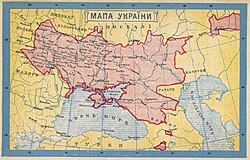
Revolusi Rusia dan Perang Kemerdekaan
sunting

Sejarawan Paul Kubicek mengatakan:
- Antara tahun 1917 dan 1920, beberapa entitas yang bercita-cita menjadi negara Ukraina merdeka muncul. Namun, periode ini sangat kacau, ditandai dengan revolusi, perang internasional dan sipil, serta kurangnya otoritas pusat yang kuat. Banyak faksi bersaing memperebutkan kekuasaan di wilayah yang sekarang menjadi Ukraina, dan tidak semua kelompok menginginkan negara Ukraina yang terpisah. Pada akhirnya, kemerdekaan Ukraina berumur pendek, karena sebagian besar wilayah Ukraina dimasukkan ke dalam Uni Soviet dan sisanya, di Ukraina barat, dibagi antara Polandia, Cekoslowakia, dan Rumania.[59]
Cendekiawan Kanada Orest Subtelny mengatakan:
- Pada tahun 1919, kekacauan total melanda Ukraina. Memang, dalam sejarah modern Eropa, tidak ada negara yang mengalami anarki yang begitu lengkap, perselisihan sipil yang pahit, dan keruntuhan otoritas total seperti yang dialami Ukraina pada saat itu. Enam pasukan berbeda—pasukan Ukraina, Bolshevik, Putih, Entente [Prancis], Polandia, dan anarkis—beroperasi di wilayahnya. Kyiv berpindah tangan lima kali dalam waktu kurang dari setahun. Kota-kota dan wilayah-wilayah terputus satu sama lain oleh berbagai front. Komunikasi dengan dunia luar hampir terputus sepenuhnya. Kota-kota yang kelaparan menjadi kosong karena orang-orang pindah ke pedesaan untuk mencari makanan.[60]
Perang Kemerdekaan Ukraina tahun 1917 hingga 1921 menghasilkan Makhnovia, Republik Rakyat Ukraina, Republik Sosialis Soviet Ukraina, dan Republik Rakyat Ukraina Barat, di antara negara-negara berumur pendek lainnya, yang sebagian besar tergabung dalam Uni Soviet, meskipun Ukraina Barat akhirnya berada di Polandia.[61][62]
Bencana kelaparan Soviet 1932–33, yang sekarang dikenal sebagai Holodomor, menyebabkan jutaan orang tewas di Uni Soviet, mayoritas di antaranya adalah warga Ukraina, tidak hanya di Ukraina tetapi juga di Kuban dan bekas wilayah Cossack Don.[63][64]
Perang Dunia II
suntingPerang Dunia Kedua dimulai pada September 1939, ketika Hitler dan Stalin menginvasi Polandia, Uni Soviet mengambil sebagian besar Polandia Timur. Jerman Nazi bersama sekutunya menginvasi Uni Soviet pada tahun 1941. Antara 4,5 dan 6 juta warga Ukraina bertempur di Tentara Soviet melawan Nazi.[65] Awalnya, sebagian warga Ukraina menganggap tentara Wehrmacht sebagai pembebas dari kekuasaan Soviet, sementara yang lain membentuk gerakan partisan. Beberapa elemen gerakan nasionalis Ukraina bawah tanah membentuk Tentara Pemberontak Ukraina yang melawan pasukan Soviet dan Nazi. Yang lain berkolaborasi dengan Jerman. Tren pro-Polandia dalam gerakan nasional Ukraina, yang menyatakan kesetiaan kepada Republik Polandia Kedua dan sebagai imbalannya menuntut otonomi bagi warga Ukraina (misalnya, Aliansi Demokratik Nasional Ukraina), menjadi terpinggirkan, terutama karena penolakan dari pihak Polandia, di mana pendukung asimilasi paksa warga Ukraina ke dalam budaya Polandia mendominasi.[66] Sekitar 1,5 juta orang Yahudi dibunuh oleh Nazi selama pendudukan mereka.[67] Di Volhynia, para pejuang Ukraina melakukan pembantaian terhadap hingga 100.000 warga sipil Polandia.[68] Kelompok-kelompok kecil sisa partisan UPA masih aktif di dekat perbatasan Polandia dan Soviet hingga tahun 1950-an.[69] Galisia, Volhinia, Bessarabia Selatan, Bukovina Utara, dan Rutenia Karpatia yang dianeksasi sebagai akibat dari Pakta Molotov–Ribbentrop pada tahun 1939 ditambahkan ke RSS Ukraina.
Setelah Perang Dunia II, beberapa amandemen terhadap Konstitusi Republik Sosialis Soviet Ukraina diterima, yang memungkinkannya untuk bertindak sebagai subjek hukum internasional yang terpisah dalam beberapa kasus dan sampai batas tertentu, tetap menjadi bagian dari Uni Soviet pada saat yang sama. Secara khusus, amandemen ini memungkinkan SSR Ukraina untuk menjadi salah satu anggota pendiri Perserikatan Bangsa-bangsa (PBB) bersama dengan Uni Soviet dan Republik Sosialis Soviet Byelorussia. Ini adalah bagian dari kesepakatan dengan Amerika Serikat untuk memastikan keseimbangan di Majelis Umum Perserikatan Bangsa-bangsa, yang menurut Uni Soviet, tidak seimbang dan lebih menguntungkan Blok Barat. Dalam kapasitasnya sebagai anggota PBB, SSR Ukraina adalah anggota terpilih dari Dewan Keamanan Perserikatan Bangsa-Bangsa pada tahun 1948–1949 dan 1984–1985. Oblast Krimea diserahkan dari RSFSR ke SSR Ukraina pada tahun 1954.[70]
Independence
sunting
With the collapse of the Soviet Union in 1991, Ukraine became an independent state, formalised with a referendum in December 1991. On 21 January 1990, over 300,000 Ukrainians[71] organized a human chain for Ukrainian independence between Kyiv and Lviv. Ukraine officially declared itself an independent country on 24 August 1991, when the communist Supreme Soviet (parliament) of Ukraine proclaimed that Ukraine would no longer follow the laws of USSR and only the laws of the Ukrainian SSR, de facto declaring Ukraine's independence from the Soviet Union. On 1 December, voters approved a referendum formalizing independence from the Soviet Union. Over 90% of Ukrainian citizens voted for independence, with majorities in every region, including 56% in Crimea. The Soviet Union formally ceased to exist on 26 December, when the presidents of Ukraine, Belarus and Russia (the founding members of the USSR) met in Białowieża Forest to formally dissolve the Union in accordance with the Soviet Constitution. With this, Ukraine's independence was formalized de jure and recognized by the international community.[butuh rujukan]
Also on 1 December 1991, Ukrainian voters in their first presidential election elected Leonid Kravchuk.[72] During his presidency, the Ukrainian economy shrank by more than 10% per year (in 1994 by more than 20%).[72] The presidency (1994–2005) of the 2nd President of Ukraine, Leonid Kuchma, was surrounded by numerous corruption scandals and the lessening of media freedoms, including the Cassette Scandal.[72][73] During Kuchma's presidency, the economy recovered, with GDP growth at around 10% a year in his last years in office.[72]
Orange Revolution and Euromaidan
suntingIn 2004, Kuchma announced that he would not run for re-election. Two major candidates emerged in the 2004 presidential election. Viktor Yanukovych,[74] the incumbent Prime Minister, supported by both Kuchma and by the Russian Federation, wanted closer ties with Russia. The main opposition candidate, Viktor Yushchenko, called for Ukraine to turn its attention westward and aim to eventually join the EU. In the runoff election, Yanukovych officially won by a narrow margin, but Yushchenko and his supporters alleged that vote rigging and intimidation cost him many votes, especially in eastern Ukraine. A political crisis erupted after the opposition started massive street protests in Kyiv and other cities ("Orange Revolution"), and the Supreme Court of Ukraine ordered the election results null and void. A second runoff found Viktor Yushchenko the winner. Five days later, Yanukovych resigned from office and his cabinet was dismissed on 5 January 2005.[butuh rujukan]
During the Yushchenko term, relations between Russia and Ukraine often appeared strained as Yushchenko looked towards improved relations with the European Union and less toward Russia.[75] In 2005, a highly publicized dispute over natural gas prices with Russia caused shortages in many European countries that were reliant on Ukraine as a transit country.[76] A compromise was reached in January 2006.[76]
By the time of the presidential election of 2010, Yushchenko and Yulia Tymoshenko — allies during the Orange Revolution[77] — had become bitter enemies.[72] Tymoshenko ran for president against both Yushchenko and Viktor Yanukovych, creating a three-way race. Yushchenko, whose popularity had plummeted,[75] persisted in running, and many pro-Orange voters stayed home.[78] In the second round of the election, Yanukovych won the run-off ballot with 48% to Tymoshenko's 45%.[79]
During his presidency (2010–2014), Yanukovych and his Party of Regions were accused of trying to create a "controlled democracy" in Ukraine and of trying to destroy the main opposition party Bloc Yulia Tymoshenko, but both have denied these charges.[80] One frequently cited example of Yanukovych's attempts to centralise power was the 2011 sentencing of Yulia Tymoshenko, which has been condemned by Western governments as potentially being politically motivated.[81]
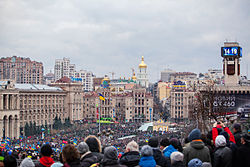
In November 2013, President Yanukovych did not sign the Ukraine–European Union Association Agreement and instead pursued closer ties with Russia.[82][83] This move sparked protests on the streets of Kyiv and, ultimately, the Revolution of Dignity. Protesters set up camps in Kyiv's Maidan Nezalezhnosti (Independence Square),[84] and in December 2013 and January 2014 protesters started taking over various government buildings, first in Kyiv, and later in Western Ukraine.[85] Battles between protesters and police resulted in about 80 deaths in February 2014.[86][87]
Following the violence, the Ukrainian parliament on 22 February voted to remove Yanukovych from power (on the grounds that his whereabouts were unknown and he thus could not fulfil his duties), and to free Yulia Tymoshenko from prison. On the same day, Yanukovych supporter Volodymyr Rybak resigned as speaker of the Parliament, and was replaced by Tymoshenko loyalist Oleksandr Turchynov, who was subsequently installed as interim President.[88] Yanukovych had fled Kyiv, and subsequently gave a press conference in the Russian city of Rostov-on-Don.[89]
Western Integration
suntingOn 1 January 2016, Ukraine joined the DCFTA with the EU. Ukrainian citizens were granted visa-free travel to the Schengen Area for up to 90 days during any 180-day period on 11 June 2017, and the Association Agreement formally came into effect on 1 September 2017.[90] Significant achievements in the foreign policy arena include support for anti-Russian sanctions, obtaining a visa-free regime with the countries of the European Union, and better recognition of the need to overcome extremely difficult tasks within the country. However, the old local authorities did not want any changes; they were cleansed of anti-Maidan activists (lustration), but only in part. The fight against corruption was launched, but was limited to sentences of petty officials and electronic declarations, and the newly established NABU and NACP were marked by scandals in their work. Judicial reform was combined with the appointment of old, compromised judges. The investigation of crimes against Maidan residents was delayed. In order to counteract the massive global Russian anti-Ukrainian propaganda of the "information war", the Ministry of Information Policy was created, which for 5 years did not show effective work, except for the ban on Kaspersky Lab, Dr.Web, 1С, Mail.ru, Yandex and Russian social networks VKontakte or Odnoklassniki and propaganda media. In 2017, the president signed the law "On Education", which met with opposition from national minorities, and quarreled with the Government of Hungary.[butuh rujukan] At the same time, the economic situation continued deterirating, mainly due to the widespread corruption. By 2018 Ukraine became the poorest country of Europe, with the GDP per capita below $3,000.[91]
On May 19, 2018, Poroshenko signed a Decree which put into effect the decision of the National Security and Defense Council on the final termination of Ukraine's participation in the statutory bodies of the Commonwealth of Independent States.[92][93] As of February 2019, Ukraine minimized its participation in the Commonwealth of Independent States to a critical minimum and effectively completed its withdrawal. The Verkhovna Rada of Ukraine did not ratify the accession, i.e. Ukraine has never been a member of the CIS.[94]
On January 6, 2019, in Fener, a delegation of the Orthodox Church of Ukraine with the participation of President of Ukraine Petro Poroshenko received a Tomos on autocephaly. The Tomos was presented to the head of the OCU, Metropolitan Epiphanius, during a joint liturgy with the Ecumenical Patriarch.[95] The next day, Tomos was brought to Ukraine for a demonstration at St. Sophia Cathedral. On January 9, all members of the Synod of the Constantinople Orthodox Church signed the Tomos during the scheduled meeting of the Synod.[butuh rujukan]
On February 21, 2019, the Constitution of Ukraine was amended, with the norms on the strategic course of Ukraine for membership in the European Union and NATO being enshrined in the preamble of the Basic Law, three articles and transitional provisions.[96]
On 21 April 2019, Volodymyr Zelenskyy was elected president in the second round of the presidential election. Early parliamentary elections on July 21 allowed the newly formed pro-presidential Servant of the People party to win an absolute majority of seats for the first time in the history of independent Ukraine (248). Dmytro Razumkov, the party's chairman, was elected speaker of parliament. The majority was able to form a government on August 29 on its own, without forming coalitions, and approved Oleksii Honcharuk as prime minister.[97] On March 4, 2020, due to a 1.5% drop in GDP (instead of a 4.5% increase at the time of the election), the Verkhovna Rada fired Honcharuk's government and Denys Shmyhal[98] became the new Prime Minister.[99]
On July 28, 2020, in Lublin, Lithuania, Poland and Ukraine created the Lublin Triangle initiative, which aims to create further cooperation between the three historical countries of the Polish–Lithuanian Commonwealth and further Ukraine's integration and accession to the EU and NATO.[100]
On May 17, 2021, the Association Trio was formed by signing a joint memorandum between the Foreign Ministers of Georgia, Moldova and Ukraine. Association Trio is tripartite format for the enhanced cooperation, coordination, and dialogue between the three countries (that have signed the Association Agreement with the EU) with the European Union on issues of common interest related to European integration, enhancing cooperation within the framework of the Eastern Partnership, and committing to the prospect of joining the European Union.[101]
At the June 2021 Brussels Summit, NATO leaders reiterated the decision taken at the 2008 Bucharest Summit that Ukraine would become a member of the Alliance with the Membership Action Plan (MAP) as an integral part of the process and Ukraine's right to determine its own future and foreign policy without outside interference.[102]
Ukraine was originally preparing to formally apply for EU membership in 2024, but instead signed an application for membership in February 2022.[103]
Russo-Ukrainian War
suntingIn March 2014, the Annexation of Crimea by the Russian Federation occurred. Though official results of a referendum on Crimean reunification with Russia were reported as showing a large majority in favor of the proposition, the vote was organized under Russian military occupation and was denounced by the European Union and the United States as illegal.[104]
The Crimean crisis was followed by pro-Russian unrest in east Ukraine and south Ukraine.[105] In April 2014 Ukrainian separatists self-proclaimed the Donetsk People's Republic and Lugansk People's Republic and held referendums on 11 May 2014; the separatists claimed nearly 90% voted in favor of independence.[106][105] Later in April 2014, fighting between the Ukrainian army and pro-Ukrainian volunteer battalions on one side, and forces supporting the Donetsk and Lugansk People's Republics on the other side, escalated into the war in Donbas.[105][107] By December 2014, more than 6,400 people had died in this conflict, and according to United Nations figures it led to over half a million people becoming internally displaced within Ukraine and two hundred thousand refugees to flee to (mostly) Russia and other neighboring countries.[108][109][110][111] During the same period, political (including adoption of the law on lustration and the law on decommunization) and economic reforms started.[112] On 25 May 2014, Petro Poroshenko was elected president[113] in the first round of the presidential election. By the second half of 2015, independent observers noted that reforms in Ukraine had considerably slowed down, corruption did not subside, and the economy of Ukraine was still in a deep crisis.[112][114][115][116] By December 2015, more than 9,100 people had died (largely civilians) in the war in Donbas,[117] according to United Nations figures.[118]

On February 2, 2021, a presidential decree banned the television broadcasting of the pro-Russian TV channels 112 Ukraine, NewsOne and ZIK.[119][120] The decision of the National Security and Defense Council and the Presidential Decree of February 19, 2021 imposed sanctions on 8 individuals and 19 legal entities, including Putin's pro-Russian politician and Putin's godfather Viktor Medvedchuk and his wife Oksana Marchenko.[121][122]
The Kerch Strait incident occurred on 25 November 2018 when the Russian Federal Security Service (FSB) coast guard fired upon and captured three Ukrainian Navy vessels attempting to pass from the Black Sea into the Sea of Azov through the Kerch Strait on their way to the port of Mariupol.[123][124]
Throughout 2021, Russian forces built up along the Russia-Ukraine Border, in occupied Crimea and Donbas, and in Belarus.[125] On February 24, 2022, Russian forces invaded Ukraine.[126] Russia quickly occupied much of the east and south of the country, but failed to advance past the city of Mykolaiv towards Odesa, and were forced to retreat from the north after failing to occupy Kyiv, Chernihiv, Sumy, and Kharkiv.[127] After failing to gain further territories and being driven out of Kharkiv Oblast by a fast-paced Ukrainian counteroffensive,[128] Russia officially annexed the Donetsk People's Republic and the Luhansk People's Republic, along with most of the Kherson and Zaporizhzhia Oblasts on 30 September.[129]
On the eve of the Russian invasion of Ukraine in 2022, the country was the poorest in Europe,[130] a handicap whose cause was attributed to high corruption levels[131] and the slow pace of economic liberalization and institutional reform.[132][133][134][135] Russia's invasion of the country damaged Ukraine's economy and future prospects of improvement to such an extent, that the GDP of the country was projected to shrink by as much as 35% in its first year alone after the invasion.[136]
Historiografi nasional
suntingPengetahuan tentang Ukraina di bagian lain dunia sebagian besar berasal dari sumber sekunder Rusia hingga relatif baru-baru ini. Setelah paruh kedua abad ketujuh belas, ketika Muscovy dan kemudian Kekaisaran Rusia menguasai sebagian besar wilayah Ukraina, penulis Rusia memasukkan Ukraina sebagai bagian dari sejarah Rusia. Ini termasuk menyebut Rus Kiev abad pertengahan sebagai "Kievan Russia" dan budaya serta penduduknya Slavia Timur Kuno sebagai "Kievan Russia" atau "Rusia Kuno". Ukraina kemudian atau bagian-bagiannya disebut "Rusia Kecil", "Rusia Selatan", "Rusia Barat" (dengan Belarus), atau "Rusia Baru" (pantai Laut Hitam dan stepa tenggara). Tetapi bagian-bagian Ukraina di luar jangkauan Rusia disebut Rutenia dan Orang Rutenia. Nama-nama yang dipilih untuk menyebut Ukraina dan orang Ukraina sering kali mencerminkan posisi politik tertentu, dan terkadang bahkan untuk menyangkal keberadaan kebangsaan Ukraina.[28]: 10–11 Sudut pandang Rusia tentang sejarah Ukraina menjadi sudut pandang yang dominan di kalangan akademisi Barat, dan meskipun bias tersebut telah diidentifikasi sejak tahun 1950-an, banyak sarjana studi Slavia dan sejarah percaya bahwa perubahan signifikan masih diperlukan untuk mengoreksi pandangan yang berpusat pada Moskow tersebut.[137]
Studi ilmiah tentang sejarah Ukraina muncul dari dorongan romantisme pada akhir abad ke-19 ketika Romantisisme Jerman menyebar ke Eropa Timur. Tokoh-tokoh terkemuka di bidang ini adalah Volodymyr Antonovych (1834–1908), yang berbasis di Kyiv, dan muridnya Mykhailo Hrushevsky (1866–1934).[138] Tantangan serius pertama terhadap pandangan Rusia tentang Ukraina adalah artikel Hrushevsky tahun 1904 yang berjudul "The Traditional Scheme of 'Russian' History and the Problem of the Rational organization of the History of the Eastern Slavs".[139] Untuk pertama kalinya, studi ilmiah skala penuh berdasarkan sumber arsip, teknik penelitian modern, dan teori sejarah modern menjadi mungkin. Namun, tuntutan pejabat pemerintah—Tsar, pada tingkat yang lebih rendah Austro-Hungaria dan Polandia, dan kemudian Soviet—membuat penyebaran ide-ide yang bertentangan dengan pemerintah pusat menjadi sulit. Oleh karena itu, sekolah-sekolah sejarawan pengasingan muncul di Eropa tengah dan Kanada setelah tahun 1920.
Interpretasi yang sangat berbeda tentang negara Rus Kyiv pada abad pertengahan muncul dalam empat aliran historiografi di Ukraina: Russofilia, Sovietofilia, Slavia Timur, dan Pencinta Ukraina. Di Uni Soviet, terjadi perubahan radikal setelah tahun 1921, yang dipimpin oleh Mikhail Pokrovsky. Hingga tahun 1934, sejarah umumnya tidak dianggap chauvinistik, tetapi ditulis ulang dengan gaya Historiografi Marxis. "Masa lalu" nasional ditulis ulang sebagai pembebasan sosial dan nasional bagi non-Rusia, dan pembebasan sosial bagi Rusia, dalam proses yang berakhir pada tahun 1917. Di bawah Stalin, negara dan historiografi resminya diberi karakter Rusia yang khas dan Russosentrisme tertentu. Sejarah kekaisaran ditulis ulang sedemikian rupa sehingga kecintaan pada bangsa non-Rusia menyebabkan persaingan dan penghormatan untuk "bergabung" dengan rakyat Rusia dengan menjadi bagian dari negara Rusia (tsar), dan sebagai imbalannya, kepentingan negara Rusia didorong oleh altruisme dan kepedulian terhadap bangsa-bangsa tetangga.[140] Aliran Russofilia dan Sovietofilia telah terpinggirkan di Ukraina yang merdeka, dengan aliran Ukrainophile mendominasi pada awal abad ke-21. Aliran Ukrainofilia mempromosikan identitas yang saling eksklusif dengan Rusia. Aliran ini telah mendominasi sistem pendidikan nasional, pasukan keamanan, serta simbol dan monumen nasional, meskipun telah ditolak sebagai nasionalis oleh sejarawan Barat. Aliran Slavia Timur, sebuah kompromi eklektik antara Ukrainofilia dan Russofilisme, memiliki basis ideologis dan simbolis yang lebih lemah, meskipun lebih disukai oleh mantan elit sentris Ukraina.[141]
Banyak sejarawan dalam beberapa tahun terakhir telah mencari alternatif selain sejarah nasional, dan sejarah Ukraina mengundang pendekatan yang melampaui paradigma nasional. Sejarah multietnis mengakui banyaknya kelompok etnis di Ukraina; sejarah transnational menggambarkan Ukraina sebagai zona perbatasan bagi berbagai kekaisaran; dan kajian wilayah mengkategorikan Ukraina sebagai bagian dari Eropa Tengah-Timur atau, lebih jarang, sebagai bagian dari Eurasia. Serhii Plokhy berpendapat bahwa melihat melampaui sejarah nasional negara tersebut telah memungkinkan pemahaman yang lebih kaya tentang Ukraina, rakyatnya, dan wilayah sekitarnya.[142] Sejak 2015, muncul kembali minat untuk mengintegrasikan sejarah "teritorial-sipil" dan "linguistik-etnis" Ukraina. Misalnya, sejarah Tatar Krimea dan sejarah yang lebih jauh dari semenanjung Krimea kini diintegrasikan ke dalam sejarah sekolah Ukraina. Ini adalah bagian dari "rakyat Ukraina" yang diamanatkan secara konstitusional, bukan "rakyat Ukraina". Perlahan, sejarah Polandia dan Yahudi juga diintegrasikan kembali. Namun, karena iklim politik saat ini yang disebabkan oleh pelanggaran kedaulatan teritorial oleh Rusia, peran Rusia sebagai "tuan rumah bersama" telah sangat diminimalkan, dan masih ada masalah-masalah sulit masa lalu yang belum terselesaikan, misalnya, peran Ukraina selama Holodomor.[143]
Setelah tahun 1991, memori sejarah menjadi alat yang ampuh dalam mobilisasi politik dan legitimasi negara Ukraina pasca-Soviet, serta pembagian memori yang digunakan secara selektif sesuai dengan pembagian politik masyarakat Ukraina. Ukraina tidak mengalami paradigma restorasionis yang lazim terjadi di beberapa negara pasca-Soviet lainnya, misalnya tiga negara Baltik —Lituania, Latvia, dan Estonia, meskipun sejarah kemerdekaan yang beragam, Gereja Ortodoks di Ukraina, represi era Soviet, kelaparan massal, dan kolaborasi Perang Dunia II digunakan untuk memberikan kerangka konstitutif yang berbeda untuk mengembangkan identitas nasional Ukraina. Politik identitas (yang mencakup produksi buku teks sejarah dan otorisasi praktik peringatan) tetap terfragmentasi dan disesuaikan untuk mencerminkan kecemasan dan kekhawatiran ideologis dari masing-masing wilayah Ukraina.[144]
Historiografi Kanada tentang Ukraina
suntingDi Ukraina Soviet, para sejarawan abad ke-20 sangat dibatasi dalam cakupan model dan topik yang dapat mereka bahas, karena Moskow bersikeras pada pendekatan Marxis resmi. Namun, para emigran Ukraina-Kanada mengembangkan kajian independen yang mengabaikan Marxisme, dan memiliki kecenderungan Barat dalam historiografi.[145] George W. Simpson dan Orest Subtelny adalah tokoh-tokoh terkemuka yang mempromosikan studi Ukraina di dunia akademis Kanada.[146] Kurangnya kemerdekaan di Ukraina berarti penekanan historiografi tradisional pada diplomasi dan politik menjadi terhambat. Berkembangnya sejarah sosial setelah tahun 1960 membuka banyak pendekatan baru bagi para peneliti di Kanada; Subtelny menggunakan model modernisasi. Tren historiografi selanjutnya dengan cepat diadaptasi ke bukti Ukraina, dengan fokus khusus pada nasionalisme Ukraina. Sejarah budaya baru, kajian pascakolonial, dan "pergeseran linguistik" yang menambah, jika tidak menggantikan sejarah sosial, memungkinkan berbagai sudut pandang. Pada tahun 1991, para sejarawan di Kanada telah dengan bebas mengeksplorasi berbagai pendekatan mengenai munculnya identitas nasional. Setelah kemerdekaan, prioritas utama di Kanada adalah membantu membebaskan kajian Ukraina dari ortodoksi Soviet-Marxis—yang meremehkan nasionalisme Ukraina dan bersikeras bahwa orang Ukraina sejati selalu berusaha untuk bersatu kembali dengan Rusia. Kemerdekaan dari Moskow berarti kebebasan dari ortodoksi yang tidak pernah cocok dengan perkembangan Ukraina. Para cendekiawan di Ukraina menyambut "paradigma nasional" yang telah dikembangkan oleh para sejarawan Kanada. Sejak 1991, studi tentang pembinaan bangsa Ukraina menjadi usaha yang semakin global dan kolaboratif, dengan para cendekiawan dari Ukraina belajar dan bekerja di Kanada, dan dengan konferensi tentang topik terkait yang menarik para cendekiawan dari seluruh dunia.[147]
Lihat pula
sunting
- Politik Ukraina
- Ruthenia
- Rus Kiev
- Sejarah Kekristenan di Ukraina
- Sejarah Uni Soviet
- Daftar penguasa Ukraina
Catatan
sunting- ^ 'Regardless of the uncertainties surrounding the origin of Rus', with Helgi/Oleh (reigned 878–912) we have a known historical figure credited with building the foundations of a Kievan state. (...) With Oleh's invasion of Kiev and the assassination of Askol'd and Dir in 882, the consolidation of the East Slavic and Finnic tribes under the authority of the Varangian Rus' had begun.'[34]
Referensi
sunting- ^ Matossian Shaping World History p. 43
- ^ "What We Theorize – When and Where Did Domestication Occur". International Museum of the Horse. Diarsipkan dari asli tanggal 14 Desember 2019. Diakses tanggal 12 Desember 2010.(Citation does not exist anymore)
- ^ "Horsey-aeology, Binary Black Holes, Tracking Red Tides, Fish Re-evolution, Walk Like a Man, Fact or Fiction". Quirks and Quarks Podcast with Bob Macdonald. CBC Radio. 7 Maret 2009. Diakses tanggal 18 September 2010.(Pranala tersebut sudah tidak ada lagi.)
- ^ Kroll, Piotr (2008). Od ugody hadziackiej do Cudnowa. Kozaczyzna między Rzecząpospolitą a Moskwą w latach 1658-1660. doi:10.31338/uw.9788323518808. ISBN 978-83-235-1880-8.
- ^ Riasanovsky, Nicholas V. (1963). A History of Russia. Oxford University Press. hlm. 199.
- ^ a b c Jerzy Jan Lerski; Piotr Wróbel; Richard J. Kozicki (1996). Historical dictionary of Poland, 966-1945. Greenwood Publishing Group. hlm. 183. ISBN 978-0-313-26007-0.
- ^ Norman Davies (1982). God's Playground, a History of Poland: The origins to 1795. Columbia University Press. hlm. 406. ISBN 978-0-231-05351-8.
- ^ Eugeniusz Romer, O wschodniej granicy Polski z przed 1772 r., w: Księga Pamiątkowa ku czci Oswalda Balzera, t. II, Lwów 1925, s. [355].
- ^ Jacek Staszewski, August II Mocny, Wrocław 1998, p. 100.
- ^ Riasanovsky (1963), p. 537.
- ^ "Ukraine – The famine of 1932–33". Encyclopædia Britannica. Diakses tanggal 26 Juni 2008.
- ^ "Macroeconomic Indicators". National Bank of Ukraine. Diarsipkan dari asli tanggal 21 Oktober 2007.
- ^ Inozmi, "Ukraine – macroeconomic economic situation" Diarsipkan 22 Februari 2012 di Wayback Machine.. Juni 2009.
- ^ Garba, R.; Usyk, V.; Ylä-Mella, L.; Kameník, J.; Stübner, K.; Lachner, J.; Rugel, G.; Veselovský, F.; Gerasimenko, N.; Herries, A. I. R.; Kučera, J.; Knudsen, M. F.; Jansen, J. D. (28 Maret 2024). "East-to-west human dispersal into Europe 1.4 million years ago". Nature. 627 (8005): 805–810. Bibcode:2024Natur.627..805G. doi:10.1038/s41586-024-07151-3. PMID 38448591.
- ^ Gray, Richard (18 December 2011). "Neanderthals built homes with mammoth bones". Telegraph.co.uk. Diarsipkan dari asli tanggal 21 December 2011.
- ^ "Molodova I and V (Ukraine)". Diarsipkan dari versi aslinya tanggal 3 December 2013. Diakses tanggal 4 December 2011.
- ^ Prat, Sandrine; Péan, Stéphane C.; Crépin, Laurent; Drucker, Dorothée G.; Puaud, Simon J.; Valladas, Hélène; Lázničková-Galetová, Martina; van der Plicht, Johannes; et al. (17 June 2011). "The Oldest Anatomically Modern Humans from Far Southeast Europe: Direct Dating, Culture and Behavior". PLOS ONE. 6 (6) e20834. plosone. Bibcode:2011PLoSO...620834P. doi:10.1371/journal.pone.0020834. PMC 3117838. PMID 21698105.
- ^ Carpenter, Jennifer (20 Juni 2011). "Early human fossils unearthed in Ukraine". BBC. Diakses tanggal 21 June 2011.
- ^ "Trypillian Civilization 5,508 – 2,750 BC". The Trypillia-USA-Project. Diarsipkan dari asli tanggal 12 Desember 2007. Diakses tanggal 16 Desember 2007.
- ^ "Scythian". Encyclopædia Britannica. Diakses tanggal 12 September 2007.
- ^ Joseph Roisman,Ian Worthington. "A companion to Ancient Macedonia" John Wiley & Sons, 2011. ISBN 978-1-4443-5163-7 pp 135–138, pp 343–345
- ^ The Oxford Classical Dictionary by Simon Hornblower and Antony Spawforth,ISBN 0-19-860641-9,"page 1515,"The Thracians were subdued by the Persians by 516"
- ^ Nicholas Geoffrey Lemprière Hammond (1959). A history of Greece to 322 B.C. Clarendon Press. hlm. 109. ISBN 978-0-19-814260-7. Diakses tanggal 8 August 2013.
- ^ Mitchiner, Michael (1978). The Ancient & Classical World, 600 B.C.-A.D. 650 (dalam bahasa Inggris). Hawkins Publications. hlm. 69. ISBN 978-0-904173-16-1.
- ^ Bunson, Matthew (1995). A dictionary of the Roman Empire. New York: Oxford University Press. hlm. 116. ISBN 0-19-510233-9.
- ^ "Ancient period - History - About Chersonesos, Sevastopol". www.chersonesos.org. Diarsipkan dari asli tanggal 2004-08-12.
- ^ Migliorati, Guido (2003). Cassio Dione e l'impero romano da Nerva ad Anotonino Pio: alla luce dei nuovi documenti (dalam bahasa Italia). Vita e Pensiero. hlm. 6. ISBN 88-343-1065-9.
- ^ a b c Magocsi, Paul Robert (1996). A History of Ukraine. Toronto: University of Toronto Press. hlm. 27. ISBN 0-8020-0830-5.
- ^ Frolova, N. (1999). "The Question of Continuity in the Late Classical Bosporus On the Basis of Numismatic Data". Ancient Civilizations from Scythia to Siberia (dalam bahasa Inggris). 5 (3): 179–205. doi:10.1163/157005799X00188. ISSN 0929-077X.
- ^ Lawler, Jennifer (2015). Encyclopedia of the Byzantine Empire (dalam bahasa Inggris). McFarland. hlm. 137. ISBN 978-1-4766-0929-4.
- ^ Gautier, Paul. "Le dossier d'un haut fonctionnaire byzantin d'Alexis Ier Comnène, Manuel Stra-boromanos". Revue des études byzantines, Paris, Vol.23, 1965. pp. 178, 190
- ^ Barford, P. M. (2001). The early Slavs: culture and society in early medieval Eastern Europe. Ithaca, NY: Cornell University Press. hlm. 32. ISBN 0-8014-3977-9. OCLC 47054689.
- ^ М. Грушевський – "Історія України". Том І, розділ IV, Велике слов'янське розселення: Історія Антів, їх походи, війна з Словянами, боротьба з Аварами, останні звістки, про Антів
- ^ Magocsi 2010, hlm. 65–66.
- ^ Tolochko P. P., Ivakin G. Y., Vermenych Y.V. Kyiv. in Encyclopedia of Ukrainian History (Енциклопедія історії України). — Kyiv: Naukova Dumka, 2007. — vol. 4. — P. 201-218.
- ^ Plokhy 2006, hlm. 30.
- ^ Magocsi 2010, hlm. 59.
- ^ Plokhy 2006, hlm. 31–32, 47.
- ^ Plokhy 2006, hlm. 30–32, 47, 57.
- ^ a b c "Kiëv; Rusland §2. Het Rijk van Kiëv". Encarta Encyclopedie Winkler Prins (dalam bahasa Belanda). Microsoft Corporation/Het Spectrum. 2002.
- ^ Plokhy 2006, hlm. 13.
- ^ Khvalkov, Evgeny (2017). The colonies of Genoa in the Black Sea region: evolution and transformation. New York, NY. hlm. 69. ISBN 978-1-351-62306-3. OCLC 994262849. Pemeliharaan CS1: Lokasi tanpa penerbit (link)
- ^ a b Magocsi 2010, hlm. 123.
- ^ "Генуэзские колонии в Одесской области - Бизнес-портал Измаила". 2018-02-05. Diarsipkan dari asli tanggal 5 February 2018. Diakses tanggal 2023-09-19.
- ^ "О СОПЕРНИЧЕСТВЕ ВЕНЕЦИИ С ГЕНУЕЮ В XIV-м ВЕКЕ". www.vostlit.info. Diakses tanggal 2023-09-19.
- ^ "Эпиграфические памятники Каффы | Старый музей" (dalam bahasa Rusia). 2019-03-26. Diarsipkan dari asli tanggal 28 September 2023. Diakses tanggal 2023-09-19.
- ^ Voloshchuk, Myroslav. Chwalba, Andrzej; Zamorski, Krzysztof (ed.). The Polish-Lithuanian Commonwealth: History, Memory, Legacy.
- ^ a b "History". www.encyclopediaofukraine.com.
- ^ Millar, Robert (2010-07-21). Authority and Identity: A Sociolinguistic History of Europe before the Modern Age (dalam bahasa Inggris). Springer. hlm. 184. ISBN 978-0-230-28203-2.
- ^ "Mukha rebellion". www.encyclopediaofukraine.com.
- ^ Brian Glyn Williams (2013). "The Sultan's Raiders: The Military Role of the Crimean Tatars in the Ottoman Empire" (PDF). The Jamestown Foundation. hlm. 27. Diarsipkan dari asli (PDF) tanggal 21 October 2013.
- ^ Darjusz Kołodziejczyk, as reported by Mikhail Kizilov (2007). "Slaves, Money Lenders, and Prisoner Guards:The Jews and the Trade in Slaves and Captivesin the Crimean Khanate". The Journal of Jewish Studies. 58 (2): 189–210. doi:10.18647/2730/JJS-2007.
- ^ Yakovenko, N. Ukrainian nobility from the end of 14th century to the mid of 17th century. Ed.2. Krytyka. Kyiv 2008. ISBN 966-8978-14-5.
- ^ A. Jabłonowski, Źródła Dziejowe (Warsaw, 1889) xix: 73
- ^ a b c d e Ukraine: Birth of a Modern Nation by Serhy Yekelchyk, Oxford University Press (2007), ISBN 978-0-19-530546-3
- ^ "Документи про заборону української мови". 2016-08-19. Diarsipkan dari asli tanggal 19 August 2016. Diakses tanggal 2022-10-04.
- ^ Orest Subtelny; Ukraine: A History; University of Toronto Press; 2000. ISBN 0-8020-8390-0. pp 117-145-146-148
- ^ a b c "History of Ukraine". www.encyclopediaofukraine.com. Diakses tanggal 2022-09-14.
- ^ Paul Kubicek, The History of Ukraine (2008) p 79
- ^ Orest Subtelny (2000). Ukraine: A History. U of Toronto Press. hlm. 359. ISBN 978-0-8020-8390-6.
- ^ Zhukovsky, Arkadii (1993). "Ukrainian-Soviet War, 1917–21". Internet Encyclopedia of Ukraine. Diarsipkan dari versi aslinya tanggal 7 Januari 2026. Diakses tanggal 18 Januari 2026.
- ^ Markus, Vasyl; Stakhiv, Matvii (1993). "Western Ukrainian National Republic". Internet Encyclopedia of Ukraine. Diarsipkan dari versi aslinya tanggal 4 November 2025. Diakses tanggal 18 Januari 2026.
- ^ "The famine of 1932–33" Diarsipkan 5 Mei 2015 di Wayback Machine., Encyclopædia Britannica. Kutip: "Kelaparan Besar (Holodomor) tahun 1932–33 – sebuah bencana demografis buatan manusia yang belum pernah terjadi sebelumnya di masa damai. Dari perkiraan enam hingga delapan juta orang yang meninggal di Uni Soviet, sekitar empat hingga lima juta adalah orang Ukraina... Sifatnya yang disengaja digarisbawahi oleh fakta bahwa tidak ada dasar fisik untuk kelaparan di Ukraina... Otoritas Soviet menetapkan kuota pengadaan untuk Ukraina pada tingkat yang sangat tinggi. Brigade agen khusus dikirim ke Ukraina untuk membantu pengadaan, dan rumah-rumah secara rutin digeledah dan bahan makanan disita... Penduduk pedesaan dibiarkan kekurangan makanan untuk memberi makan diri mereka sendiri."
- ^ Anne Applebaum. Red Famine: Stalin's War on Ukraine (2017) Diarsipkan 27 February 2022 di Wayback Machine..
- ^ Rosenfeld, Alvin H., ed. (2013). Resurgent Antisemitism. Indiana University Press. ISBN 978-0-253-00890-9.
- ^ Pietrzak, Michał (2018). "Wprowadzenie". Dalam Borecki, Paweł (ed.). O ustroju, prawie i polityce II Rzeczypospolitej. Pisma wybrane (dalam bahasa Polski). Wolters Kluwer. hlm. 9.
- ^ "Opinion | The messy, bloody history that led Ukraine into the impeachment inquiry". NBC News. 28 September 2019.
- ^ "Mariusz Zajączkowski: 1943 Volhynia massacre". Diarsipkan dari asli tanggal 13 April 2014. Diakses tanggal 9 April 2014.
- ^ "Ukrainian Insurgent Army: Myths and facts - Oct. 12, 2012". KyivPost. 12 Oktober 2012.
- ^ Crimea profile – Overview, BBC News
- ^ Subtelny, Orest (2000). Ukraine: A History. University of Toronto Press. hlm. 576. ISBN 0-8020-8390-0.
- ^ a b c d e Ukraine country profile – Overview Diarsipkan 25 March 2022 di Wayback Machine., BBC News
- ^ Adrian Karatnycky, "Ukraine's Orange Revolution," Foreign Affairs, Vol. 84, No. 2 (Mar. – Apr. 2005), pp. 35–52 in JSTOR Diarsipkan 6 December 2018 di Wayback Machine.
- ^ "Yanukovych is president". UaWarExplained.com (dalam bahasa Inggris). 2022-03-29. Diakses tanggal 2022-03-29.
- ^ a b Profile: Viktor Yushchenko Diarsipkan 23 October 2017 di Wayback Machine., BBC News
- ^ a b Ukraine country profile – Overview 2012 Diarsipkan 9 June 2012 di Wayback Machine., BBC News
- ^ "The Orange Revolution". UaWarExplained.com (dalam bahasa Inggris). 2022-03-29. Diakses tanggal 2022-03-29.
- ^ Ukraine's New President: Is the Orange Revolution Over?, Time.com (11 February 2010)
- ^ "The Orange Revolution". UaWarExplained.com (dalam bahasa Inggris). 2022-03-29. Diakses tanggal 2022-03-29.
- ^ Ukraine right-wing politics: is the genie out of the bottle? Diarsipkan 14 October 2017 di Wayback Machine., openDemocracy.net (3 January 2011)
Ukraine viewpoint: Novelist Andrey Kurkov Diarsipkan 11 October 2018 di Wayback Machine., BBC News (13 January 2011)
Ukraine ex-PM Tymoshenko charged with misusing funds Diarsipkan 1 December 2017 di Wayback Machine., BBC News (20 December 2010)
The Party of Regions monopolises power in Ukraine Diarsipkan 3 September 2011 di Wayback Machine., Centre for Eastern Studies (29 September 2010)
Ukraine launches battle against corruption Diarsipkan 21 March 2017 di Wayback Machine., BBC News (18 January 2011)
Ukrainians' long wait for prosperity Diarsipkan 21 March 2017 di Wayback Machine., BBC News (18 October 2010)
Ukraine:Journalists Face Uncertain Future Diarsipkan 5 October 2011 di Wayback Machine., Pulitzer Center on Crisis Reporting (27 October 2010)
"Our Ukraine comes to defense of Tymoshenko, Lutsenko, Didenko, Makarenko in statement". Interfax-Ukraine. 25 May 2011. Diarsipkan dari asli tanggal 3 June 2012. - ^ "U.S. Government Statement of Concern about Arrest of Former Prime Minister Yulia Tymoshenko". Diarsipkan dari asli tanggal 4 March 2016. Diakses tanggal 8 February 2016. US Embassy, Kyiv, (24 September 2011)
https://www.bbc.co.uk/news/world-europe-14459446 Diarsipkan 21 October 2018 di Wayback Machine. BBC News, (24 September 2011) - ^ Why is Ukraine in turmoil? Diarsipkan 18 December 2013 di Wayback Machine., BBC News (21 February 2014)
- ^ "Ukraine 'still wants to sign EU deal' | News | al Jazeera".
- ^ Ukraine crisis: Police storm main Kyiv 'Maidan' protest camp Diarsipkan 1 December 2008 di Wayback Machine., BBC News (19 February 2014)
- ^ Ukraine protests timeline Diarsipkan 3 June 2014 di Wayback Machine., BBC News (21 February 2014)
- ^ Sandford Daniel (19 February 2014). "Ukraine crisis: Renewed Kyiv assault on protesters". BBC News. Diakses tanggal 19 February 2014.
- ^ "Ukraine crisis: Yanukovych announces 'peace deal'". BBC News. 21 February 2014. Diakses tanggal 21 February 2014.
- ^ "Profile: Olexander Turchynov". BBC News. 23 February 2014. Diakses tanggal 25 February 2014.
- ^ Taylor, Charles (28 February 2014). "Profile: Ukraine's ousted President Viktor Yanukovych". BBC News. Diakses tanggal 4 May 2014.
- ^ "European Commission - EU-Ukraine Association Agreement fully enters into force". europa.eu. (Press release)
- ^ Starobin, Paul (18 December 2023). "Ukraine's real power broker". Business Insider.
- ^ "Україна остаточно вийшла з СНД". espreso.tv. Diakses tanggal 2018-05-19.
- ^ "Президент підписав Указ про остаточне припинення участі України у статутних органах СНД — Офіційне інтернет-представництво Президента України". Офіційне інтернет-представництво Президента України (dalam bahasa Ukraina). Diakses tanggal 2018-05-19.
- ^ Лащенко, Олександр (26 November 2020). "Україні не потрібно виходити із СНД – вона ніколи не була і не є зараз членом цієї структури". Радіо Свобода.
- ^ "Οικουμενικό Πατριαρχείο" (dalam bahasa Yunani). Diakses tanggal 2021-06-14.
- ^ "The law amending the Constitution on the course of accession to the EU and NATO has entered into force | European integration portal". eu-ua.org (dalam bahasa Ukraina). Diarsipkan dari asli tanggal 28 September 2020. Diakses tanggal 2021-03-23.
- ^ Kitsoft. "Кабінет Міністрів України — Новим Прем'єр-міністром України став Олексій Гончарук". www.kmu.gov.ua (dalam bahasa Ukraina). Diakses tanggal 2020-07-06.
- ^ "Гончарука звільнили з посади прем'єра й відставили весь уряд". BBC News Україна (dalam bahasa Ukraina). 2020-03-04. Diakses tanggal 2020-07-06.
- ^ "Денис Шмигаль – новий прем'єр України". Українська правда (dalam bahasa Ukraina). Diakses tanggal 2020-07-06.
- ^ "Lithuania, Poland and Ukraine Inaugurate 'Lublin Triangle'". Jamestown.
- ^ "Україна, Грузія та Молдова створили новий формат співпраці для спільного руху в ЄС". www.eurointegration.com.ua.
- ^ "Brussels Summit Communiqué issued by the Heads of State and Government participating in the meeting of the North Atlantic Council in Brussels 14 June 2021". NATO.
- ^ "У 2024 році Україна подасть заявку на вступ до ЄС". www.ukrinform.ua. 29 January 2019.
- ^ "Crimea referendum: Voters 'back Russia union'". BBC News. 10 March 2014. Diakses tanggal 4 May 2014.
- ^ a b c Ukraine crisis timeline Diarsipkan 3 June 2014 di Wayback Machine., BBC News
- ^ Putin Tells Separatists In Ukraine To Postpone May 11 Referendum Diarsipkan 19 March 2015 di Wayback Machine., NPR (7 May 2014)
"Ukraine rebels hold referendums in Donetsk and Luhansk". BBC News. 11 May 2014. Diakses tanggal 11 May 2014.
"Russian Roulette (Dispatch Thirty-Eight)". Vice News. 13 May 2014. Diarsipkan dari asli tanggal 4 July 2014. Diakses tanggal 7 July 2014. - ^ Ukraine underplays role of far right in conflict Diarsipkan 2 June 2018 di Wayback Machine., BBC News (13 December 2014)
- ^ Fergal Keane reports from Mariupol on Ukraine's 'frozen conflict' Diarsipkan 23 July 2016 di Wayback Machine., BBC News (12 December 2014)
- ^ Half a million displaced in eastern Ukraine as winter looms, warns UN refugee agency Diarsipkan 11 November 2016 di Wayback Machine., United Nations (5 December 2014)
- ^ Ukraine conflict: Refugee numbers soar as war rages Diarsipkan 8 July 2018 di Wayback Machine., BBC News (5 August 2014)
- ^ UN Says At Least 6,400 Killed In Ukraine's Conflict Since April 2014 Diarsipkan 23 December 2015 di Wayback Machine., RFE/RL (1 June 2015)
- ^ a b "Ukraine Reform Monitor: August 2015". Carnegie Endowment for International Peace. August 2015. Diakses tanggal 22 December 2015.
- ^ "Petro Poroshenko becomes President of Ukraine". UaWarExplained.com (dalam bahasa Inggris). 2022-03-29. Diakses tanggal 2022-03-29.
- ^ Bershidsky, Leonid (6 November 2015). "Ukraine Is in Danger of Becoming a Failed State". Bloomberg News. Diarsipkan dari asli tanggal 10 November 2015. Diakses tanggal 8 November 2015.
- ^ Kuzio, Taras (25 August 2015). "Money Still Rules Ukraine". Foreign Policy. Diakses tanggal 22 December 2015.
- ^ Minakov, Mikhail; Stavniichuk, Maryna (16 February 2016). "Ukraine's constitution: reform or crisis?". OpenDemocracy. Diarsipkan dari asli tanggal 17 February 2016. Diakses tanggal 19 February 2016.
- ^ "Separate districts of Donbas and Luhansk regions (ORDLO)". UaWarExplained.com (dalam bahasa Inggris). 2022-03-29. Diakses tanggal 2022-03-29.
- ^ At Least 9,115 Killed in Ukraine Conflict, U.N. Says Diarsipkan 24 July 2016 di Wayback Machine., New York Times (9 December 2015)
Kyiv, Separatists Accuse Each Other Of Violating Holiday Cease-Fire Diarsipkan 26 December 2015 di Wayback Machine., Radio Free Europe (24 December 2015) - ^ "УКАЗ ПРЕЗИДЕНТА УКРАЇНИ №43/2021". Офіційне інтернет-представництво Президента України (dalam bahasa Ukraina). Diakses tanggal 2021-02-06.
- ^ "Зеленський "вимкнув" 112, ZIK і NewsOne з ефіру. Що відомо". BBC News Україна (dalam bahasa Ukraina). Diakses tanggal 2021-02-06.
- ^ "УКАЗ ПРЕЗИДЕНТА УКРАЇНИ №64/2021". Офіційне інтернет-представництво Президента України (dalam bahasa Ukraina). Diakses tanggal 2021-02-20.
- ^ "Зеленський ввів у дію санкції проти Медведчука". Українська правда (dalam bahasa Ukraina). Diakses tanggal 2021-02-20.
- ^ "Tension escalates after Russia seizes Ukraine naval ships". BBC News. 2018-11-26. Diakses tanggal 2021-06-14.
- ^ Polityuk, Andrew Osborn, Pavel (2018-11-26). "Russia fires on and seizes Ukrainian ships near annexed Crimea". Reuters. Diakses tanggal 2021-06-14. Pemeliharaan CS1: Banyak nama: authors list (link)
- ^ "Buildup of Russian forces along Ukraine's border that has some talking of war". NPR.org (dalam bahasa Inggris). Diakses tanggal 2022-10-04.
- ^ Ellyatt, Holly (24 February 2022). "Russian forces invade Ukraine". CNBC (dalam bahasa Inggris). Diakses tanggal 2022-10-04.
- ^ Bigg, Matthew Mpoke (2022-09-13). "Russia invaded Ukraine more than 200 days ago. Here is one key development from every month of the war". The New York Times (dalam bahasa American English). ISSN 0362-4331. Diakses tanggal 2022-10-04.
- ^ Ortiz, John Bacon and Jorge L. "Russians admit defeat in Kharkiv; Zelenskyy visits Izium after troops flee shattered city: Ukraine updates". USA TODAY (dalam bahasa American English). Diakses tanggal 2022-10-04.
- ^ Maynes, Charles (2022-09-30). "Putin illegally annexes territories in Ukraine, in spite of global opposition". NPR (dalam bahasa Inggris). Diakses tanggal 2022-10-04.
- ^ "GDP per capita (Current US$) | Data".
- ^ Bullough, Oliver (6 February 2015). "Welcome to Ukraine, the most corrupt nation in Europe". The Guardian. Diakses tanggal 3 March 2021.
Since 1991, officials, members of parliament and businessmen have created complex and highly lucrative schemes to plunder the state budget. The theft has crippled Ukraine. The economy was as large as Poland's at independence, now it is a third of the size. Ordinary Ukrainians have seen their living standards stagnate, while a handful of oligarchs have become billionaires.
- ^ "Ukraine: Can meaningful reform come out of conflict?". Bruegel | The Brussels-based economic think tank (dalam bahasa Inggris). 25 July 2022. Diakses tanggal 2023-03-17.
- ^ Pikulicka-Wilczewska, Agnieszka (2017-07-19). "Why the reforms in Ukraine are so slow?". New Eastern Europe - A bimonthly news magazine dedicated to Central and Eastern European affairs (dalam bahasa Inggris (Britania)). Diakses tanggal 2023-03-17.
- ^ "The slow-reform trap". Bruegel | The Brussels-based economic think tank (dalam bahasa Inggris). Diakses tanggal 2023-03-17.
- ^ "Ukraine Country Assistance Evaluation" (PDF). www.oecd.org. November 8, 2000.
- ^ Gramer, Amy Mackinnon, Robbie (5 October 2022). "The Battle to Save Ukraine's Economy From the War". Foreign Policy (dalam bahasa American English). Diakses tanggal 2023-03-18. Pemeliharaan CS1: Banyak nama: authors list (link)
- ^ Prince, Todd (2023-01-01). "Moscow's Invasion Of Ukraine Triggers 'Soul-Searching' At Western Universities As Scholars Rethink Russian Studies". Radio Free Europe/Radio Liberty (dalam bahasa Inggris). Diakses tanggal 2023-12-17.
- ^ Serhii Plokhy, Unmaking Imperial Russia: Mykhailo Hrushevsky and the Writing of Ukrainian History (2005)
- ^ Magocsi 2010, hlm. 21.
- ^ Velychenko, Stephen (1993). Shaping Identity in Eastern Europe and Russia: Soviet-Russian and Polish Accounts of Ukrainian History, 1914?1991. New York. hlm. 23. ISBN 978-1-137-05825-6. OCLC 1004379833. Pemeliharaan CS1: Lokasi tanpa penerbit (link)
- ^ Taras Kuzio, "National Identity and History Writing in Ukraine," Nationalities Papers 2006 34(4): 407–427, online in EBSCO
- ^ Serhii Plokhy, "Beyond Nationality" Ab Imperio 2007 (4): 25–46,
- ^ The politics of memory in Poland and Ukraine: from reconciliation to de-conciliation. Tomasz Stryjek, Joanna Konieczna-Sałamatin. London. 2022. hlm. 98. ISBN 978-1-003-01734-9. OCLC 1257314140. Pemeliharaan CS1: Lain-lain (link) Pemeliharaan CS1: Lokasi tanpa penerbit (link)
- ^ See Andriy Portnov, "Exercises with history Ukrainian style (notes on public aspects of history's functioning in post-Soviet Ukraine)," Ab Imperio 2007 (3): 93–138, in Ukrainian
- ^ Roman Senkus, "Ukrainian Studies in Canada Since the 1950s: An Introduction." East/West: Journal of Ukrainian Studies 5.1 (2018): 3–7.
- ^ Bohdan Krawchenko, "Ukrainian studies in Canada." Nationalities Papers 6#1 (1978): 26–43.
- ^ Serhy Yekelchyk, "Studying the Blueprint for a Nation: Canadian Historiography of Modern Ukraine," East/West: Journal of Ukrainian Studies (2018) 5#1 pp 115–137. online Diarsipkan 28 February 2019 di Wayback Machine.
Daftar pustaka
suntingSurvei dan referensi
sunting- Encyclopedia of Ukraine (University of Toronto Press, 1984–93) 5 vol; from Canadian Institute of Ukrainian Studies, partly online as the Internet Encyclopedia of Ukraine.
- Ukraine: A Concise Encyclopedia. ed by Volodymyr Kubijovyč; University of Toronto Press. 1963; 1188pp
- Allen, W. E. D. (1963). The Ukraine: a history. Russell & Russell. hlm. 404. OCLC 578666051.
- Bilinsky, Yaroslav The Second Soviet Republic: The Ukraine after World War II (Rutgers UP, 1964)
- Doroshenko, Dmytro, History of the Ukraine. Institute Press (Edmonton, Alberta), 1939: Online.
- Hrushevsky, Mykhailo. A History of Ukraine (1986 [1941]).
- Hrushevsky, Mykhailo. History of Ukraine-Rus' in 9 volumes (1866–1934). Available online in Ukrainian as "Історія України-Руси" (1954–57). Translated into English (1997–2014).
- Ivan Katchanovski; Kohut, Zenon E.; Nebesio, Bohdan Y.; and Yurkevich, Myroslav. Historical Dictionary of Ukraine. Second edition (2013). 968 pp.
- Kubicek, Paul. The History of Ukraine (2008) excerpt and text search
- Liber, George. Total wars and the making of modern Ukraine, 1914–1954 (U of Toronto Press, 2016).
- Magocsi, Paul R. (2010) [1996]. A History of Ukraine: The Land and Its Peoples (Edisi 2nd rev.). Toronto: University of Toronto Press. ISBN 978-1-4426-1021-7.
- Manning, Clarence, The Story of the Ukraine. Georgetown University Press, 1947: Online.
- Plokhy, Serhii (2006). The Origins of the Slavic Nations: Premodern Identities in Russia, Ukraine, and Belarus. Cambridge University Press. ISBN 978-1-139-45892-4.
- Plokhy, Serhii (2015). The Gates of Europe: A History of Ukraine. Basic Books. ISBN 978-0-465-05091-8.
- Reid, Anna. Borderland: A Journey Through the History of Ukraine (2003) ISBN 0-7538-0160-4
- Snyder, Timothy D. (2003). The Reconstruction of Nations: Poland, Ukraine, Lithuania, Belarus, 1569–1999. Yale U.P. ISBN 978-0-300-10586-5. pp. 105–216.
- Subtelny, Orest (2009). Ukraine: A History. Toronto: University of Toronto Press. ISBN 978-0-8020-8390-6. A Ukrainian translation is available online Diarsipkan 16 December 2010 di Wayback Machine..
- Wilson, Andrew. The Ukrainians: Unexpected Nation. Yale University Press; 2nd edition (2002) ISBN 0-300-09309-8.
- Yekelchyk, Serhy (2007). Ukraine: Birth of a Modern Nation. Oxford: Oxford University Press. ISBN 978-0-19-530546-3. OCLC 219616283.
Studi topikal
sunting- Kononenko, Konstantyn. Ukraine and Russia: A History of the Economic Relations between Ukraine and Russia, 1654–1917 (Marquette University Press 1958)
- Luckyj, George S. Towards an Intellectual History of Ukraine: An Anthology of Ukrainian Thought from 1710 to 1995. (1996)
- Shkandrij, Myroslav. Ukrainian Nationalism: Politics, Ideology, and Literature, 1929–1956 (Yale University Press; 2014) 331 pages; Studies the ideology and legacy of the Organization of Ukrainian Nationalists Especially by Dmytro Dontsov, Olena Teliha, Leonid Mosendz, Oleh Olzhych, Yurii Lypa, Ulas Samchuk, Yurii Klen, and Dokia Humenna.
1930-an, Perang Dunia II
sunting- Applebaum, Anne. Red Famine: Stalin's War on Ukraine (2017); 496 pp online review
- Boshyk, Yuri (1986). Ukraine During World War II: History and Its Aftermath. Canadian Institute of Ukrainian Studies. ISBN 0-920862-37-3.
- Berkhoff, Karel C., Harvest of Despair: Life and Death in Ukraine Under Nazi Rule. Harvard U. Press, 2004. 448 pp.
- Brandon, Ray, and Wendy Lower, eds. The Shoah in Ukraine: History, Testimony, Memorialization. (2008). 378 pp. online review
- Conquest, Robert. The Harvest Of Sorrow: Soviet Collectivisation and the Terror-Famine (1986)
- Gross, Jan T. Revolution from Abroad: The Soviet Conquest of Poland's Western Ukraine and Western Belorussia (1988).
- Kostiuk, Hryhory. Stalinist Rule in the Ukraine. Frederick A. Praeger, Inc., New York, 1960 (156 pp.): Online.
- Kudelia, Serhiy. "Choosing Violence in Irregular Wars: The Case of Anti-Soviet Insurgency in Western Ukraine," East European Politics and Societies (2013) 27#1 pp 149–181
- Lower, Wendy. Nazi Empire-Building and the Holocaust in Ukraine. U. of North Carolina Press, 2005. 307 pp.
- Manning, Clarence, Ukraine under the Soviets. Bookman Associates, New York, 1953 (219 pp.): Online.
- Narvselius, Eleonora. "The 'Bandera Debate': The Contentious Legacy of World War II and Liberalization of Collective Memory in Western Ukraine," Canadian Slavonic Papers (2012) 54#3 pp 469–490.
- Redlich, Shimon. Together and Apart in Brzezany: Poles, Jews, and Ukrainians, 1919–1945. Indiana U. Press, 2002. 202 pp.
- Zabarko, Boris, ed. Holocaust In The Ukraine, Mitchell Vallentine & Co, 2005. 394 pp.
Sejarah terkini
sunting- Aslund, Anders, and Michael McFaul. Revolution in Orange: The Origins of Ukraine's Democratic Breakthrough (2006)
- Blaj, L. (2013). "Ukraine's Independence and Its Geostrategic Impact in Eastern Europe". Debatte: Journal of Contemporary Central and Eastern Europe. 21 (2–3): 165. doi:10.1080/0965156X.2013.841797. S2CID 143454991.
- Paul D'Anieri (1999). Politics and Society in Ukraine. Avalon. ISBN 978-0-8133-3538-4.
- Dimarov, Anatoliy et al. A Hunger Most Cruel: The Human Face of the 1932–1933 Terror-Famine in Soviet Ukraine (2002) excerpt and text search
- Askold Krushelnycky. An Orange Revolution: A Personal Journey Through Ukrainian History. (2006). ISBN 0-436-20623-4. 320 pages.
- Kutaisov, Aleksandr. Ukraina (1918).
- Kuzio, Taras. Ukraine: State and Nation Building (1998)ISBN 0-415-17195-4
- Luckyj, George S. Literary Politics in the Soviet Ukraine, 1917–1934 (1990).ISBN 0-8223-1081-3
- Wanner, Catherine. Burden of Dreams: History and Identity in Post-Soviet Ukraine (1998) excerpt and text search
Historiografi dan memori
sunting- von Hagen, Mark (1995). "Does Ukraine Have a History?". Slavic Review (dalam bahasa Inggris). 54 (3): 658–673. doi:10.2307/2501741. ISSN 0037-6779. Wikidata Q113708200.
- Himka, John-Paul. "The National and the Social in the Ukrainian Revolution of 1917-1920- The Historiographical Agenda." Archiv für Sozialgeschichte, vol 34 (1994): 95–110.
- Hrushevskyi, Mykhailo (1904). "The traditional scheme of 'Russian' history and the problem of a rational organization of the history of the East Slavs". Articles on Slavistics (dalam bahasa Ukraina). 1, 2 (55, 2): 35–42, 355–364. Wikidata Q28703759.
- Kasianov, Georgiy, and Philipp Ther, eds. Laboratory of Transnational History: Ukraine and Recent Ukrainian Historiography (Central European University Press 2009)[tanpa ISBN]
- Krawchenko, Bohdan. "Ukrainian studies in Canada." Nationalities Papers 6.1 (1978): 26–43.
- Plokhy, Serhii, ed. (2016), The Future of the Past (dalam bahasa Inggris), Harvard Ukrainian Research Institute, OL 20220458W, Wikidata Q116456399
- Plokhy, Serhii (2021). Quo Vadis Ukrainian History? (dalam bahasa Inggris). hlm. 1–14. doi:10.2307/J.CTV2902B86.6. ISBN 978-0-674-26885-2. Wikidata Q116456336.
- Reid, Anna. "Putin's War on History: The Thousand-Year Struggle Over Ukraine" Foreign Affairs (May/June 2022) 101#1 pp 54–63. excerpt[pranala nonaktif permanen]
- Smith-Peter, Susan (1 April 2022). "What do Scholars of Russia owe Ukraine?". Jordan Center for the Advanced Study of Russia (dalam bahasa Inggris). Jordan Center for the Advanced Study of Russia. Wikidata Q116456099.
- Subtelny, Orest. "The Current State of Ukrainian Historiography". Journal of Ukrainian Studies (dalam bahasa Inggris). 18 (1–2): 33–54. ISSN 0228-1635. Wikidata Q116456077.
- Velychenko, Stephen, National history as cultural process: a survey of the interpretations of Ukraine's past in Polish, Russian, and Ukrainian historical writing from the earliest times to 1914 (Edmonton, 1992)
- Velychenko, Stephen, Shaping identity in Eastern Europe and Russia: Soviet-Russian and Polish accounts of Ukrainian history, 1914–1991 (London, 1993)
- Verstiuk, Vladyslav. "Conceptual Issues in Studying the History of the Ukrainian Revolution." Journal of Ukrainian Studies 24.1 (1999): 5–20
- Wade, Rex A. "The Revolution At Ninety-(One): Anglo-American Historiography Of The Russian Revolution Of 1917" Journal of Modern Russian History and Historiography 1.1 (2008): vii-42.
- Yekelchyk, Serhy. "Studying the Blueprint for a Nation: Canadian Historiography of Modern Ukraine." East/West: Journal of Ukrainian Studies 5.1 (2018).
Panduan pengajaran dan pembelajaran
sunting- John Vsetecka, "Integrating Scholarship on Ukraine into Classroom SyllabiLet Ukraine Speak: Integrating Scholarship on Ukraine into Classroom Syllabii".
- Harvard Ukrainian Research Institute, "Teaching and Studying Ukraine: List of Resources".
Sumber primer dalam bahasa Inggris
sunting- Luckyj, George S. Towards an Intellectual History of Ukraine: An Anthology of Ukrainian Thought from 1710 to 1995. (1996)
Bahasa Ukraina
sunting- Essays on History on Ukraine
- Volume 1 by Natalia Yakovenko, "From the Earliest Times until the End of the 18th Century"
- Volume 2: Ярослав Грицак (Yaroslav Hrytsak) (1996). Формування модерної української нації XIX-XX ст. (Formation of the Modern Ukrainian Nation in the late 19th–20th centuries). Kyiv: Генеза (Heneza). ISBN 966-504-150-9.. Available online.
- "Ukraine: Briefly about Her Past and Present Diarsipkan 11 April 2016 di Wayback Machine.", in Welcome to Ukraine, 2003, 1.
- Alexander F. Tsvirkun History of Ukraine.7 class electronic textbooks. Kyiv., 2005 (co-authored with Valentin A.Savelii)
- Alexander F. Tsvirkun E-learning course. History of Ukraine. Journal Auditorium, Kyiv 2010
Pranala luar
sunting Media terkait History of Ukraine di Wikimedia Commons
- Sejarah Ukraina: Dokumen Primer (daftar web)
- Sejarah Ukraina: 10 buku lengkap
- pratinjau sejarah Ukraina dipublikasi di Den' (di Ukraina).