







A landslide victory is an election result in which the winning candidate or party achieves a decisive victory by an overwhelming margin, securing a very large majority of votes or seats far beyond the typical competitive outcome.[1][2] The term became popular in the 19th century to describe a victory in which the opposition is "buried",[1] similar to the way in which a geological landslide buries whatever is in its path. A landslide victory for one party is often accompanied by an electoral wipeout for the opposition, as the overwhelming support for the winning side inflicts a decisive loss on its rivals. What qualifies as a landslide victory can vary depending on the type of electoral system, as the term does not entail a precise, technical, or universally agreed-upon measurement. Instead, it is used informally in everyday language, making it subject to interpretation. Even within a single electoral system, there is no consensus on the exact margin that constitutes a landslide victory.[1]
A landslide victory implies a powerful expression of popular will and a ringing endorsement by the electorate for the winner's political platform. A landslide can be viewed by a winning candidate or party as a mandate or a tacit authorization from the public to implement their proposed policies and pursue their agenda with confidence. Emboldened by the result, the winner may undertake ambitious reforms or significant policy shifts to reflect the electorate's desire for meaningful change.[3] However, it can also indicate deep political polarization in an electorate[4] or an unfair election.[5]
A combination of factors, including charismatic leadership, a favorable shift in public sentiment driven by dissatisfaction with or support for the status quo, strategic electoral campaigning and a positive media portrayal, can create the conditions necessary for a landslide victory. A landslide may fundamentally reshape the political landscape of a country; one example of this phenomenon is Franklin D. Roosevelt's election as US president in 1932.[6] In a post-landslide scenario, a winning party can sometimes implement its policies with little resistance, while its severely weakened opposition may struggle to perform essential checks and balances.
Notable examples
editArgentina
edit- 2011 Argentine presidential election – Cristina Fernández de Kirchner of the Justicialist Party was re-elected with over 54% of the vote.[7]
Australia
editLocal and mayoral elections:
- 2008 Brisbane City Council election – The Liberal Party won a landslide victory over the Labor Party. Campbell Newman was re-elected Lord Mayor of Brisbane with 66.1% of the two-party-preferred vote, with a swing of 13.7%.[8] The LNP won 16 of the 26 wards.

- 2021 Mandurah City Council election – Rhys Williams was re-elected Mayor of Mandurah with 85% of the vote.[9]
State and territory elections:
- 2021 Western Australian state election – Mark McGowan led the Labor Party to win 53 out of the 59 seats in the lower house. The Labor Party had a primary vote of 59.92% and a two-party-preferred vote of 69.68%. The National Party won 4 seats and the Liberal Party won 2 seats, making the National Party the official opposition, the first time they had held this status since the 1940s. To date, the election is the most decisive result at any Australian state or federal election since Federation, in terms of both percentage of lower house seats controlled by the governing party (89.8%) and two-party preferred margin.[10][11]
Federal:
- 2025 Australian federal election – Anthony Albanese led the Labor Party to win 94 of 150 seats in the House of Representatives – the highest number held by one party of any election held in the country. Both leaders Peter Dutton of the Liberal Party and Adam Bandt of the Greens lost their seats in their respective divisions of Dickson and Melbourne. The result came as a surprise to public polling which predicted that the Coalition would form government.[12]
Bangladesh
edit- 2026 Bangladeshi general election – The Bangladesh Nationalist Party won a 2/3rds majority in the Jatiya Sangsad.
Brazil
edit- 2002 and 2006 Brazilian presidential elections – Luiz Inácio Lula da Silva of the Workers' Party won with over 60% of the vote in the second rounds.
Canada
editIn a Canadian federal election, a landslide victory occurs when a political party gains a significant majority of the House of Commons of Canada.[13]
Landslide victories may also occur during provincial elections, and territorial elections in Yukon. Landslide victories are not possible for territorial elections in the Northwest Territories, and Nunavut, as its members are elected without reference to political parties, operating as a consensus government.
National landslide victories
editThe following Canadian federal elections resulted in landslide victories:[14]
- 1935 – The Liberals, led by William Lyon Mackenzie King, won 171 seats (an increase of 34) and gained a majority of 50, while the Conservatives, led by R. B. Bennett, won just 39 (a decrease of 98).
- 1940 – The Liberals, led by William Lyon Mackenzie King, won 179 seats (an increase of 6) and gained a majority of 56 seats while the Progressive Conservatives, led by Robert James Manion, won just 39 (unchanged from their previous share).
- 1949 – The Liberals, led by Louis St. Laurent, won 191 seats (an increase of 73) and gained a majority of 59, while the Progressive Conservatives, led by George A. Drew, won just 41 (a decrease of 25).

- 1958 – The Progressive Conservatives, led by John Diefenbaker, won 208 seats (an increase of 96) and gained a majority of 75, while the Liberals, led by Lester B. Pearson, won just 48 (a decrease of 57).
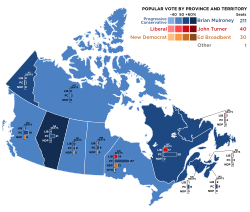
- 1984 – The Progressive Conservatives, led by Brian Mulroney, won 211 seats (an increase of 111) and gained a majority of 69, while the Liberals, led by John Turner, won just 40 (a decrease of 95). Mulroney is the only prime minister to have won a majority of seats in every single province.
- 1993 – The Liberals, led by Jean Chrétien, won 177 seats (an increase of 96) and gained a majority of 29, while the Bloc Québecois, led by Lucien Bouchard, which ran only in Quebec, won 54 (an increase of 44). The ruling Progressive Conservatives, led by Kim Campbell, won just 2 (a decrease of 154).
Chile
edit- 2013 Chilean presidential election – Michelle Bachelet of the Socialist Party won a second term with over 62% of the vote in the second round.
- 2025 Chilean general election - José Antonio Kast of the Republican Party of Chile won the election with 58% of the vote in the second round.
France
edit- 2002 French presidential election – Jacques Chirac of Rally for the Republic won re-election in the second round with over 80% of the vote.
Germany
edit- 1957 West German federal election – The CDU/CSU won an absolute majority.[15]
Hungary
edit- 2026 Hungarian parliamentary election – The TISZA Party won in a historic landslide, securing at least 141 of 199 seats.[16]
India
editNational election
edit- In the 1951–52, 1957, and 1962 Indian general elections, Jawaharlal Nehru's Indian National Congress secured landslide majorities in the Lok Sabha.
- In the 1971 and 1980 Indian general elections, Indira Gandhi's Indian National Congress secured landslide majorities in the Lok Sabha.
- 1984 Indian general election – The Indian National Congress led by Rajiv Gandhi was re-elected after winning over 400 seats in the lower house of India's Parliament.[17]
- In the 2014 and 2019 Indian general elections, Narendra Modi's Bharatiya Janata Party secured landslide majorities in the Lok Sabha.[18]
State election
edit- In the 1989 Sikkim Legislative Assembly election the governing Sikkim Sangram Parishad won all of the of 32 seats in the legislative assembly and secured 70.41% of the votes polled.
- In the 2004 Sikkim Legislative Assembly election the governing Sikkim Democratic Front won 31 of the 32 seats in the legislative assembly and secured 71.09% of the votes polled.
- In the 2009 Sikkim Legislative Assembly election the governing Sikkim Democratic Front won all of the of 32 seats in the legislative assembly and secured 65.91% of the votes polled.
- In the 2010 Bihar Legislative Assembly election the governing National Democratic Alliance alliance won 206 of the 243 seats in the state in a landslide. The Janata Dal (United) won 115 seats on its own. No other political party could win enough seats to be recognised as official opposition in the state.
- In the 2015 Delhi Legislative Assembly election the Aam Aadmi Party won 67 of the 70 seats in the legislative assembly and secured 54.3% of the votes polled.
- In the 2017 Uttar Pradesh Legislative Assembly election the Bharatiya Janata Party led National Democratic Alliance won 325 of the 403 seats in the legislative assembly and secured 39.67% of the votes polled. It remains one of the biggest mandates in the most populous state of India.
- In the 2022 Punjab Legislative Assembly election the Aam Aadmi Party won 92 of the 117 seats in the legislative assembly and secured 42.01% of the votes polled.
- In the 2022 Gujarat Legislative Assembly election the governing Bharatiya Janata Party won a landslide victory of 156 seats of the 182 seats in the state (85.7%), the most ever won by any party in Gujarat's history and securing 52.50% of the total votes polled. No other political party could win enough seats to be recognised as official opposition in the state.
- In the 2024 Sikkim Legislative Assembly election the governing Sikkim Krantikari Morcha won 31 of 32 seats in the legislative assembly and secured 58.38% of the votes polled. No other political party could win enough seats to be recognised as official opposition in the state.
- In the 2024 Maharashtra Legislative Assembly election the governing Bharatiya Janata Party led Maha Yuti alliance won 235 of the 288 seats in the state in a landslide. It was the biggest victory recorded in the state. The Bharatiya Janata Party on its own won 132 of the 149 seats it contesting recording a 88.59 % win percentage. No other political party could win enough seats to be recognised as official opposition in the state.
- In the 2025 Bihar Legislative Assembly election the governing Bharatiya Janata Party led National Democratic Alliance alliance won 202 of the 243 seats in the state in a landslide. The Bharatiya Janata Party on its own won 89 of the 101 seats it contesting recording a 88.11 % win percentage.
Local election
edit- In 2025 Haryana local elections, in Faridabad Municipal Corporation, Bharatiya Janata Party candidate Praveen Joshi polled 4,16,927 votes, securing roughly 80.6% of the valid votes in a contest against the Congress candidate (who received 1,00,075 votes). This margin of 3.16 lakh votes is cited as the highest-ever for a mayoral election in India.
Indonesia
edit- 2009 Indonesian presidential election – Susilo Bambang Yudhoyono of the Democratic Party won in the first round with over 60% of the vote.
- 2024 Indonesian presidential election – Prabowo Subianto of the Gerindra Party won in the first round, receiving over 96 million votes and 58.59% of the vote.[19][20]
Jamaica
edit- 2020 Jamaican general election – The Jamaica Labour Party led by Andrew Holness was re-elected after winning a supermajority in Parliament.[21]
Japan
edit- 1986 Japanese general election – The Liberal Democratic Party led by Yasuhiro Nakasone was re-elected after winning 300 seats in Parliament and an outright majority.[22]
- 2009 Japanese general election – The Democratic Party of Japan led by Yukio Hatoyama was elected after winning over 300 seats in Parliament.[23]
- 2026 Japanese general election – The Liberal Democratic Party led by Sanae Takaichi was re-elected after winning a supermajority (316 seats) in Parliament. The landslide was so decisive that the LDP, which actually won 330 seats, had to forfeit 14 of those simply due to not having enough list candidates.[24]
Mexico
edit- 2024 Mexican presidential election – Claudia Sheinbaum of Morena won with over 60% of the vote, becoming the country's first female president.
New Zealand
editUntil 1996, New Zealand used the traditional first-past-the-post system as in the U.K. to determine representation in its Parliament. Thus, landslide elections at that time were defined in an identical fashion, i.e. where one party won an overwhelming majority of the seats. Since 1996, New Zealand has used the mixed member proportional system as in Germany, making landslides much less likely.[25]
First past the post
- 1893 election – The Liberals won 51 seats and 57.8% of the vote while the Conservatives won 13 seats and just 24.5% of the vote.[26]
- 1899 election – The Liberals won 49 seats and 52.7% of the vote while the Conservatives won 19 seats and just 36.6% of the vote.[26]
- 1905 election – The Liberals won 58 seats and 53.1% of the vote while the Conservatives won 16 seats and just 29.7% of the vote.[26]
- 1925 election – The Reform Party won 55 seats while the Labour & Liberal parties won just 23 seats combined.[26]
- 1935 election – The Labour Party won 53 seats while the Coalition won just 19 seats.[26]
- 1938 election – The Labour Party won 53 seats while the National Party won just 25 seats.[26]
- 1990 election – The National Party won 67 seats while the Labour Party won just 29 seats.[26]
Philippines
editPresidential elections
edit- 1935 Philippine presidential election – Manuel L. Quezon of the Nacionalista Party won decisively with nearly 68% of the vote while Emilio Aguinaldo won just around 18.5%.[27]
- 1941 Philippine presidential election – Manuel L. Quezon of the Nacionalista Party easily won reelection with around 80% of the vote while Juan Sumulong of the Popular Front won just around 18% of the vote.[28]
- 1953 Philippine presidential election – Ramon Magsaysay of the Nacionalista Party defeated the incumbent president Elpidio Quirino of the Liberal Party with nearly 69% of the vote.[28][29]
- 1969 Philippine presidential election – Sitting president Ferdinand Marcos of the Nacionalista Party overwhelmingly won reelection with roughly 61.5% of the vote, becoming the first president of the Third Republic of the Philippines to be reelected.[28]
- 1981 Philippine presidential election and referendum – Incumbent president Ferdinand Marcos won reelection with around 88% of the votes, the highest margin of victory in Philippine election history.[28]
- 2022 Philippine presidential election – Bongbong Marcos of the Partido Federal ng Pilipinas won with nearly 58% of the vote.[30]
Senate elections
edit- 1949 Philippine Senate election – The Liberal Party won all the 8 seats contested in the election, wiping out the Nacionalistas and pushing their total number of seats in the Senate up to 17.[28]
- 1951 Philippine Senate election – The Nacionalista Party won all 9 contested seats, with Senate President Mariano Jesús Cuenco losing his Senate seat. While the Liberals still held a majority after this election, the Nacionalistas were able to push their total number of seats up to 11.[28]
- 1955 Philippine Senate election – The Nacionalista Party won all 8 contested seats in the election, while the Liberal Party lost all 4 of their remaining seats in the Senate. This was the first time in the history of the Third Republic that a single party had control of all seats in the Senate.[28]
- 1957 Philippine Senate election – The Nacionalista Party won 6 of the 8 seats contested in the election, bringing down their total number of seats to 22, the Liberal Party meanwhile only managed to win 2 seats in the Senate.[28]
- 1967 Philippine Senate election – The Nacionalista Party won 6 of the 8 seats contested in this election, bringing their total number of seats from 11 to 15. The Liberal Party only managed to win 1 seat contested in this election.[28]
- 1969 Philippine Senate election – The Nacionalista Party won 6 of the 8 seats contested in this election, bringing their total number of seats from 15 to 17. The Liberal Party only managed to take 2 seats.[28]
With the establishment of the Fifth Republic and the change to a multi-party system, Senate elections are now usually contested by electoral alliances consisting of multiple parties.[28]
- 1987 Philippine Senate election – The Lakas ng Bayan party won 22 out of the 24 seats contested in the elections, while the opposition Grand Alliance for Democracy won just 2 seats.[28]
- 1992 Philippine Senate election – The Laban ng Demokratikong Pilipino party won 16 of the 24 seats contested in the election.[28]
- 1995 Philippine Senate election – The Laban ng Demokrationg Pilipino party won 9 of the 12 seats contested in the election, with the rival Nationalist People's Coalition winning just 3 seats.[28]
- 2001 Philippine Senate election – The government-backed People Power Coalition won 8 of the 13 seats contested in the election.[28]
- 2007 Philippine Senate election – The Genuine Opposition alliance won 7 of the 12 seats contested, with the administration-backed TEAM Unity winning just 3 seats. However following an electoral protest by GO candidate Koko Pimentel which led to Senator Juan Miguel Zubiri resigning his seat and the Senate Electoral Tribunal proclaiming that Koko Pimental had indeed won the election, claiming the position as the 12th winning senator and thus bringing GO's seats up to 8 and reducing TEAM Unity's seats to just 2.[28][31]
- 2013 Philippine Senate election – The government-backed Team PNoy coalition won 9 of the 12 seats contested in this election, while the opposition United Nationalist Alliance won just 3.[28]
- 2019 Philippine Senate election – The government-backed Hugpong ng Pagbabago coalition won 9 of the 12 seats contested in this election. Meanwhile the opposition Otso Diretso were not able to win any seats in the Senate, the first time under the 1987 Constitution that the opposing alliance failed to win a single seat.[32]
House of Representatives elections
editBefore 1972, the House of Representatives was under a two-party system dominated by either Nacionalistas or the Liberals. By the time the 1987 election took place however, new parties have garnered enough support to win multiple seats in Congress, effectively switching into a multi-party system and thus made landslides from a single party very unlikely.
- 1925 Philippine House of Representatives elections – The reconciled Nacionalista Consolidado won with 64 seats while the opposition Democrata Party won just 22 seats.[33]
- 1938 Philippine legislative election – The Nacionalista Party won all 88 seats in the National Assembly of the Philippines.[28]
- 1941 Philippine House of Representatives elections – The Nacionalista Party won 95 out of 98 seats in the House of Representatives of the Philippines.[28]
- 1957 Philippine House of Representatives elections – The Nacionalista Party won 82 out of 102 seats with around 61% of the vote.[28]
- 1961 Philippine House of Representatives elections – The Nacionalista Pary won 74 (a decrease of 7) of the 104 seats in the House, with around 61% of the vote.[28]
- 1969 Philippine House of Representatives elections – The Nacionalista Party won 88 of the 110 seats in the House, with around 59% of the vote.[28]
- 1978 Philippine parliamentary election – In the inaugural elections of the Batasang Pambansa under the parliamentary system, Ferdinand Marcos led the Kilusang Bagong Lipunan to victory with 150 seats, thus making him the first prime minister of the country since 1899. The opposition Lakas ng Bayan alliance of Ninoy Aquino failed to win a single seat.[28]
- 2007 Philippine House of Representatives elections – The administration-backed TEAM Unity won 142 of the 218 district seats contested in the House.[28]
Portugal
edit- 2026 Portuguese presidential election – António José Seguro of the Socialist Party won with nearly 67% of the vote in the second round.[34]
Samoa
edit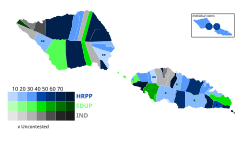
- 2006 Samoan general election – The Human Rights Protection Party, led by Tuilaʻepa Saʻilele Malielegaoi, won a landslide victory, winning 33 seats, an increase of ten. The main opposition party, the new Samoa Democratic United Party, won 10 seats.[35]
- 2016 Samoan general election – The Human Rights Protection Party, led by Tuilaʻepa Saʻilele Malielegaoi, won by a landslide victory, winning 35 of the 49 seats in the Legislative Assembly, gaining six seats. The main opposition party, the Tautua Samoa Party (led by Palusalue Faʻapo II) only won two seats, losing 11 seats. Independents won 13 seats.[36]
South Africa
edit- From 1994 to 2019, the African National Congress won supermajorities in the National Assembly of South Africa under universal suffrage.[37]
Taiwan
edit- 2008 Taiwanese presidential election – Ma Ying-jeou of the Kuomintang won with over 58% of the vote.[38]
- 2016 and 2020 Taiwanese presidential elections – Tsai Ing-wen of the Democratic Progressive Party won with over 56% of the vote both times, while her party also secured consecutive majorities in the Legislative Yuan.[39]
Ukraine
edit- 2019 Ukrainian presidential election – Volodymyr Zelenskyy won all regions but one and 73.22% of the popular vote in the second round of the election, unseating incumbent Petro Poroshenko, who received 24.45% of the popular vote. This landslide victory[40][41][42][43] was the largest margin in the history of Ukrainian presidential elections.[44]
United Kingdom
editIn UK general elections, a landslide victory involves winning a large majority in parliament and often goes with a large swing from one party to another as well. Landslide victories have usually occurred after a long period of government from one particular party and a change in the popular mood.[45]
Large majorities, however, are not always the advantage they appear to be. Anthony Seldon gives a number of examples of the infighting that can arise from large majorities. He claims that a "sweet spot" parliamentary majority of 35–50 seats is enough to protect from by-elections and still comfortably pass legislation.[46]
Notable landslide election results
- 1906 – Henry Campbell-Bannerman led his Liberal Party to victory over Arthur Balfour's Conservative Party who lost more than half their seats, including his own seat in Manchester East, as a result of the large national swing to the Liberal Party (The 5.4% swing from the Conservatives to Liberals was at the time the highest ever achieved). The Liberal Party won 397 seats (an increase of 214) and a majority of 124 seats, while the Conservative Party were left with 156 seats (a decrease of 246).[47][48]

- 1945 – Clement Attlee led the Labour Party to victory over Winston Churchill's Conservative Party, a 12.0% swing from the Conservatives to Labour. Labour won 393 seats (an increase of 239) while the Conservative Party were left with 197 (a decrease of 190).[49]
- 1983 – Margaret Thatcher led the Conservative Party to win a landslide victory (her second term in office) with 397 seats (an increase of 58, the party's highest seat count since 1931) and a majority of 144 seats, [1] while the Labour Party led by Michael Foot won 209 seats (a decrease of 60). Additionally in the popular vote the party finished just two points ahead of the SDP–Liberal Alliance. However, they receive far more seats due to the first past the post system. [2]
- 1997 – Tony Blair led the Labour Party to win a first landslide victory with 418 seats (an increase of 146) and gained an overall majority of 179 while the Conservative Party led by John Major won 165 seats (a decrease of 178). The swing from the Conservatives to Labour was 10.2% and was the second biggest general election victory of the 20th Century after 1931.[50]
- 2001 – Tony Blair led the Labour Party to win a second landslide victory with 412 seats (a decrease of 6) and retained an overall majority of 167 while the Conservative Party led by William Hague won 166 seats (an increase of 1), making Tony Blair the first Labour Prime Minister to serve two consecutive full terms in office.[51]

- 2019 – Boris Johnson led the Conservative Party to win a landslide victory (his second term in office) with 365 seats (an increase of 48, the party's highest seat count since 1987) and a majority of 80 seats, while the Labour Party led by Jeremy Corbyn won 202 seats (a decrease of 60, the party's worst result since 1935). The election led to 54 Labour seats changing to Conservative predominantly in the Midlands and Northern England – some of which had been held by Labour since the first half of the 20th century.[52]
- 2024 – Keir Starmer led the Labour Party to win a landslide victory with 411 seats (an increase of 211, the party's highest seat count since 2001) and a majority of 172 seats, while the Conservative Party led by Rishi Sunak won 121 seats (a decrease of 251, the party's worst ever result, exceeding the previous worst defeat of 1906.[53])
United States
editThis section needs additional citations for verification. (November 2025) |
A landslide victory in presidential elections occurs when a candidate has an overwhelming majority in the Electoral College. In federal and state congressional elections, a landslide victory occurs when a party wins 60% or more of the seats in a legislative chamber.[54]
Presidential elections
edit- 1928 – Herbert Hoover (R) received 444 (83.6%) of the electoral votes while Al Smith (D) received only 87 (16.4%).
- 1932 – Franklin D. Roosevelt (D) received 472 (88.9%) of the electoral votes while Herbert Hoover (R) received only 59 (11.1%).

- 1936 – Franklin D. Roosevelt (D) received 523 (98.5%) of the electoral votes—the largest share since 1820 and the largest in a non-unanimous election—while Alf Landon (R) received only 8 (1.5%). Additionally, Roosevelt received 60.8% of the popular vote.
- 1940 – Franklin D. Roosevelt (D) received 449 (84.6%) of the electoral votes while Wendell Willkie (R) received only 82 (15.4%).
- 1944 – Franklin D. Roosevelt (D) received 432 (81.4%) of the electoral votes while Thomas E. Dewey (R) received only 99 (18.6%).
- 1952 – Dwight D. Eisenhower (R) received 442 (83.2%) of the electoral votes while Adlai Stevenson II (D) received only 89 (16.8%).
- 1956 – Dwight D. Eisenhower (R) received 457 (86.1%) of the electoral votes while Adlai Stevenson II (D) received only 73 (13.7%).
- 1964 – Lyndon B. Johnson (D) received 486 (90.3%) of the electoral votes while Barry Goldwater (R) received only 52 (9.7%). Additionally, Johnson received 61.1% of the popular vote.

- 1972 – Richard Nixon (R) received 520 (96.7%) of the electoral votes while George McGovern (D) received only 17 (3.2%). One Republican elector voted for John Hospers of the Libertarian Party. Additionally, Nixon received 60.7% of the popular vote.
- 1980 – Ronald Reagan (R) received 489 (90.9%) of the electoral votes while Jimmy Carter (D) received only 49 (9.1%).

- 1984 – Ronald Reagan (R) received 525 (97.6%) of the electoral votes while Walter Mondale (D) received only 13 (2.4%). Additionally, Reagan received 58.8% of the popular vote.
- 1988 – George H. W. Bush (R) received 426 (79.2%) of the electoral votes while Michael Dukakis (D) received only 111 (20.8%).
- 1996 – Bill Clinton (D) received 379 (70.4%) of the electoral votes while Bob Dole (R) received 159 (29.6%) and Ross Perot of the Reform Party received none.[55][56][57][58][59]
Congressional elections
edit- House of Representatives
- 1932 – Coinciding with Franklin D. Roosevelt's win in the presidential election, the Democratic Party won 313 seats with 54.5% of the popular vote, which caused the Republican Party to lose its two-seat majority. This election marked a beginning of political dominance for the Democratic Party that would last until the 1994 election.
- 1934 – The Democratic Party gained nine seats from the previous election.
- 1936 – Coinciding with Franklin D. Roosevelt's election to a second term as president, the Democratic Party gained an additional twelve seats from the previous election with 55.9% of the popular vote, bringing the total amount of seats held by the party to 334. This would be the most recent election where one party won more than 300 seats in the House of Representatives, and was the last of four straight elections where Republicans lost seats due to the effects of the Great Depression.[60]
- Senate
- 1920 – Coinciding with Warren G. Harding's win in the presidential election, the Republican Party gained ten seats from the Democratic Party, giving them a 59–37 majority.
- 1932 –– Coinciding with Franklin D. Roosevelt's win in the presidential election, the Democratic Party gained twelve seats from the Republican Party, giving them a 60–36 majority.
See also
editReferences
edit- ^ a b c Murse, Tom (8 October 2020). "Landslide Victory: Definition in Elections". ThoughtCo. Archived from the original on 27 June 2017. Retrieved 18 October 2020.
- ^ Multiple sources:
- "Landslide". Merriam-Webster.com Dictionary. Merriam-Webster. OCLC 1032680871. Retrieved 7 November 2024.
- "Landslide". Cambridge Dictionaries (Online). Cambridge University Press. n.d. Retrieved 7 November 2024.
- "Landslide". Collins English Dictionary. HarperCollins. OCLC 1120411289. Retrieved 7 November 2024.
- ^ James H Fowler; Oleg Smirnov (2009), Mandates, Parties, and Voters: How Elections Shape the Future, p. 15
- ^ Johnston, Ron; Jones, Kelvyn; Manley, David (July 2019). "MultiLevel Modeling of Space–Time Variations: Exploring Landslide Voting Patterns at United States Presidential Elections, 1992–2016". Geographical Analysis. 51 (3): 280–313. doi:10.1111/gean.12176.
- ^ Newton-Farrelly, Jenni (November 2009). "FROM GERRY-BUILT TO PURPOSE-BUILT: DRAWING ELECTORAL BOUNDARIES FOR UNBIASED ELECTION OUTCOMES". Representation. 45 (4): 471–484. doi:10.1080/00344890903257565.
- ^ Jason D. Mycoff; Joseph August Pika (2008), Confrontation and Compromise: Presidential and Congressional Leadership, 2001–2006, Rowman & Littlefield Publishers, p. 11
- ^ "Fernández wins Argentina primary, looks poised for re-election". CNN. Archived from the original on 16 September 2011. Retrieved 21 June 2012.
- ^ "Newman wins Brisbane election landslide". ABC News. 15 March 2008. Archived from the original on 31 May 2023. Retrieved 31 May 2023.
- ^ "The Mayor that was re-elected in a landslide, collecting 85 per cent of the votes". 20 October 2021. Archived from the original on 31 May 2023. Retrieved 31 May 2023.
- ^ "Biggest State Election Landslides". Armarium Interreta. 12 March 2021. Archived from the original on 12 March 2021. Retrieved 7 April 2021.
- ^ "Mark McGowan claims WA election victory as Liberals all but wiped out". The New Daily. 14 March 2021.
- ^ Crowley, political reporter Tom (5 May 2025). "Most polls underestimated Labor. How did they get it wrong?". ABC News. Retrieved 12 March 2026.
- ^ Cecco, Leyland (25 April 2025). "Canadian ex-PM seeks to help Liberals match his 1993 landslide victory". The Guardian. ISSN 0261-3077. Retrieved 12 April 2026.
- ^ "Party Standings in the House of Commons (1867-date)". PARLINFO. Library of Parliament. 24 March 2016. Archived from the original on 19 April 2016. Retrieved 5 April 2016.
- ^ Barnes, Samuel H.; Grace, Frank; Pollock, James K.; Sperlich, Peter W. (2013). "The German Party System and the 1961 Federal Election". American Political Science Review. 56 (4): 899–914. doi:10.2307/1952792. ISSN 1537-5943 – via University of Cambridge.
- ^ Kassam, Ashifa; Garamvolgyi, Flora (12 April 2026). "Magyar's parliamentary majority in Hungary increases after final count". Retrieved 18 April 2026.
- ^ "Political Tsunami turns Jamaica green with massive JLP victory". Archived from the original on 4 April 2023. Retrieved 20 November 2020.
- ^ "Archived copy". TheGuardian.com. Archived from the original on 4 August 2020. Retrieved 9 February 2026.
{{cite web}}: CS1 maint: archived copy as title (link) - ^ "Early results showing Prabowo on course for landslide win in Indonesia's presidential election, securing around 60% of votes cast". CNA. 14 February 2024. Archived from the original on 14 February 2024. Retrieved 14 February 2024.
- ^ "Indonesia election commission confirms Prabowo Subianto wins presidency". Al Jazeera. 20 March 2024. Retrieved 20 March 2024.
- ^ "Political Tsunami turns Jamaica green with massive JLP victory". Archived from the original on 4 April 2023. Retrieved 20 November 2020.
- ^ "衆院党派別得票数・率(比例代表)". (in Japanese) Jiji. 31 August 2009. Archived from the original on 20 February 2014.
- ^ "'Major win' for Japan opposition". BBC News. 30 August 2009. Archived from the original on 11 June 2019. Retrieved 31 August 2009.
- ^ McCurry, Justin (8 February 2026). "Sanae Takaichi's conservatives cement power in landslide Japan election win". The Guardian. ISSN 0261-3077. Retrieved 12 April 2026.
- ^ Electoral Commission (17 July 2014). Mixed Member Proportional Representation in New Zealand (Video). Wellington. Archived from the original on 19 September 2014. Retrieved 5 April 2016.
- ^ a b c d e f g "1890–1993 general elections". Electoral Commission New Zealand. Archived from the original on 8 April 2023. Retrieved 9 July 2023.
- ^ "Coalition ticket wins by landslide, September 21, 1935". The Philippines Free Press Online. 21 September 1935. Retrieved 18 April 2026.
- ^ a b c d e f g h i j k l m n o p q r s t u v w x Presidential Communications Development and Strategic Planning Office (2015). Philippine Electoral Almanac Revised And Expanded.
- ^ Elsbree, Willard H. (1954). "The 1953 Philippine Presidential Elections". Pacific Affairs. 27 (1): 3–15. doi:10.2307/3035268. ISSN 0030-851X.
- ^ Verizon, Cliff (25 May 2022). "Marcos officially declared Philippines' next president". Nikkei Asia. Retrieved 26 May 2022.
- ^ "Local News". Sun.Star. Archived from the original on 3 March 2016. Retrieved 18 April 2026.
- ^ Chiu, Jeannette Andrade, Patricia Denise (15 May 2019). "What went wrong with Otso Diretso?". INQUIRER.net. Retrieved 18 April 2026.
{{cite web}}: CS1 maint: multiple names: authors list (link) - ^ Presidential Communications Development and Strategic Planning Office (2015). Philippine Electoral Almanac Revised And Expanded.
- ^ "Quanto recordes bateu Seguro e quantos ficaram por bater?". Renascença. 8 February 2026. Retrieved 9 February 2026.
- ^ "Elections in 2006". Inter-Parliamentary Union. Archived from the original on 17 March 2022. Retrieved 26 September 2023.
- ^ "Legislative Assembly (Fono)". Inter-Parliamentary Union. Archived from the original on 1 September 2022. Retrieved 26 September 2023.
- ^ "Archived copy". Archived from the original on 16 December 2025. Retrieved 9 February 2026.
{{cite web}}: CS1 maint: archived copy as title (link) - ^ "Tsai Ing-wen wins landslide in Taiwan presidential election". aljazeera.com. Archived from the original on 12 January 2020. Retrieved 12 January 2020.
- ^ "Tsai Ing-wen wins landslide in Taiwan presidential election". aljazeera.com. Archived from the original on 12 January 2020. Retrieved 12 January 2020.
- ^ Higgins, Andrew; Mendel, Iuliia (21 April 2019). "Ukraine Election: Volodymyr Zelensky, TV Comedian, Trounces President". The New York Times. Retrieved 21 February 2026.
- ^ Ellyatt, Holly (23 April 2019). "Ukraine faces up to reality after political novice wins landslide". CNBC. Retrieved 21 February 2026.
- ^ Walker, Shaun (22 April 2019). "Comedian wins landslide victory in Ukrainian presidential election". The Guardian. Retrieved 21 February 2026.
- ^ "Ukraine election: Comedian Zelensky wins presidency by landslide". www.bbc.com. 22 April 2019. Retrieved 21 February 2026.
- ^ "Як змінювався рівень довіри та підтримки Зеленського та його попередників (оновлено)" [How the level of trust and support for Zelensky and his predecessors has changed (updated)]. Слово і Діло (in Ukrainian). 21 February 2026.
- ^ Multiple sources:
- Bush, Stephen (8 June 2021). "Despite all reports, the election wasn't a landslide – and Johnson may be about to discover that reality". New Statesman. Archived from the original on 15 December 2022. Retrieved 19 December 2022.
- "Election results 2019: Boris Johnson returns to power with big majority". BBC News. 12 December 2019. Archived from the original on 12 December 2019. Retrieved 19 December 2022.
- Holder, Josh; Voce, Antonio; Barr, Caelainn; Holder, Josh; Voce, Antonio; Barr, Caelainn. "How did Boris Johnson achieve his landslide victory? A visual guide". The Guardian. ISSN 0261-3077. Archived from the original on 11 July 2022. Retrieved 19 December 2022.
- "Inside the landslide: Thatcher's personal papers for 1983 opened to the public". University of Cambridge. 10 October 2013. Archived from the original on 15 December 2022. Retrieved 19 December 2022.
- ^ Seldon, Anthony (8 June 2017). "Politicians dream of landslide victories – but they are a curse, not a blessing". The Guardian.
- ^ "1906: The Liberal landslide". bbc.co.uk. 9 February 2006. Archived from the original on 10 April 2025. Retrieved 31 December 2015.
- ^ Liberal Landslide: The General Election of 1906.
- ^ Labour Landslide, July 5–19, 1945.
- ^ Labour's Landslide: The British General Election 1997.
- ^ "The rise and fall of New Labour". BBC News. 3 August 2010. Archived from the original on 30 December 2021. Retrieved 30 December 2021.
- ^ "Boris Johnson must fulfil his One Nation pledge". Financial Times. 13 December 2019. Archived from the original on 14 December 2019. Retrieved 14 December 2019.
- ^ "UK election results 2024". BBC. 6 July 2024. Archived from the original on 4 July 2024. Retrieved 6 July 2024.
- ^ "Presidential Election Margin of Victory | The American Presidency Project". www.presidency.ucsb.edu. Retrieved 12 April 2026.
- ^ Friel, Brian (7 November 1996). "Divided Government". Government Executive. Retrieved 11 December 2025.
President Clinton was re-elected Tuesday by amassing a landslide victory in the Electoral College
- ^ Hanlon, Seth D. (4 December 1996). "Democrat Roll". The Harvard Crimson. Archived from the original on 18 December 2025. Retrieved 11 December 2025.
On November 5, 1996, the American people, in a coast-to-coast electoral landslide, re-elected a Democratic president… Voters re-elected him in a tremendous electoral landslide
- ^ "Clinton Rides Landslide: First Democrat To Be Re-Elected Since Roosevelt". The Spokesman-Review. Knight-Ridder. 6 November 1996. Archived from the original on 4 August 2021. Retrieved 11 December 2025.
- ^ King, John (6 November 1996). "Clinton easily keeps White House" (PDF). The Observer. Notre Dame, Indiana. Associated Press. Archived (PDF) from the original on 28 March 2025. Retrieved 11 December 2025.
President Clinton won a land-slide re-election and political redemption Tuesday night
- ^ Smith, Craig Allen (August 1997). "Bill Clinton and the 1996 presidential campaign". American Behavioral Scientist. 40 (8): 1250–1264. doi:10.1177/0002764297040008021.
…the apparent contradiction between Clinton's modest aggregate public approval ratings and his landslide re-election
- ^ "CNN Explains: How today's GOP has its roots in anti-slavery crusade – CNN.com". cnn.com. 26 August 2012. Retrieved 5 October 2014.